

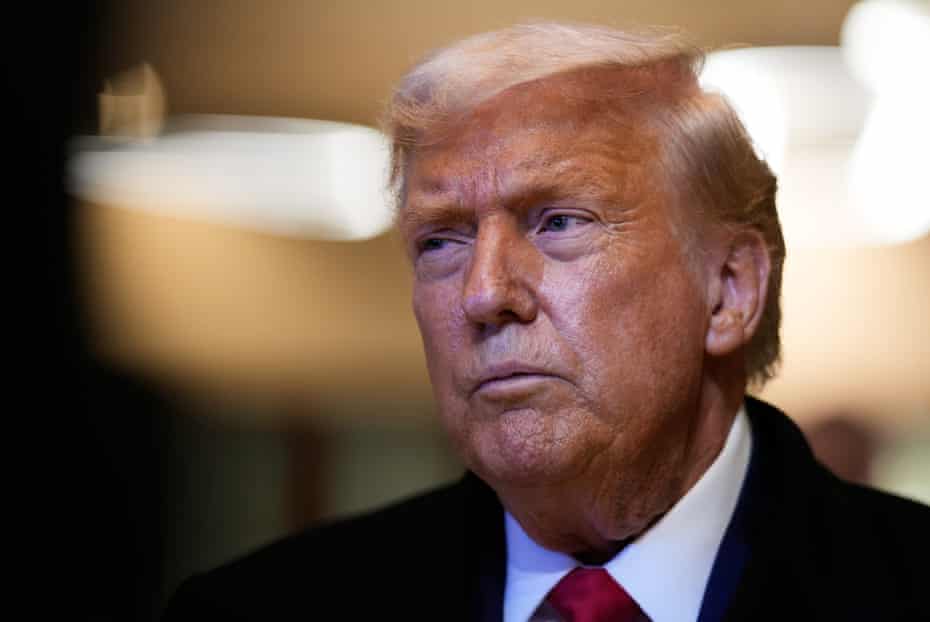
Donald Trump’s announcement of a proposed “framework for a future deal” on Greenland has been met with widespread scepticism in Greenland and unease among Danish politicians, even as financial markets steadied and European leaders welcomed his decision to withdraw threatened tariffs.

Speaking at the World Economic Forum in Davos, the US president reiterated his desire for Greenland, referring to “right, title and ownership,” but stepped back from earlier suggestions of military action. Hours later, he posted on social media claiming progress toward a future agreement on Greenland and confirmed that planned tariffs on eight European countries would be dropped. He later described the development as merely “a concept of a deal” in comments to CNBC.

Denmark’s foreign minister, Lars Løkke Rasmussen, said the shift eased tensions. “The day ended better than it started,” he remarked, adding that discussions should now focus on addressing US security concerns in the Arctic while respecting Denmark’s sovereignty. Italy’s prime minister, Giorgia Meloni, also welcomed the move, though Nato secretary general Mark Rutte, who was involved in talks with Trump, cautioned that “a lot of work remains.”

Rutte offered few details about the discussions and said Greenland’s status had not been addressed. A Nato spokesperson later clarified that no compromise on Greenland’s sovereignty had been proposed during the talks. Trump, for his part, gave limited information but said negotiations were continuing on a US missile defence system that could be partly based in Greenland.

The lack of transparency angered some Danish lawmakers. Sascha Faxe criticised the talks for excluding Greenland, saying no agreement could be valid without its direct involvement. “This wasn’t real negotiation,” she said, describing it as an informal exchange rather than a binding process.
Media reports suggest the tentative proposal could allow the US sovereignty over limited areas hosting military bases, likening it to British-controlled bases in Cyprus. The United States already enjoys extensive military access to Greenland under longstanding agreements and could expand its presence. The reported framework may also permit US mining of rare earth minerals without Danish approval.

Greenlandic representatives pushed back strongly. Aaja Chemnitz Larsen, a Greenlandic MP in Denmark’s parliament, said it was “out of the question” for Nato or the US to have a say over Greenland’s sovereignty or mineral resources.
Trump’s apparent retreat followed days of heightened transatlantic tensions, including warnings from European leaders and market volatility after his earlier, more aggressive comments. Sweden’s foreign minister, Maria Stenergard, said allied diplomacy had made an impact, while Dutch prime minister Dick Schoof described the tariff reversal as “de-escalation.”

Trump had threatened tariffs of 10% on Denmark and several European allies from February 1 over their opposition to a US takeover of Greenland. Markets rebounded after he dropped the threat, with analysts noting that investors responded positively to signs he would not pursue force.
In Greenland itself, the reaction was overwhelmingly doubtful. Residents interviewed by AFP dismissed Trump’s claims, insisting the territory belongs to its people. As talks continue, uncertainty remains over whether Denmark has endorsed any framework and what, if anything, the proposal ultimately entails.




