

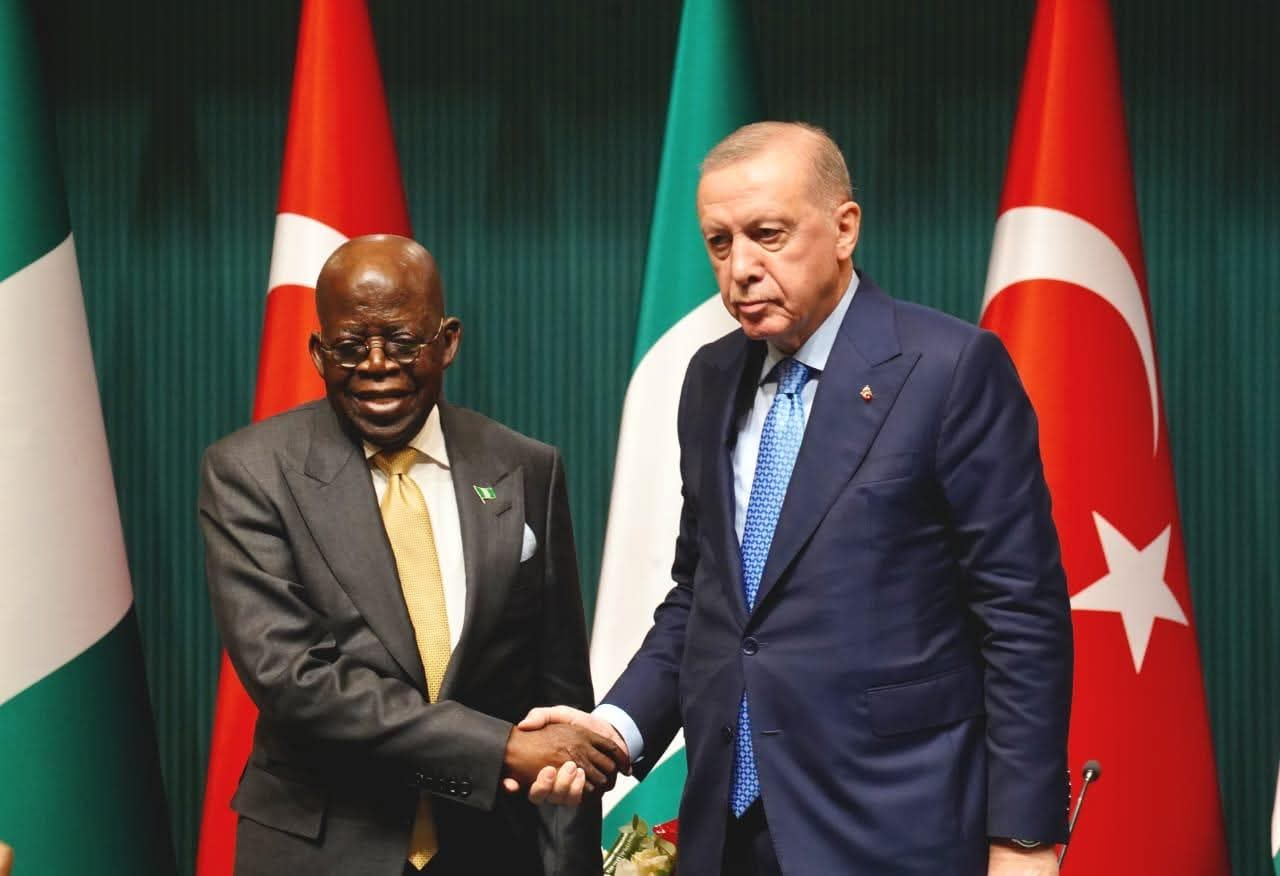
Turkey has announced an ambitious plan to raise bilateral trade with Nigeria to $5 billion, as President Recep Tayyip Erdoğan hosted President Bola Ahmed Tinubu on a state visit to Ankara marked by both economic and security commitments.
The declaration reflects a strengthening strategic relationship between two influential regional powers—Türkiye, an increasingly assertive industrial and defence actor, and Nigeria, Africa’s largest economy and most populous nation.
Both leaders signalled that the partnership must shift beyond diplomatic symbolism into measurable trade growth, investment expansion, and coordinated counterterrorism action.

Trade ties between the two countries have developed steadily over recent years, with Turkish firms active in Nigeria’s construction, manufacturing, and infrastructure sectors.
Erdoğan’s $5 billion target represents not only a commercial ambition but also a wider geopolitical statement: that Nigeria is being viewed as a central long-term partner in Africa’s economic future.
The Ankara talks also carried significant security implications.
Nigeria continues to confront insurgency and violent extremism, while instability across the Sahel has heightened regional vulnerability.
Türkiye’s growing role as a defence-industrial power, with expertise in modern surveillance and security technology, positions it as a potentially valuable ally as Nigeria strengthens its counterterrorism architecture.
Analysts note that security cooperation is increasingly becoming an international shared priority, rather than a challenge Nigeria must confront alone.
Discussions in Ankara highlighted the importance of intelligence sharing, defence capacity building, and strategic support against transnational threats.
For President Tinubu, the visit is part of a broader diplomatic repositioning effort.
Since taking office, his administration has sought to project Nigeria as an investment-ready destination, a reliable global partner, and a stabilising force in West Africa.
Engagements with Gulf states, Western partners, and now Türkiye reflect a pragmatic foreign policy anchored in economic opportunity and alliance-building.

Comparatively, Nigeria’s external diplomacy has often been cautious, with fewer clearly defined economic deliverables.
Tinubu’s approach signals a shift toward a more transactional and development-driven strategy, aimed at attracting capital, securing partnerships, and restoring Nigeria’s relevance in emerging global alignments.
International Analysts argue that securing stronger international friendships within only two years underscores an early diplomatic momentum that could translate into long-term economic benefits if sustained.
The Ankara engagement, they suggest, strengthens Nigeria’s positioning as a serious actor in global investment and security cooperation.

Much will depend, however, on implementation. If trade frameworks, industrial investments, and security platforms evolve beyond declarations into concrete projects, the Nigeria–Turkey partnership may become one of the more significant bilateral resets of Tinubu’s presidency.
” Nigeria’s growing partnership with Türkiye reflects President Tinubu’s commitment to rebuilding Nigeria’s global influence through economic diplomacy and strategic cooperation. The trade ambition and counterterrorism alignment show Nigeria emerging as an investment-ready ally and regional stabiliser.
Early progress within two years suggests stronger outcomes ahead if reforms and implementation remain consistent.” – The National Patriots.

Dr. G. Fraser. MFR.
Ankara, Turkey.



