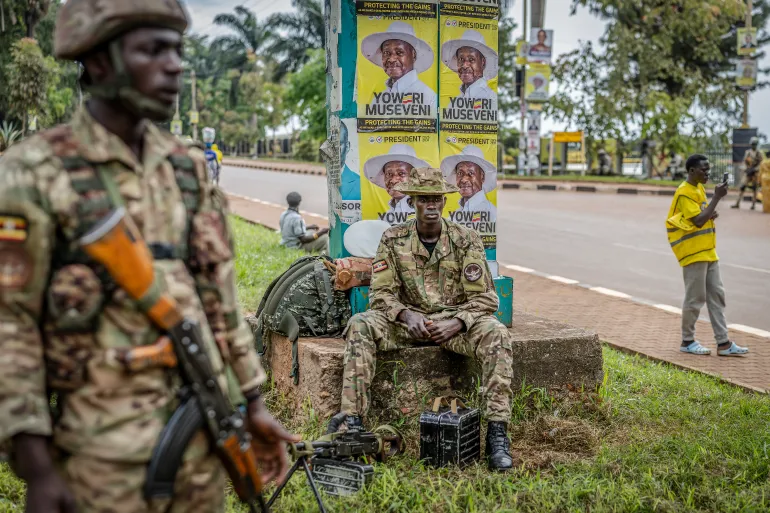
Ugandan authorities have shut down internet services across the country just days ahead of the presidential election, as President Yoweri Museveni seeks to extend his rule, which has lasted for four decades.
The directive was issued by a government regulator, ordering telecom operators to suspend public internet access from 6:00 p.m. on Tuesday. Internet monitoring organisation NetBlocks later confirmed a nationwide disruption of connectivity.

The shutdown has intensified fears of political suppression ahead of the January 15 election. Museveni, 81, who is Africa’s third-longest-serving president, is facing a major challenge from opposition candidate and popular musician-turned-politician, Bobi Wine.
Security agencies have reportedly arrested hundreds of opposition supporters in the days leading up to the vote. Pro-Bobi Wine rallies have been dispersed using live ammunition and tear gas. Another opposition leader, Kizza Besigye — who has contested against Museveni in four previous elections — is currently being held on treason charges.
The United Nations Human Rights Office has condemned the Ugandan government, accusing it of fostering an atmosphere marked by intimidation and widespread repression before the polls.
Similarly, the International Crisis Group, based in Brussels, said Museveni’s strong control over state institutions has effectively secured his re-election.
Bobi Wine has described his campaign as a fight against impunity but has expressed doubts about the possibility of a free and fair election, according to reports from Kampala.

Authorities, however, maintain that the security measures are necessary to prevent disorder by opposition supporters. The Uganda Communications Commission defended the internet blackout, saying it was introduced to combat misinformation, disinformation, electoral fraud, and related threats.
Beyond the internet restrictions, the government also ordered two local civil society organisations — Chapter Four Uganda and the Human Rights Network for Journalists-Uganda — to immediately suspend their activities. Officials accused Chapter Four Uganda of actions considered harmful to national security.
A political analyst at Antwerp University, Kristof Titeca, warned that the government’s actions have made it increasingly risky for opposition groups to organise, noting that the cost of engaging in political opposition has become extremely high.

Uganda previously enforced a similar internet shutdown during the 2021 elections, which were criticised for alleged state violence and electoral irregularities. Despite earlier assurances from authorities that the internet would remain accessible this time, services were still cut.
Apart from Museveni and Bobi Wine, six other candidates are contesting the presidency in the East African nation, which has a population of about 45 million people. The electoral commission reports that 21.6 million voters are registered for the election.