

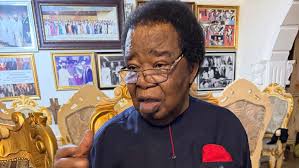
PROFESSOR AKINWANDE BOLAJI AKINYEMI TURNS 84: REFLECTS ON NIGERIA’S TRAJECTORY AND GLOBAL POLITICS
Professor Akinwande Bolaji Akinyemi, a towering figure in International Relations, celebrates his 84th birthday on Sunday, January 4, 2026. Born on January 4, 1942, in Ilesa, Osun State, Akinyemi’s life has been marked by academic excellence and public service spanning decades.
He attended Igbobi College, Yaba (1955–1959) and Christ’s School, Ado Ekiti (1960–1961), before pursuing higher education abroad at Temple University, Philadelphia (1962–1964), the Fletcher School of Law and Diplomacy, Tufts University (1964–1966), and Trinity College, Oxford (1966–1969).

Throughout his illustrious career, he has served as Regents Lecturer at UCLA (1979), Professor of Political Science at the University of Lagos (1983–1985), and Visiting Fellow at St John’s College, Cambridge (1984). He was also a lecturer at the University of Ibadan before becoming Director-General of the Nigerian Institute of International Affairs (NIIA) (1975–1983), a key institution shaping Nigeria’s foreign policy.
At NIIA, he spearheaded initiatives such as the Technical Aid Corps (TAC), which deployed Nigerian professionals overseas to volunteer in developing countries, promoting Nigeria’s influence in Africa and the Global South. He also introduced the concept of a “Concert of Medium Powers” and, during his tenure as Minister of External Affairs, controversially supported Nigeria’s development of nuclear capabilities, terming it the “black bomb” to challenge the racial monopoly on nuclear arms.

Akinyemi has remained active in public life, participating in the 2014 National Conference as deputy chairman and serving on various national commissions, including the Electoral Reform Panel under President Umaru Yar’Adua (2007). In January 2025, President Bola Tinubu appointed him as Board Chairman of the NIIA.
REFLECTING ON NIGERIA’S POLITICAL TRAJECTORY
When asked about Nigeria’s journey, Akinyemi shared insights from his personal experience:
“I was born in colonial Nigeria, yet we grew up believing the nation was destined for greatness. Schools nurtured that vision, reinforced by both expatriate and Nigerian teachers. Early post-independence Nigeria had promising trajectories—more schools, universities, and a civil service infused with integrity. Even after the civil war, there were signs of progress,” he recalled.
He highlighted a personal experience in 1970 when returning to the University of Ibadan: “Despite the post-war context, officials treated me with respect. There was no corruption, no bureaucracy blocking progress. That period reflected the potential Nigeria had.”
However, Akinyemi noted setbacks, including the assassination of General Murtala Mohammed in 1976 and the various challenges of military and civilian regimes that followed. While military interventions sometimes offered temporary solutions, Nigeria’s “upward curve” often stalled, diminishing hope for his generation.

He reflected: “It wasn’t about losing faith completely, but we often saw progress disrupted. Each attempt to rise seemed checked by forces within and outside the system, whether in governance, ideology, or human shortcomings.”
ON INTERNATIONAL INTERVENTIONS AND US ENGAGEMENT
On recent US involvement in Nigeria, particularly regarding security and counter-terrorism, Akinyemi described former President Donald Trump’s intervention as a potentially positive force:
“Trump’s action in Sokoto should be seen as a constructive engagement. It signals that Nigeria cannot ignore threats like terrorism and that equitable treatment of all groups must be ensured,” he said.
Akinyemi emphasized the importance of interpreting diplomatic engagements correctly: “Sending delegations that misrepresent the realities on the ground only confuses international actors. Trump responded to evidence, not narratives. Future interventions will likely follow the same pattern.”

NIGERIA AS A MEDIUM POWER
The scholar also spoke on Nigeria’s place in global geopolitics:
“Nigeria must embrace its role as a medium power, defining objectives, principles, and capabilities to protect its sovereignty. Security is essential—not to dominate, but to deter potential aggressors through a balance of unacceptable loss,” he explained.
He highlighted parallels with other nations: “Brazil manufactures its own defense equipment, which ensures deterrence. Nigeria must aim for self-reliance in defense and economy, strengthening its position regionally and globally. Military strength and economic independence underpin diplomatic influence.”
ON THE MULTIPOLAR WORLD ORDER
Akinyemi observed that the current global order is multipolar, with emerging powers like China challenging US dominance. He cited the Russia-Ukraine conflict as an illustration:
“Russia’s actions are guided by historical and security concerns. Western interventions, including US policies, have sometimes disrupted agreements. Understanding power, parity, and deterrence is key in navigating these crises.”
He further drew parallels to Nigeria’s internal dynamics: “Just as cultural and linguistic diversity in Nigeria must be managed carefully, geopolitical divisions in Ukraine require careful balancing. Lessons from history and diplomacy remain critical.”

CONCLUSION
At 84, Professor Akinyemi remains a voice of experience and insight, urging Nigeria to pursue strategic self-reliance, equitable governance, and prudent diplomacy in a complex and evolving global order.



