

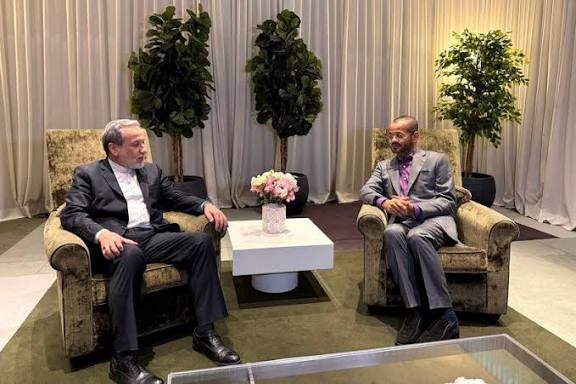
Omani Foreign Minister Badr Albusaidi said the US and Iran had shown “openness to new and creative ideas” after indirect talks mediated by Oman in Geneva.

The discussions involved Jared Kushner and Steve Witkoff on the US side, with Iran’s delegation led by Foreign Minister Abbas Araghchi. IAEA Director General Rafael Grossi also participated.

Albusaidi, the mediator, described the talks as having achieved “significant progress.” He announced that negotiations would resume “soon” after consultations in the respective capitals, with technical-level discussions scheduled to begin next week in Vienna.

Araghchi confirmed “good progress” had been made, noting agreement on some issues but differences remaining on others. He said further negotiations would take place in less than a week. There has been no official US reaction yet.
The talks occurred in two sessions: a three-hour morning meeting and a shorter evening session, held at the Omani ambassador’s residence in Geneva.

The prospect of continued dialogue could lower the immediate risk of military action by President Donald Trump, who has ordered a major US military build-up in the Middle East — the largest since the 2003 Iraq invasion — including two aircraft carriers, warships, fighter jets, and thousands of troops.
Trump has threatened strikes on Iran, initially in response to the regime’s crackdown on anti-government protests and later focusing on its nuclear programme. Iran has vowed a forceful response to any attack.

For decades, the US and Israel have accused Iran of pursuing nuclear weapons, which Iran denies, insisting its programme is for peaceful purposes. Iran is the only non-nuclear-armed state enriching uranium to near weapons-grade levels.
According to Iranian state media, negotiators rejected US demands to fully halt uranium enrichment and transfer Iran’s 400kg stockpile of enriched uranium out of the country. They maintained Iran’s right to peaceful nuclear energy.

Reported concessions include a possible temporary three-to-five-year suspension of enrichment at minimal levels under international monitoring. In exchange, Iran demanded the lifting of sanctions that have severely damaged its economy.
Iran has refused to discuss limits on its ballistic missile programme or its support for regional proxies, including Hamas, Hezbollah, militias in Iraq, and the Houthis in Yemen.
The US bombed three Iranian nuclear sites last June during a conflict with Israel. Trump claimed the facilities were “obliterated,” while Iran says enrichment activities ceased afterward but has blocked IAEA access to the sites.
Recent US media reports, citing unnamed officials, suggest Trump is considering initial strikes on Revolutionary Guards or nuclear sites to pressure Iran, potentially escalating to a broader campaign aimed at regime change if talks fail.

Trump’s State of the Union address mentioned Iran’s nuclear ambitions and missile threats vaguely, without detailing justification for strikes. He accused Iran of restarting a weapons programme post-bombing and said he would not allow it to acquire nuclear weapons.
Iran’s Foreign Minister Araghchi has publicly stated that Iran “will under no circumstances ever develop a nuclear weapon.”

Israeli Prime Minister Benjamin Netanyahu has warned against any deal that excludes limits on Iran’s missiles and proxies, describing Iran as a major regional threat.
Regional US allies express concern that strikes could spark a wider conflict, noting air power alone cannot topple the regime.
The USS Gerald R. Ford aircraft carrier departed Souda Bay, Crete, on Thursday amid the ongoing tensions.




