

Nigeria on Edge as Footage Suggests Organized Backing for Bandits
Viral Video Allegedly Showing Bandits Receiving Supplies Deepens Fears About Organized Sponsorship in Nigeria.

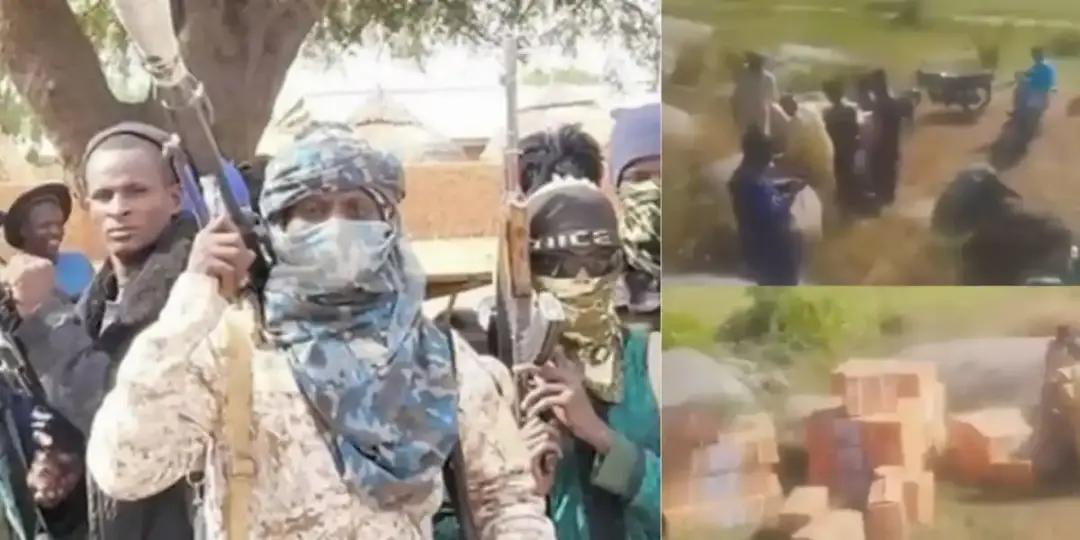
A viral video circulating across social media has triggered nationwide alarm after appearing to show suspected bandits receiving supplies from unidentified individuals in a remote forest. The footage, which spread rapidly after being shared by Instagram personality Tunde Ednut, has intensified public concern about the expanding networks that sustain criminal groups across northern Nigeria.
The video, though yet to be independently authenticated, depicts several armed men stationed in a forest clearing as supplies—believed to include food items, communication tools, and materials for coordinating kidnappings—are handed over discreetly. The images have reinforced growing fears among citizens that banditry is increasingly supported by organized logistical chains far more sophisticated than previously acknowledged.

A Pattern of Unchecked Expansion
Nigeria’s banditry crisis has escalated over the past decade, concentrating heavily in states such as Kwara, Niger, Sokoto, Kebbi, Kano, and Kogi, where rural communities contend with kidnappings, extortion, and deadly raids. According to data from various security reports, more than 10,000 Nigerians have been killed and tens of thousands displaced since 2015 due to bandit-related violence. Mass abductions—once rare—have become commonplace, with over 1,000 schoolchildren kidnapped in the last four years alone.
Security analysts have long argued that the resilience of these groups is rooted not just in arms access, but in a steady flow of resources: food, fuel, motorcycle parts, ammunition, and intelligence supplied through covert networks. The latest video appears to reinforce that argument.
How Bandits Sustain Themselves in the Forests
Groups operating in the dense forests of Zamfara, Niger, Kogi, and Kaduna typically rely on three core supply systems:
● Direct Support from Criminal Collaborators: Middlemen who deliver food, phone lines, fuel, and ransom information in exchange for a share of proceeds.
● Forced Exploitation of Local Communities: Bandits often coerce villagers, truck drivers, and traders into providing supplies under threats of violence.
● Corrupt or Complicit Networks: Investigations over the years—though rarely conclusive—have identified instances where compromised actors within local and regional systems provide cover, information, or logistical help.
Despite difficult terrain, experts note that these channels are not impossible to disrupt. Modern counterterrorism strategies around the world—including in Colombia, the Sahel, and Afghanistan—show that cutting off supply routes is often the fastest way to weaken forest-based armed groups.
Why Tracking Their Sponsors Should Not Be Difficult
Nigeria possesses multiple security structures capable of dismantling such networks—if adequately coordinated and empowered. With air surveillance, geospatial mapping, signal interception tools, and forensic financial tracking, identifying sponsors and collaborators is technically feasible.

Advanced methods include:
Thermal imaging and drone surveillance to identify frequently traveled supply paths.
Cell-site simulators and call metadata analysis to map communication patterns around forest settlements.
Financial intelligence monitoring, especially tracing ransom channels, bulk food purchases, and fuel movement.
Embedding specialized intelligence units within affected communities to track recurring suspicious activities.
Countries like Kenya, India, and Brazil, facing similar terrain-based insurgencies, have successfully disrupted armed groups by focusing not on the fighters, but on the logistics that keep them fed and armed.
Nigeria’s military intelligence and the Department of State Services (DSS) have the foundational capacity to replicate these models. What remains unclear—and widely criticized—is the level of political will behind such an operation.
Public Frustration Reaches Breaking Point
As outrage grows, Nigerians are questioning why such groups continue to act with impunity.
A few fictional reactions gathered from public forums reflect this sentiment:
Sarah Okezie, teacher: “These men are not magicians. Someone brings them food, someone fuels their bikes, someone delivers ammunition. Why has no one been arrested for supplying them?”
Mohammed Lawal, security analyst: “If this video doesn’t trigger a full investigation, then what will? A functioning system would have already traced every person in that clip.”
Agnes Chukwura, business owner: “We keep hearing that the forests are difficult to penetrate. But suppliers enter and leave those forests every day. So why can’t our security agencies track them?”

These comments echo a broader public sentiment: a loss of trust in state institutions and a demand for transparency, accountability, and operational competence.
A Turning Point or Another National Distraction?
The viral video may mark a pivotal moment. It exposes what many Nigerians have long suspected—that banditry is not merely a spontaneous criminal trend, but a sustained enterprise benefiting from deeper support systems.
For authorities, the path forward is clear:
Launch a multi-agency investigation into supply networks
Deploy modern surveillance and intelligence-gathering technologies
Publicly disclose preliminary findings to rebuild trust
Crack down on collaborators, financiers, and logistical couriers
It is no longer enough to chase armed groups after attacks occur. The real battle lies in dismantling their support structure.
Whether this footage becomes a catalyst for decisive action—or fades into the long archive of unresolved national crises—depends on how swiftly and transparently security agencies respond.
For now, Nigerians wait, watch, and hope that this moment provokes the accountability the nation desperately needs.
Dr. Imran Khazaly
Headlinenews.news Special Investigative Report.




