

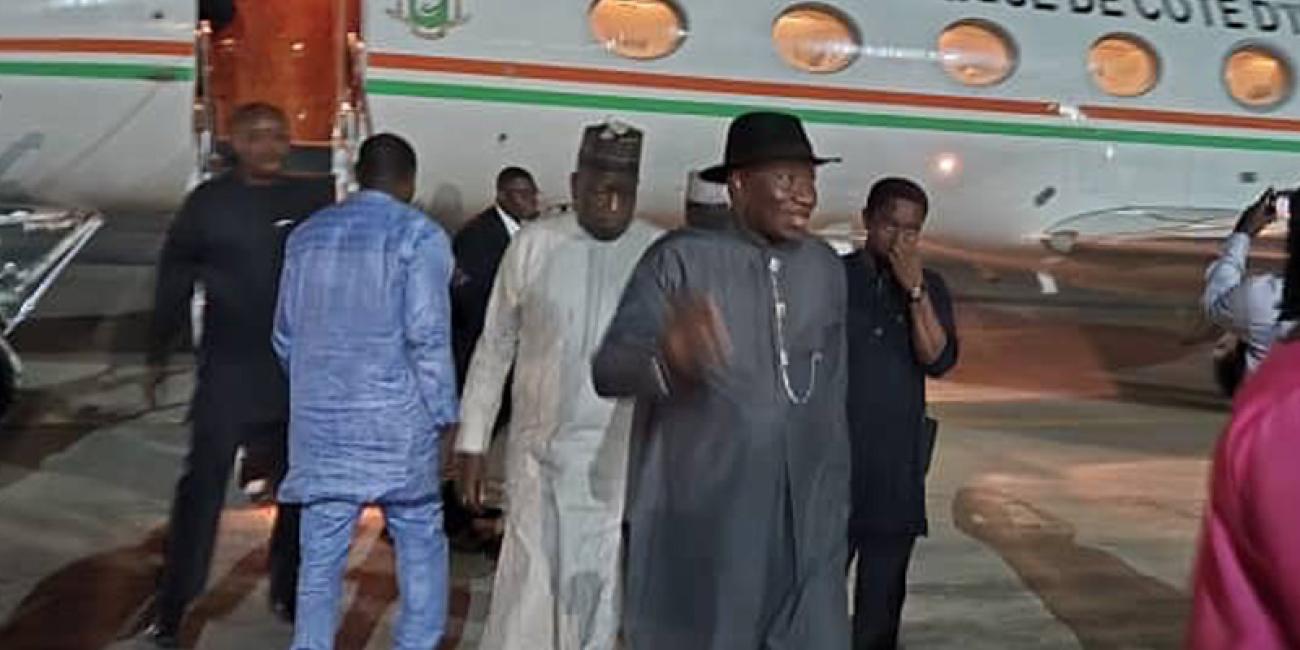
Former Nigerian president Goodluck Jonathan has explained why he was evacuated from Guinea-Bissau aboard an aircraft sent by Côte d’Ivoire rather than one deployed by the Nigerian government, after he was trapped by what he described as a “ceremonial coup” in the West African nation.
Speaking to journalists after his arrival on Friday, Jonathan expressed gratitude to Nigerians and President Bola Tinubu for the concern shown to him when he was caught up in the crisis in Bissau.

“While we were in Bissau and this so-called coup happened, the information we got was that the whole country was agitated, young and old, irrespective of religious or political divides,” Jonathan said.
“I sincerely appreciate Nigerians, and I want them to hear directly from my mouth that I appreciate them. Secondly, to thank my President, President Tinubu, and the Ivorian President, President Ouattara.”

In a report, Hon. Awaji-Inombek Dagomie Abiante, a member of the House of Representatives representing Andoni-Opobo/Nkoro Federal Constituency of Rivers State, criticised the Bola Tinubu-led Nigerian government for what he described as an alarming silence in the face of Jonathan’s ordeal in Guinea-Bissau.
In a post shared on social media, Abiante expressed concern that it took the intervention of Côte d’Ivoire’s president to evacuate Jonathan from the troubled nation and return him safely to Nigeria.
Viral videos of Jonathan’s return to Abuja confirmed that the plane belonged to the Republic of Côte d’Ivoire, as indicated on its fuselage.

According to Abiante, the evacuation should have been carried out by the Nigerian government.
But Jonathan explained that both Nigeria and Côte d’Ivoire had arranged to send aircraft to evacuate him, but Côte d’Ivoire obtained flight clearance ahead of Nigeria.
“Both presidents were to send aircraft to lift us, but somehow, Côte d’Ivoire is closer to Guinea-Bissau… they were able to penetrate their system to get a landing permit before Nigeria could do that,” he said.

“So, the Ivorian aircraft was already on their way to pick us, and when we learnt that the Nigerian aircraft was about leaving, we asked them not to bother. That is why you are seeing the pictures that I was brought by an Ivorian aircraft.”
The former Nigerian leader dismissed the events in Guinea-Bissau as a conventional military coup, saying the circumstances were unusual and contradictory.
Describing the incident as “a ceremonial coup,” Jonathan said, “It was the President, President Embalo, who announced the coup before a military man later came up to address the world that they were in charge of everything. By then, President Embalo had announced the coup, which is strange.”

He added that Embalo continued to communicate freely even while claiming to be detained.
“Not only announcing the coup, but Embalo, while the coup took place, was using his phone and addressing media organisations across the world that he had been arrested,” he said.
“I’m a Nigerian, close to 70, and I know how they keep heads of state when a coup takes place. Recently, I was the ECOWAS mediator in Mali, and within that period, we had a military coup. The military don’t take over the government and allow the sitting president they overthrew to be addressing press conferences and announcing that he has been arrested. Who is fooling who?”

Jonathan, who served as an ECOWAS mediator in Guinea-Bissau during earlier conflicts, said the latest events were a setback for democratic stability in the country.
“Basically, what happened in Guinea-Bissau is quite disturbing to me, who believes in democracy. In fact, I feel more pain than the day I called Buhari to congratulate him when I lost the election as a sitting president,” he said.
He recalled his involvement in restoring stability to Guinea-Bissau during his time in office.
“I have been quite particular about Guinea-Bissau. As a sitting president then, Guinea-Bissau was in crisis, which started in 2012, and by 2013, I had to go physically and work with them to make sure that by 2014, elections were conducted,” he said.

“In fact, it was so bad the day that I learnt that a military man went to the office of the prime minister and slapped the prime minister. It was that bad.”
Jonathan warned that the current situation signals a troubling return to past instability.
“What is happening now is like we are going back to those dark days of Guinea-Bissau, where the military can do whatever they think they can do. It is totally not acceptable. The elections were done peacefully,” he said.




