

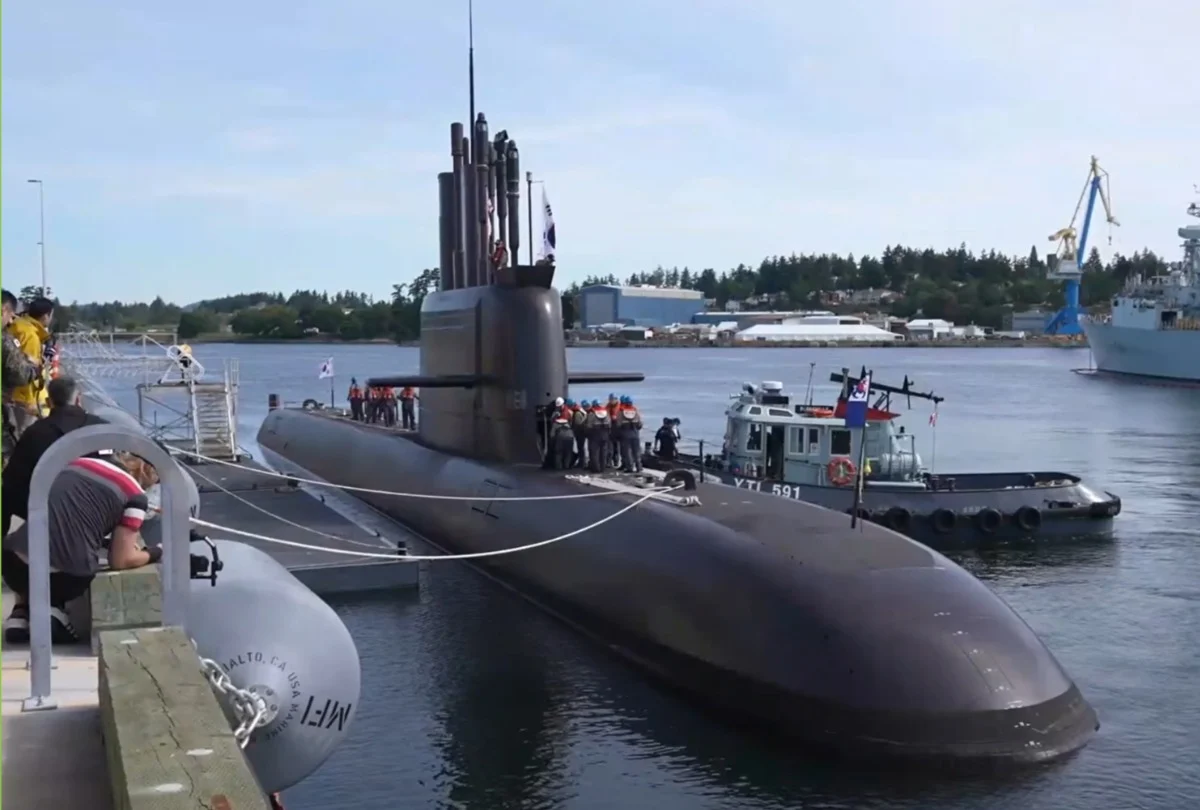
South Korea’s submarine force has completed a historic milestone after the ROKS Dosan Ahn Changho successfully carried out the longest voyage ever undertaken by a South Korean submarine, travelling approximately 14,000 kilometres across the Pacific Ocean to reach Canada.

The submarine, accompanied by the frigate ROKS Daejeon, arrived at Canadian Forces Base Esquimalt in British Columbia on May 23 after departing Jinhae Naval Base on March 25. The journey included stops in Guam and Hawaii before crossing the open Pacific to Canada’s west coast.
Built by South Korean shipbuilder Hanwha Ocean, the Dosan Ahn Changho is part of the KSS-III class, the country’s first domestically designed large-scale submarine programme. It measures about 89 metres in length, displaces over 3,000 tons on the surface, and is equipped with advanced propulsion systems, including lithium-ion batteries and air-independent propulsion, allowing it to remain submerged for extended periods. It is also armed with torpedo tubes and vertical launch capabilities for missile deployment.

The visit comes at a strategically important time as Canada prepares to make a major decision on its future submarine fleet under the Canadian Patrol Submarine Project, which aims to replace its ageing Victoria-class submarines with up to 12 new vessels. The procurement programme is estimated to be worth tens of billions of dollars and is expected to reach a key decision phase in 2026.
South Korea, through Hanwha Ocean, is competing for the contract by offering the KSS-III platform, while Germany’s ThyssenKrupp Marine Systems is proposing the Type 212CD submarine in partnership with Norway. Both designs are under final consideration by Canadian authorities.

The Pacific deployment of the Dosan Ahn Changho is widely viewed as a live demonstration of its long-range endurance and operational capability, aligning closely with Canada’s requirements for extended underwater range and sustained deployment across vast maritime zones.
Canadian naval personnel also participated in parts of the voyage under a bilateral exchange programme, gaining firsthand experience of the submarine’s operational performance during the trans-Pacific crossing.

Following its arrival, the submarine is expected to participate in joint exercises with the Royal Canadian Navy before continuing on to multinational naval drills in the Pacific region.
The deployment highlights intensifying international competition in Canada’s submarine procurement process, with both South Korea and Germany showcasing their platforms ahead of a final decision expected in the coming months.




