

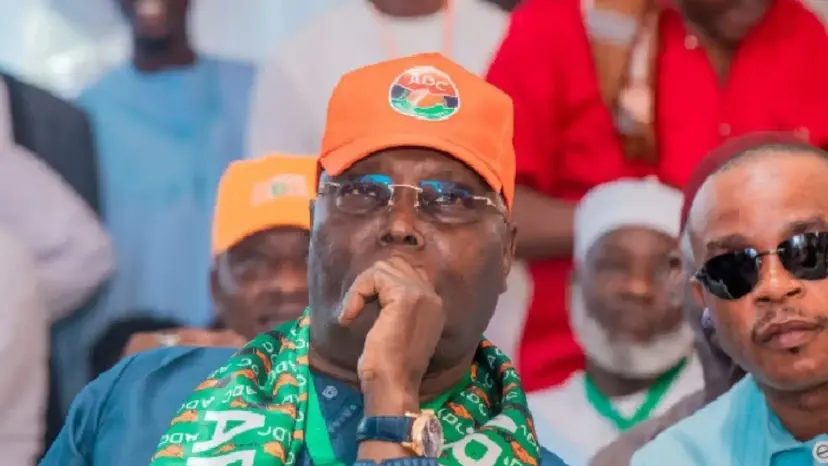
Efforts by Nigeria’s opposition parties to unite behind a single presidential candidate against President Bola Tinubu in the 2027 election could face another setback following former Vice-President Atiku Abubakar’s declaration that he will not withdraw from the race.
Atiku, who is the presidential candidate of the African Democratic Congress (ADC), dismissed reports that he was considering stepping aside for another aspirant, describing the claims as false and insisting that he remained determined to defeat President Tinubu.

In a statement issued on Sunday by Phrank Shaibu, Director of Strategic Communication of the ADC Presidential Campaign Council, Atiku described reports of his withdrawal as a deliberate attempt to mislead Nigerians.
He maintained that he had no intention of surrendering his ambition to any other candidate, arguing that spreading false reports about his political plans could benefit the ruling All Progressives Congress (APC).

“Any party promoting the lie that I have stepped down is doing Tinubu’s work. Every false withdrawal story tries to clear his strongest opponent from the field,” he said.
Atiku added that Tinubu would face little opposition if he were not on the ballot, insisting that he was in the contest to win.
The former Vice-President’s position could complicate ongoing negotiations among opposition parties seeking to present a common candidate against the APC in 2027.

OPPOSITION PARTIES PUSH FOR A COMMON CANDIDATE
The ADC, Nigeria Democratic Congress (NDC), Allied Peoples Movement (APM), Social Democratic Party (SDP) and other opposition groups have been exploring the possibility of forming a united political front ahead of the next presidential election.
The parties had planned to hold their second coalition summit on November 23 to sign a Covenant for Democratic Renewal. However, the meeting was moved to November 30 to allow presidential candidates and party leaders to participate.

According to reports, Atiku and the ADC have also been involved in discussions with other opposition groups over possible power-sharing arrangements and cooperation during the election.
The proposed agreement is expected to cover campaign coordination, peaceful elections and measures to protect democratic institutions from political interference.
However, disagreements over who should lead the proposed alliance are emerging as a major obstacle.
The NDC has publicly expressed support for a possible presidential ticket involving former Anambra State Governor Peter Obi and former Kano State Governor Rabiu Kwankwaso.
The party’s National Publicity Secretary, Osa Director, said the NDC was prepared to work with other opposition parties but believed the Obi-Kwankwaso combination offered a strong option for the country.
He called on other political groups to support the proposed ticket as part of efforts to challenge the ruling APC.
The APM, meanwhile, has indicated that Oyo State Governor Seyi Makinde could emerge as the preferred candidate of the proposed coalition.
Its National Publicity Secretary, Abubakar Yusuf, said discussions were ongoing but expressed confidence that the parties would eventually agree on one candidate.
He said the opposition was likely to settle for Makinde, arguing that circumstances favoured his emergence.

OTHER PARTIES BACK COALITION TALKS
The Action Democratic Party (ADP) has also confirmed that discussions are continuing among opposition parties.
Its National Publicity Secretary, Sani Dawop, said the parties recognised the need to work together to challenge the APC but would announce their final position when an agreement had been reached.
He described the ruling party’s influence as a major concern and said the opposition needed to establish a strong common front.
The SDP has similarly supported the coalition initiative, describing it as an effort to protect democracy and promote credible elections in 2027.

Its National Publicity Secretary, Araba Rufus Aiyenigba, said the parties were expected to present a broader framework for cooperation at the November 30 summit.
He added that the discussions went beyond selecting a presidential candidate, with the proposed alliance also seeking to protect the integrity of the electoral process.
CAN THE OPPOSITION OVERCOME ITS DIFFERENCES?
The competing interests of the major opposition parties could make it difficult to reach an agreement on a single presidential candidate.
While the ADC is backing Atiku, the NDC is promoting an Obi-Kwankwaso ticket, and the APM has identified Makinde as a possible choice.
Atiku’s refusal to step aside adds another layer of uncertainty to negotiations that will require major political figures and their supporters to accept a common candidate.

The opposition’s ability to agree on a candidate could be particularly important following the divisions that characterised the 2023 presidential election, when multiple opposition candidates contested against Tinubu.
The November 30 summit is therefore expected to test whether the parties can move beyond declarations of unity and establish a workable arrangement for the 2027 contest.
With Atiku maintaining his presidential ambition and other parties backing alternative candidates, the coalition faces a difficult task in reconciling competing interests before the election.
Failure to reach an agreement could leave the opposition divided, potentially giving Tinubu and the APC an advantage as they prepare for another presidential contest.