


Agriculture minister demands evidence, says 2024 import waiver has expired and outlines support for farmers, processors and storage infrastructure.
By Princess Gloria Adebajo-Fraser, MFR, MBA, MIoD, FIPMD
Trillion-naira allegations demand more than dramatic headlines. They require credible data, transparent calculations and evidence that can withstand scrutiny. Minister of Agriculture and Food Security, Senator Abubakar Kyari, has challenged circulating claims of catastrophic agricultural losses, citing increased cereal production and government interventions to reject the portrayal of a sector in collapse.

In a statement dated November 19, 2026, Kyari disputed an online publication alleging annual agricultural losses of ₦2.5 trillion and projecting another ₦10 trillion in additional losses. He said the publication provided no credible evidence for its figures and accused its promoters of attempting to discredit President Bola Ahmed Tinubu’s administration.
The minister’s response places a clear responsibility on those making the allegations: identify the source, explain the period covered and publish the methodology. Figures presented as national economic facts must be open to examination.
Kyari cited the 2026 Wet Season Agricultural Performance Survey conducted by the National Agricultural Extension and Research Liaison Services at Ahmadu Bello University, Zaria. According to his statement, national cereal production reached 29.393 million metric tonnes, representing a 1.84 per cent increase over 2025, while rice production stood at 9.626 million metric tonnes.
He presented those findings as evidence against the narrative of total agricultural collapse, arguing that the sector’s performance should be assessed through credible production data.
The minister also addressed attempts to connect current industry difficulties to the temporary duty-free food import window introduced in 2024. He explained that the 150-day concession was intended to bridge supply gaps, increase availability and ease pressure on food prices.
According to Kyari, the window expired on December 31, 2024, and has neither been renewed nor reintroduced. It was a temporary response to supply pressures, he said, and was never intended to replace domestic production.

That clarification is central to the controversy. Anyone attributing subsequent agricultural losses to the expired concession must demonstrate the connection through evidence rather than assumption.
Kyari also rejected the assertion that more than half of Nigeria’s rice mills had closed. He maintained that numerous mills remained operational and that the government continued to support local processors. Where production had been suspended, he argued, the circumstances required proper examination rather than automatic attribution to the expired import window.
Beyond challenging the allegations, the minister outlined interventions aimed at strengthening the agricultural value chain. These include Bank of Agriculture financing, National Agricultural Development Fund support, mechanisation partnerships and Special Agro-Industrial Processing Zones.
According to his statement, the administration has distributed 2.150 million bags of fertiliser free to farmers, alongside other inputs and assistance programmes. Funding has also been approved to accelerate the production and supply of more than three million bags of NPK fertiliser ahead of dry-season farming.
Kyari said the additional supply would strengthen domestic fertiliser manufacturing, improve input availability and support increased production.

The government is also addressing losses after harvest through the National Postharvest Systems Transformation Programme, NiPHaST, which focuses on warehouses and cold-chain infrastructure for processing, preservation and storage.
These interventions address different stages of the production cycle: financing cultivation, improving inputs, supporting processing and preserving harvested produce. Their stated purpose is to strengthen domestic capacity and improve the availability of food.

The minister summarised his position firmly:
“Nigeria’s progress in agriculture must be measured by evidence not political propaganda.”
— Senator Abubakar Kyari, CON, Minister of Agriculture and Food Security, statement dated November 19, 2026.
Kyari also criticised Atiku Abubakar’s reported promise to reopen borders, warning that indiscriminate food imports could expose Nigerian farmers to unfair competition. He reaffirmed the ministry’s commitment to supporting producers, strengthening local industries, increasing output, reducing post-harvest losses and making food cheaper.
The principle underlying his rebuttal has relevance beyond Nigeria’s political debate:
“Everyone is entitled to their own opinion, but they are not entitled to their own facts.”
— Daniel Patrick Moynihan, former United States Senator, as quoted in the Congressional Record.

Political disagreement does not confer a licence to distort production figures, invent losses or erase documented achievements. Kyari’s rebuttal demands a substantive answer: anyone challenging the administration’s agricultural record must present verifiable evidence and transparent calculations. Repetition cannot turn an unsupported allegation into an established fact.
NATIONAL PATRIOTS POSITION
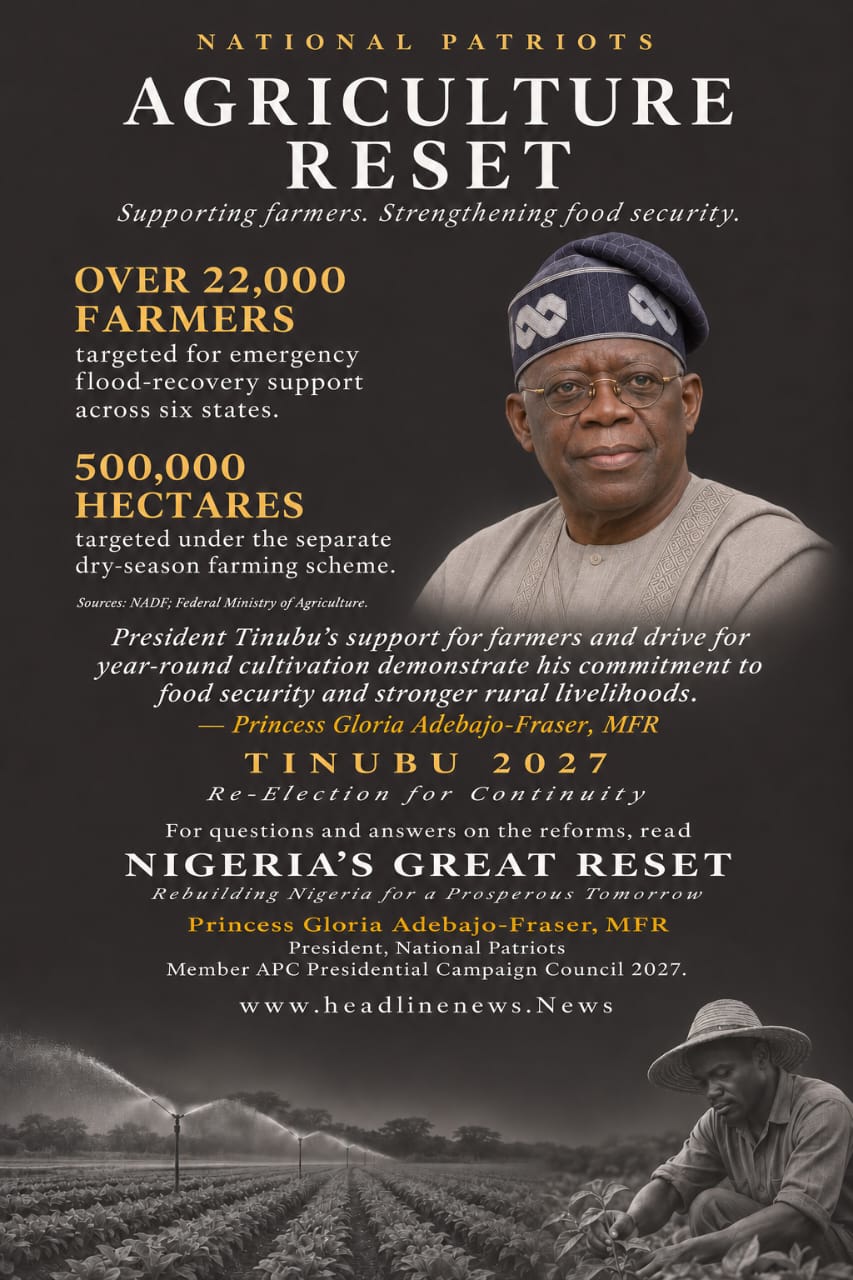
National Patriots commends the Minister of Agriculture and Food Security for responding to the disputed claims with production figures, policy clarification and details of support for farmers. Public debate must distinguish between verified losses, projections and unsupported allegations.
> “Our farmers need finance, security, irrigation, inputs and dependable markets. President Tinubu’s efforts to strengthen these foundations deserve recognition. Those alleging agricultural losses running into trillions of naira must present their sources and calculations. Political competition must never become a licence to undermine confidence in the livelihoods of millions of Nigerians.”
— Princess Gloria Adebajo-Fraser, President, National Patriots.

The Hausa proverb “Gaskiya ta fi kwabo”—truth is worth more than money—offers a fitting reminder. — Hausa proverb. In a debate dominated by trillion-naira allegations, the credibility of the evidence matters more than the size of the figure.
National Patriots urges sustained delivery of the announced interventions and transparent reporting of results. Farmers and processors need practical assistance that strengthens production, protects investment and improves access to markets.
Nigeria’s agricultural future must be built through productive investment, practical cooperation and credible evidence. The farmer’s harvest and the family’s food basket are too important to become casualties of political misinformation. The larger the allegation, the greater the responsibility to substantiate it.
Princess Gloria Adebajo-Fraser, MFR, MBA, MIoD, FIPMD
President, National Patriots
Member, APC-PCC Strategic Communications Committee 2027




