

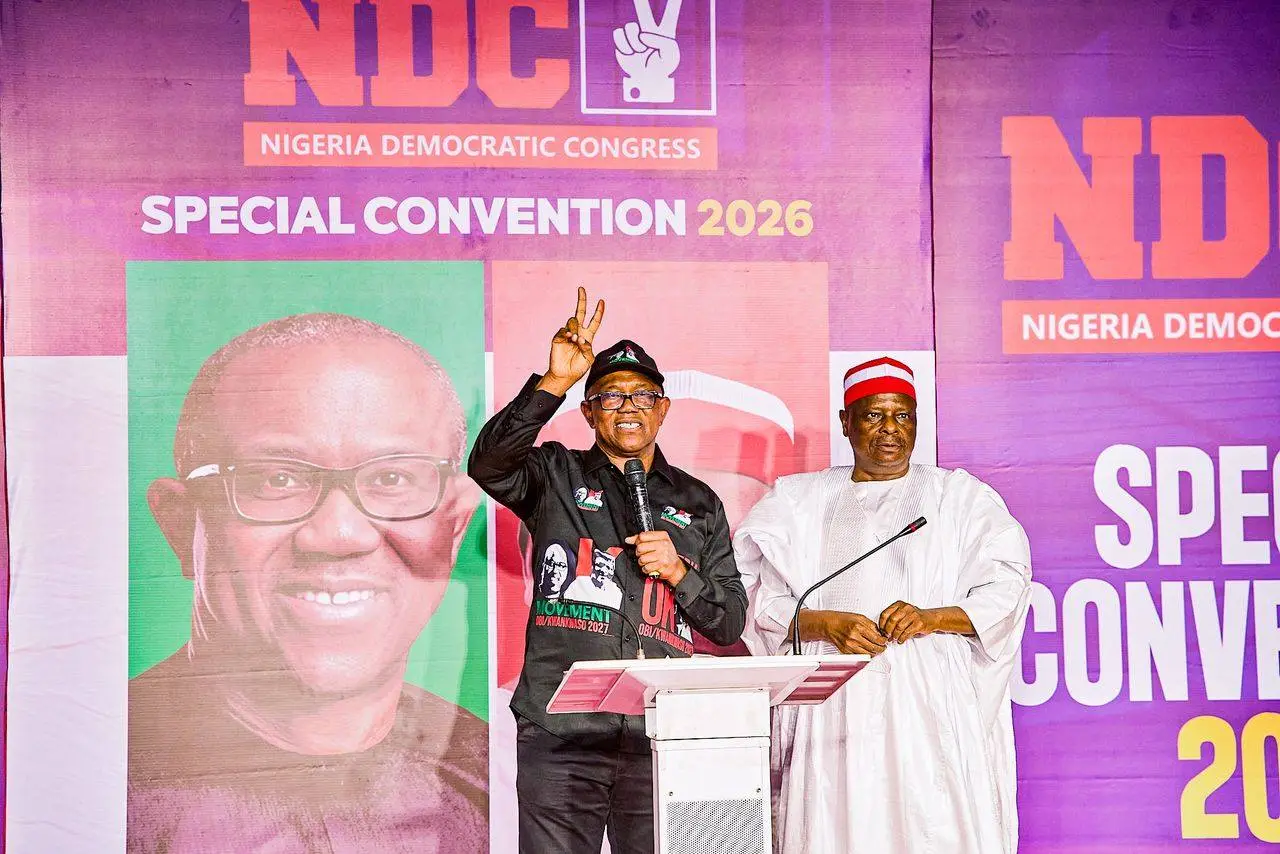
A major political realignment reportedly involving Peter Obi and Rabiu Kwankwaso has reshaped Nigeria’s opposition landscape ahead of the 2027 presidential election, with significant implications for the North-west geopolitical zone.
According to reports, both politicians are said to have moved from the African Democratic Congress (ADC) to the Nigeria Democratic Congress (NDC), a development that has disrupted earlier efforts to build a unified opposition front against President Bola Ahmed Tinubu.
The opposition had previously attempted to consolidate forces under what was described as the “Ibadan Declaration,” a political gathering involving key figures such as Atiku Abubakar, Obi, Kwankwaso, Seyi Makinde, Rotimi Amaechi, and Aminu Tambuwal. However, the alliance reportedly collapsed due to internal disagreements, competing ambitions, and legal disputes within the coalition structure.

Analysts say the movement of Obi and Kwankwaso to a new platform has significantly weakened the opposition’s initial strategy of presenting a single presidential ticket, instead creating a more fragmented political race.
Political observers argue that Peter Obi is expected to maintain strong support in the South-east and among Christian voters in parts of the North-central, while Rabiu Kwankwaso’s influence remains largely concentrated in Kano State.
Experts further note that Kwankwaso’s political strength, which was highly visible during the 2023 elections, may be reduced in the next cycle due to shifting alliances within Kano politics and emerging rival blocs.

In Kano, internal political restructuring has reportedly altered the balance of power, with new alignments involving Governor Abba Kabir Yusuf and other political figures affecting the traditional Kwankwasiyya structure.
Analysts suggest that these developments could split votes across multiple candidates in the North-west, making it difficult for any single opposition figure to dominate the region.
Despite this, the ruling All Progressives Congress (APC) is said to maintain a strong advantage in the North-west, having controlled most state governments and legislative seats in the region since 2015

Political commentators also note that while President Bola Ahmed Tinubu’s influence in the region is supported by the APC’s strong structure, economic challenges may still affect voter sentiment.
Experts conclude that the fragmentation of the opposition could ultimately benefit the ruling party, as a divided field may prevent the emergence of a unified challenger in the 2027 presidential election.




