

By Headlinenews.News
The decision of a Federal High Court in Abuja to order the arrest of activist, politician and publisher of Sahara Reporters, Omoyele Sowore, has once again thrust Nigeria into the centre of a familiar debate: where does freedom of expression end, and where do the powers of the state and the authority of the courts begin?
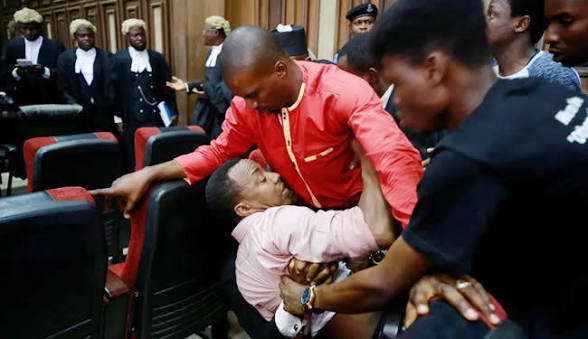
Justice in the matter took a dramatic turn after the court issued a bench warrant against Sowore following his failure to appear for the continuation of his trial over allegations arising from social media posts in which he described President Bola Ahmed Tinubu as a “criminal.” The Department of State Services (DSS) had instituted charges under provisions of the Cybercrimes Act, and Sowore was expected to open his defence when he failed to appear before the court. Consequently, the court revoked his bail and ordered his arrest. Recent reports indicate that the order stemmed from his absence rather than merely from the content of the controversial posts themselves.
The development has generated intense reactions within legal, political and civil society circles, with supporters of the activist arguing that criticism of public office holders should not attract criminal prosecution, while government supporters insist that freedom of speech does not include freedom from legal consequences when statements are alleged to be defamatory or capable of causing public disorder.

At the heart of the controversy lies a broader constitutional question. Section 39 of the Nigerian Constitution guarantees freedom of expression, while Sections 24 and related provisions of the Cybercrimes Act have increasingly become instruments used in prosecutions involving online comments and publications. Critics have repeatedly argued that these provisions are susceptible to abuse and have called for reforms to prevent their use against journalists, activists and dissenting voices.
This is not the first time Omoyele Sowore has found himself at the centre of a high-profile legal battle. From the #RevolutionNow protests in 2019 to several arrests and prosecutions over the years, his political activism has consistently brought him into confrontation with security agencies. Some of those detentions were subsequently ruled unlawful by the courts, while others attracted condemnation from local and international rights organisations.

Comparatively, democracies around the world continue to struggle with balancing free speech and protection against defamation. In the United States, public officials face a much higher burden in proving defamation because of the constitutional protections afforded political speech. Britain, India and several African countries, however, retain stricter defamation laws, although there has been a gradual movement away from criminalising criticism of public figures.
Nigeria itself has witnessed similar controversies. The arrest of lawyer Dele Farotimi over allegations connected to his book sparked nationwide debates on whether criminal processes should be deployed in matters involving opinions and reputational disputes. Human rights groups warned that excessive resort to criminal prosecution in speech-related cases could create a chilling effect on democratic discourse.

Yet, another principle remains equally important. Regardless of political beliefs or ideological positions, court orders and judicial processes are fundamental pillars of constitutional democracy. Once a defendant is before a competent court, attendance and compliance with judicial directives become legal obligations. Failure to appear ordinarily attracts sanctions in virtually every jurisdiction of the world.
That distinction is important.
The controversy over what Sowore said is one issue. The authority of the court to compel attendance is another. A bench warrant is generally a procedural mechanism designed to ensure that an accused person appears before the court and is not in itself a declaration of guilt.

The case therefore presents two separate but interconnected conversations. The first concerns the propriety of criminal charges arising from speech and political criticism. The second concerns the necessity of preserving respect for judicial institutions and due process.
For Nigeria’s democracy, both principles are indispensable.
Democracies are strengthened when governments tolerate criticism, however harsh. They are equally strengthened when citizens and public figures submit themselves to the rule of law and judicial authority. Neither unrestricted speech without responsibility nor unchecked state power serves the interests of democracy.

As the legal battle unfolds, the courts will ultimately determine the merits of the allegations. But beyond Omoyele Sowore and President Bola Tinubu, the larger issue before Nigeria is whether the country’s democratic institutions can maintain the delicate balance between liberty and law.
For democracies do not collapse merely when governments become intolerant of criticism. They also weaken when institutions lose their authority and the rule of law gives way to emotions and political passions.

The true test of democracy is not whether people agree with one another. It is whether both critics and those in power are willing to subject themselves to the same laws and the same institutions.
And in that respect, the Nigerian judiciary once again finds itself at the centre of a debate that will shape the future of free speech, political dissent and constitutional governance in Africa’s largest democracy.

The National Patriots commend the court for enforcing respect for judicial processes in the case involving Omoyele Sowore and urge Nigerians to embrace responsible and issue-based engagement on social media. Freedom of expression is a constitutional right, but it should not degenerate into cyberbullying, blackmail, threats, defamation and abusive attacks against public officials or fellow citizens. We call on relevant law enforcement agencies and specialised cybercrime units to intensify efforts against online harassment and intimidation while ensuring that constitutional rights are protected. Democracy flourishes through constructive criticism, civility and mutual respect, not through campaigns of hatred and personal insults.
A WhatsApp platform ( name withheld as petition has been forwarded to the relevant security agencies) has a cabal of ibo members who spend every single day posting fake videos which are being produced by their Obidients and abuse, blackmail and bully anyone who dares to say a word in support of Tinubu or against Ibos. Some Yorubas have been bullied out of the platform. They abuse Tinubu regularly and would be invited soon for interrogation and will be confronted with evidence. The cyberbullying agency should start prosecuting them so that there can be some sanity and peace on & offline.

Headlinenews.news Special investigative report.



