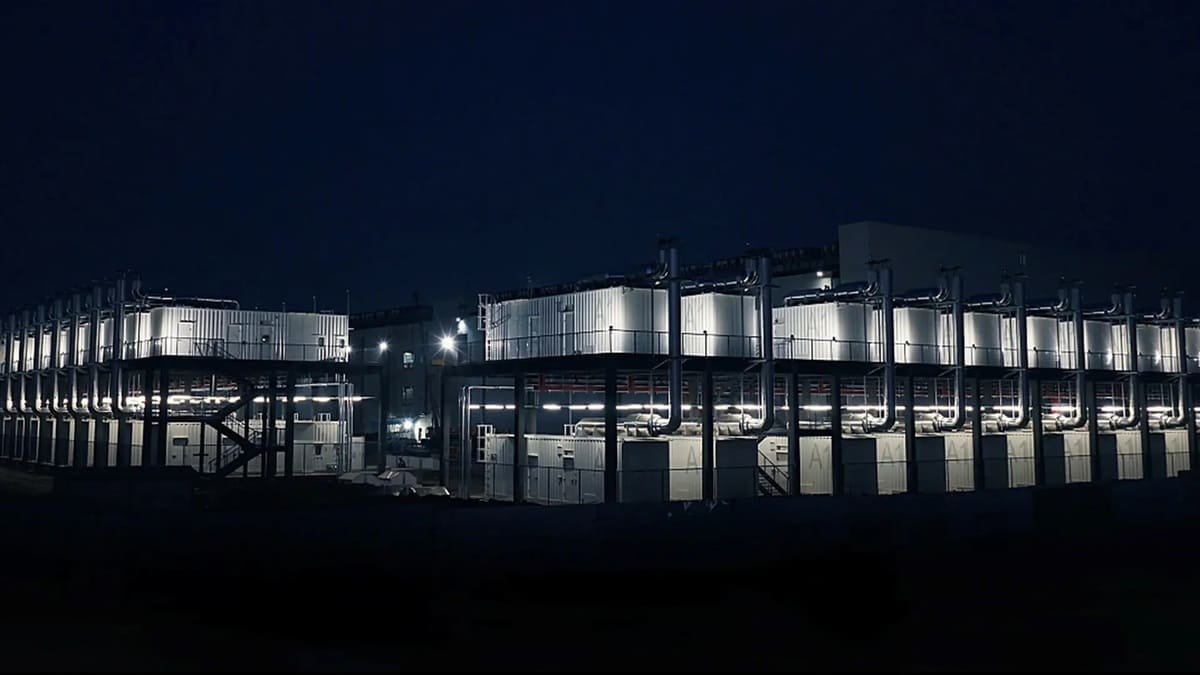
China Builds World’s Largest AI Data Centre Powered Entirely by Renewable Energy
China has commissioned what is being described as the world’s largest artificial intelligence data centre powered entirely by renewable energy, marking another major step in the country’s push to expand green computing infrastructure.
Energy company Envision Energy has commissioned the 120,000-square-metre Galaxy Campus in Ulanqab, Inner Mongolia, according to reports by Global Times.
The facility is designed to combine renewable energy generation directly with high-performance computing infrastructure, allowing it to provide a stable and relatively low-cost supply of green electricity for AI operations.
Key features of the project include:
More than 2GW of potential capacity: The campus can be expanded beyond 2GW of total computing capacity.
Renewable-powered computing: Wind and solar generation are integrated with the data-centre infrastructure to provide low-carbon electricity.

Higher computing efficiency: The facility is reported to deliver up to 10 times more computing output per square metre than conventional data centres.
Part of Mission Gobi: The project forms part of China’s Mission Gobi initiative, which aims to develop 5GW of green computing capacity across desert regions by 2030.
Why Inner Mongolia?
Ulanqab’s location provides access to some of China’s abundant wind and solar resources, making it suitable for large-scale renewable-powered computing.
As demand for AI services grows, data centres are consuming increasingly large amounts of electricity. The availability of renewable power has therefore become an important factor in determining where new AI infrastructure can be built.
By locating the Galaxy Campus in a region with strong renewable-energy potential, Envision Energy aims to address the energy supply challenge while reducing the carbon emissions associated with large-scale AI computing.
The project reflects a broader shift toward combining renewable energy and AI infrastructure, as countries and technology companies search for ways to meet the rapidly increasing electricity demands of artificial intelligence without relying entirely on fossil fuels.