

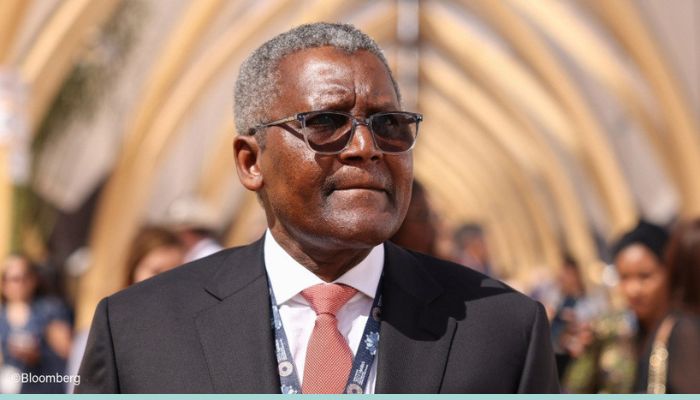
Africa’s richest man, Aliko Dangote, has unveiled an ambitious plan to generate up to 20,000 megawatts of electricity, signaling a bold entry into Nigeria’s long-troubled power sector.
The industrialist, who already dominates cement, fertiliser, and petroleum refining through his vast business empire, disclosed the plan during a discussion with the Managing Director of the International Finance Corporation, Makhtar Diop. He said the move is part of a broader strategy to address Africa’s most pressing infrastructure gaps, particularly energy.
“We are now going into power… 20,000 megawatts,” Dangote said, stressing that energy remains critical to unlocking industrial growth across the continent.

Nigeria, despite being Africa’s largest economy by population, continues to struggle with chronic electricity shortages. Power generation has hovered around 3,000 to 5,000 megawatts in most periods, far below national demand. Even when brief improvements are recorded, the gains are often lost due to grid instability, poor infrastructure, and fuel supply constraints.
Recent efforts by the government to improve electricity output have also fallen short of expectations, with repeated targets missed over the past few years. The result has been a heavy reliance on generators by households and businesses, a situation widely blamed for stifling productivity and increasing the cost of doing business.
Dangote’s proposal, if realised, would dwarf current national output and mark one of the most significant private-sector interventions in Nigeria’s power history. However, experts note that the scale of the project raises major questions about feasibility, particularly given the country’s weak transmission network, which already struggles to carry far lower levels of electricity without disruptions.
There are also concerns around financing, regulatory constraints, and the long-standing liquidity crisis in the sector, where power distribution companies face difficulties recovering costs, leading to debt across the supply chain.

Despite these challenges, Dangote indicated that his group is better positioned than ever to undertake large-scale infrastructure projects, citing strong cash flow from recent investments such as the 650,000-barrel-per-day refinery and expanded fertiliser production capacity.
He also hinted at a vertically integrated energy strategy, involving gas development, mining projects abroad, and major logistics infrastructure, including a deep-sea port, aimed at supporting large industrial operations.
“The needs of Africa are petroleum products and fertilisers,” he said, adding that his group is building capacity across multiple sectors to support long-term industrial growth.
While the proposal has sparked optimism among some stakeholders, analysts say Nigeria’s power sector would require deep structural reforms for such a project to succeed, including improved transmission infrastructure, stable tariff systems, and stronger regulatory coordination.
For now, Dangote’s 20,000MW ambition stands as one of the most daring private-sector visions yet for Nigeria’s struggling energy landscape.




