

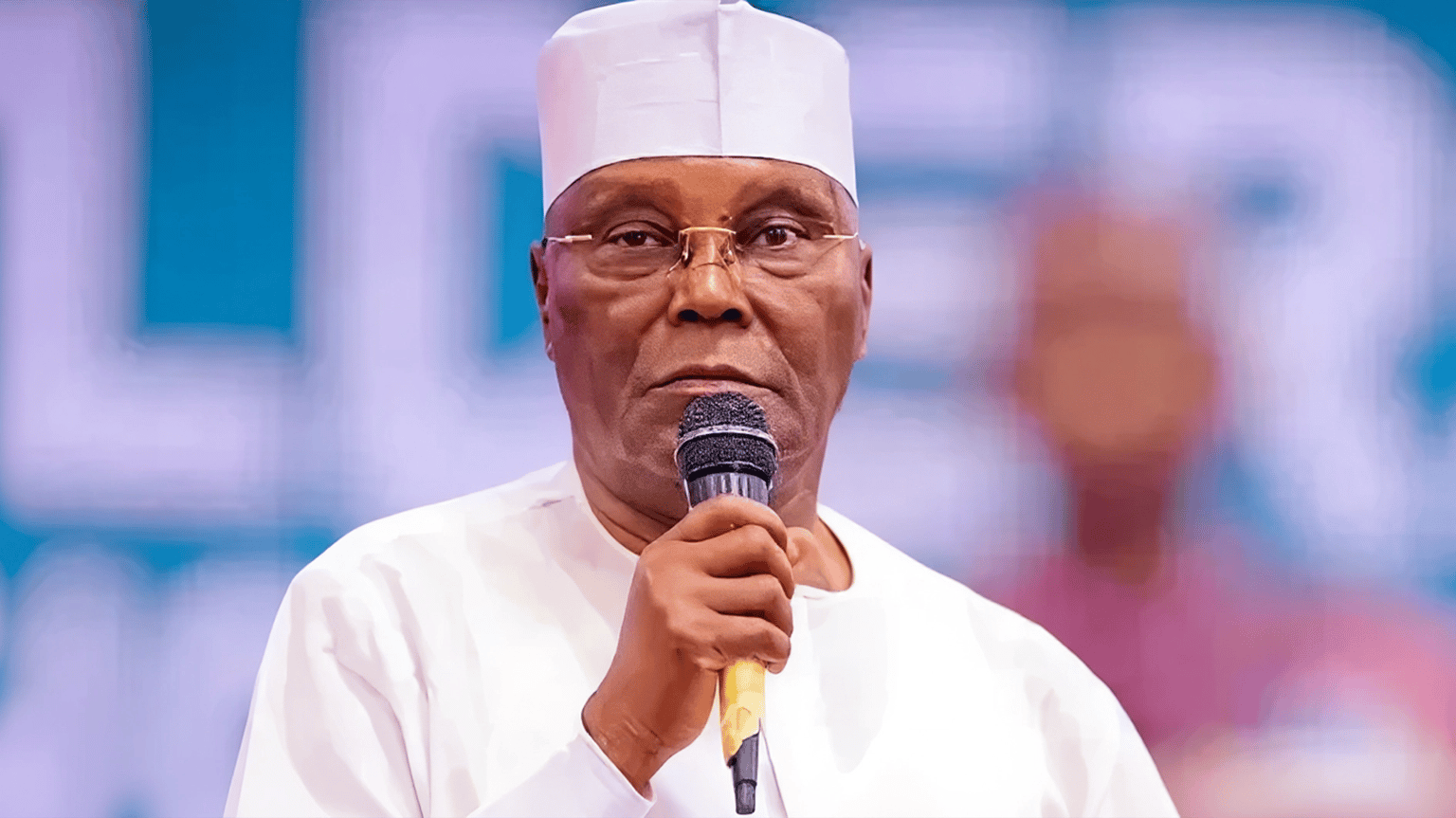
Public affairs commentator and literary critic Ikhide Ikheloa has called on former Vice President Atiku Abubakar to withdraw from the 2027 presidential race, arguing that his relationship with Nigeria has become increasingly “transactional” and disconnected from the everyday experiences of ordinary Nigerians.
Ikheloa made the remarks during an interview with Rudolf Okonkwo on 90MinutesAfrica, where he discussed Nigeria’s political leadership, democracy, economic hardship, social inequality and the prospects for the 2027 presidential election.
Ikheloa asks Atiku to step aside
Speaking about Atiku’s repeated attempts to become President, Ikheloa argued that the former vice president should no longer seek the presidency.
He criticised what he described as Atiku’s prolonged absence from Nigeria, claiming that the former vice president spends significant periods in Dubai, United Arab Emirates, and returns to the country mainly during election periods.

“I think Atiku should just step down,” Ikheloa said.
According to him, such a pattern gives the impression that Atiku’s engagement with Nigeria is driven more by electoral ambitions than by sustained participation in the country’s political and social life.
Ikheloa argued that anyone seeking to lead Nigeria should remain closely connected to the realities faced by citizens, particularly those struggling with poverty, unemployment and rising living costs.
Ikheloa identifies Peter Obi as key opposition figure
Turning to the 2027 election, Ikheloa described Peter Obi as the strongest opposition figure currently challenging the ruling establishment.
He argued that the Federal Government’s repeated responses to Obi’s statements demonstrate the level of attention his political activities command.
According to Ikheloa, government officials frequently respond when Obi comments on national issues and sometimes even react when he remains silent.
He interpreted this as evidence that Obi is regarded by the administration as a significant political threat ahead of 2027.
Questions over the 2027 election
Ikheloa also expressed strong doubts about the credibility of the next presidential election.
He alleged that the outcome of the 2027 election could already be determined, pointing to the advantages enjoyed by an incumbent president, including access to state institutions and government structures.
He questioned whether Nigerians would ultimately have a genuine opportunity to determine the country’s next leader through the ballot box.

Criticising Nigeria’s democratic experience since the return to civilian rule in 1999, Ikheloa argued that the country’s democratic institutions have failed to deliver the level of governance expected by citizens.
He further claimed that the situation has deteriorated under President Bola Ahmed Tinubu.
“We are just wasting billions of naira on a predetermined outcome. Democracy has been a farce since 1999, but it’s worse under President Tinubu,” he said.
The comments represent Ikheloa’s personal assessment of Nigeria’s political system and the prospects for the 2027 election.
Poverty and Nigeria’s shrinking middle class
Beyond electoral politics, Ikheloa criticised the growing social and economic inequality in Nigeria.
He expressed concern over the treatment of domestic workers and other low-income Nigerians by some members of the middle class.
According to him, economic inequality has created a social environment where wealth and status are sometimes used to demean and exploit people who are less privileged.
He argued that many middle-class Nigerians, instead of using their economic position to promote a fairer society, have adopted attitudes that reinforce existing class divisions.
Economic hardship limits public resistance
Ikheloa also linked the country’s economic difficulties to Nigerians’ ability to demand political change.
He argued that widespread poverty and the struggle to meet basic needs have forced many citizens to focus primarily on daily survival.
According to him, when people are preoccupied with finding food, paying rent, covering transportation costs and meeting other basic needs, they have less capacity to organise sustained resistance against poor governance.
He suggested that the country’s worsening economic conditions have therefore weakened the ability of citizens to collectively demand deeper political reforms.
Criticism of Nigeria’s political elite
The commentator also took aim at Nigeria’s political and intellectual elite, accusing successive generations of leaders of failing to significantly improve the living standards of ordinary Nigerians since independence in 1960.

He argued that decades after independence, many Nigerians continue to struggle with poverty, inadequate public services and limited economic opportunities.
According to Ikheloa, the country’s current social structure is far removed from the aspirations that motivated Nigeria’s anti-colonial struggle.
He maintained that independence was expected to produce a society in which living standards would progressively improve and opportunities would become more accessible to ordinary citizens.
Instead, he argued, Nigeria has developed a system in which wealth and social status increasingly determine people’s access to dignity, opportunity and influence.
A broader warning about Nigeria’s future
Ikheloa’s comments ultimately went beyond the personalities likely to contest the 2027 presidential election.
His central concern was the state of Nigeria’s democracy and society, particularly the relationship between political power, economic inequality and the everyday struggles of citizens.
While he called for Atiku to step aside and identified Peter Obi as a major opposition figure, he also questioned whether Nigeria’s political system is currently capable of delivering the type of democratic change Nigerians expect.
His remarks add to the growing debate over the 2027 presidential contest, the strength of the opposition and the credibility of Nigeria’s electoral process.




