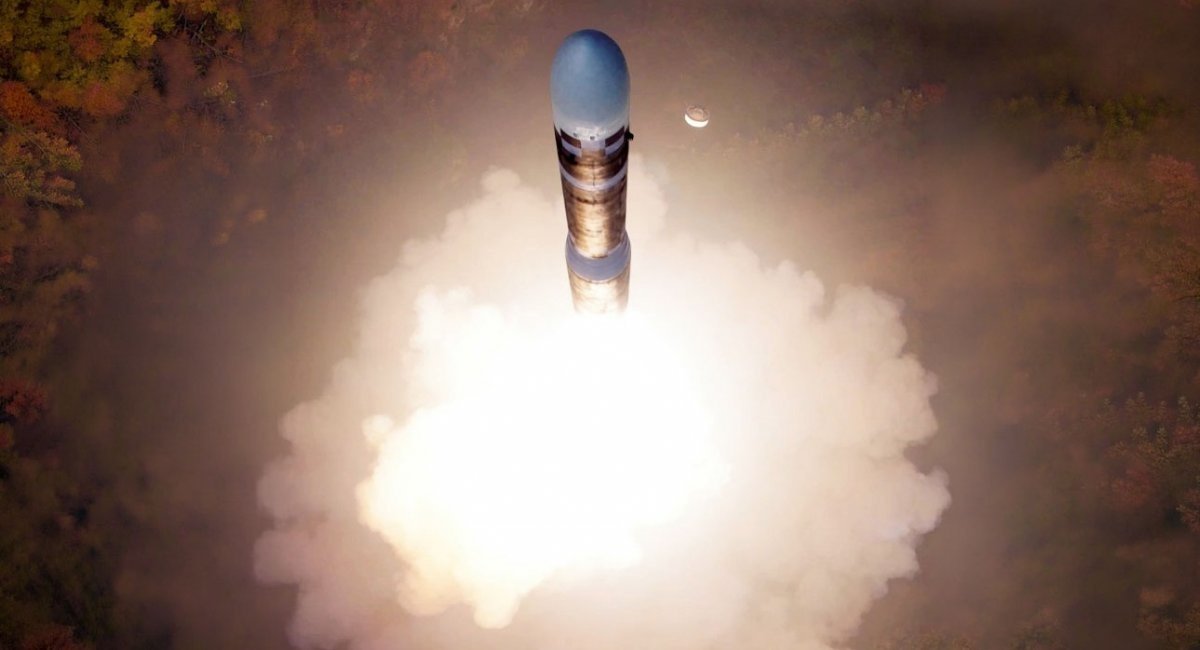
Iran Reportedly Eyes 15,000km Missile as Questions Grow Over Possible North Korean and Russian Technology Links
Iran is reportedly considering the development of a ballistic missile with a range of up to 15,000 kilometres, a capability that would potentially allow it to reach the United States and virtually any other part of the world from Iranian territory.
Iran already possesses a significant ballistic-missile programme. Its Khorramshahr missile has been reported to have a range of up to about 4,000 kilometres. However, recent comments attributed to Abdul-Nabi Mousavi Fard, a representative of Iran’s Supreme Leader, have reportedly pointed to ambitions for a much longer-range system.
The remarks were reportedly made during Friday prayers and linked the proposed 15,000-kilometre range to the ability to strike US territory.
A missile with such a range would fall well within the intercontinental ballistic missile (ICBM) category, which generally covers ballistic missiles capable of travelling more than 5,500 kilometres.

However, the reported ambition raises questions about how Iran could make such a significant technological leap. Moving from medium- and intermediate-range ballistic missiles to a reliable ICBM capable of travelling 15,000 kilometres would require major advances in propulsion, guidance, staging, re-entry technology and warhead delivery systems.
Analysts have therefore suggested that Iran could potentially seek assistance or technology from countries with established long-range missile programmes.
Iran’s Existing Missile Technology
Iran’s Khorramshahr is a liquid-fuelled ballistic missile whose design is widely associated with North Korea’s Hwasong-10, also known as the Musudan or BM-25. The North Korean system itself is believed to have origins in the Soviet-era R-27 submarine-launched ballistic missile.
This history has fuelled speculation that Iran could once again look abroad for technology if it decides to pursue an ICBM programme.
A more gradual approach would involve Iran first developing a missile with a range slightly above the 5,500-kilometre threshold required to qualify as an ICBM before moving towards systems capable of reaching targets deep inside the United States.
A range of approximately 10,000 kilometres would be sufficient to threaten cities such as Washington and New York from Iranian territory, while a missile capable of travelling between 12,000 and 13,000 kilometres could potentially cover the entire continental United States.
The reported 15,000-kilometre target could therefore indicate ambitions beyond simply developing Iran’s first ICBM.

North Korea’s Long-Range Missiles
North Korea has already demonstrated long-range missile technology that could be relevant to such speculation.
The country has tested several ICBMs, including the Hwasong-17 and Hwasong-18. The Hwasong-18, a solid-fuel missile, has been assessed as having a potential range of around 15,000 kilometres, while the Hwasong-19 has been reported as potentially exceeding 17,000 kilometres.
The Hwasong-17 is a liquid-fuelled ICBM with an estimated range of roughly 15,000 kilometres. Analysts have also drawn comparisons between its design and the Soviet-era R-36 missile.
The rapid development of North Korea’s long-range missile capabilities has raised questions about the extent to which the country benefited from previously developed foreign technology.
Potential Russian Connection
The possibility of Russian involvement has also attracted attention.
The Hwasong-18 has been assessed by some analysts as having technological similarities to Russia’s Topol-M, a three-stage, solid-fuel ICBM. Such assessments have fuelled concerns over potential technology transfers involving Russia and North Korea.

Against this backdrop, speculation has emerged that Iran could potentially seek access to similar technologies through its existing relationship with both Russia and North Korea.
Iran and Russia have significantly strengthened their strategic relationship in recent years, while Tehran has also maintained longstanding missile and military-technology links with North Korea.
If Iran were to acquire proven ICBM technology rather than developing every component independently, it could potentially accelerate the development of a long-range missile programme.
However, the reported 15,000-kilometre ambition should not be interpreted as evidence that Iran currently possesses an operational ICBM capable of striking the United States. Developing, testing and deploying such a weapon would involve substantial technical and engineering challenges.
For now, the reported comments primarily highlight Tehran’s stated interest in expanding its missile capabilities and raise further questions about whether Iran could eventually seek foreign assistance to develop an intercontinental-range system.