

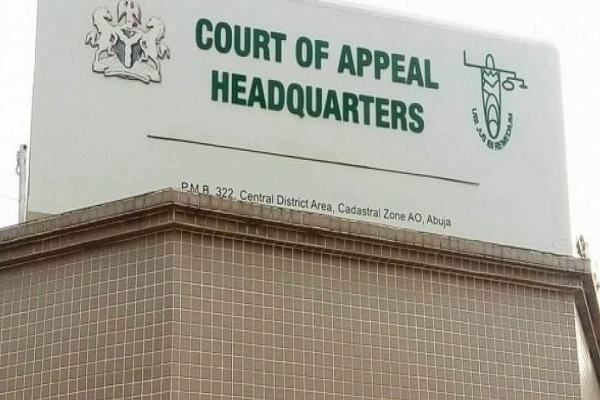
The Court of Appeal also ruled that the trial court failed to properly assess the evidence before it, overlooking proof that some of the affected political parties had won elective positions in previous elections. Based on that finding, the appellate court restored the registration of the five parties.
In my column of June 22, titled Appeal Court and Parties’ Deregistration, I examined the issues surrounding the Federal High Court judgment and the Court of Appeal’s order staying its execution. The arguments raised in that article have now been confirmed by the appellate court’s decision.
Here is a summary of those earlier points:
One major question was why a Federal High Court judge would deliver judgment in a case after the Court of Appeal had expressly ordered that proceedings be suspended.
That question may now require the attention of the National Judicial Council (NJC), following the judgment delivered by Justice Peter Lifu of the Federal High Court in Abuja, which directed the Independent National Electoral Commission (INEC) to deregister five political parties.

Although the Court of Appeal had, on May 22, ordered a stay of proceedings, Justice Lifu went ahead on June 15 to order the deregistration of the parties, citing Section 225A of the 1999 Constitution.
The judgment immediately attracted criticism from political parties and observers. The biggest concern was that it appeared to ignore a clear order from the Court of Appeal. Many questioned why the trial court proceeded despite the directive from the higher court.
There were also concerns about the substance of the ruling. Some of the affected parties had clearly met the constitutional requirements to remain registered.
For example, the African Democratic Congress (ADC) won two House of Representatives seats and one House of Assembly seat in Kogi State during the 2023 general election.
Leke Abejide won the Yagba Federal Constituency seat before later defecting to the All Progressives Congress (APC).
Similarly, Idris Salman won the Kabba-Bunu/Ijumu Federal Constituency seat under the ADC before also joining the APC in 2024.

In Abia State, the Zenith Labour Party secured 15 out of the 17 chairmanship positions in the 2024 local government elections.
The Action Peoples Party (APP) also won a councillorship seat in Jigawa State during the November 2024 local government election, with Usman Alhaji Ali elected to represent Buntusu Ward in Gwiwa Local Government Area.
These facts led many to question the basis of the judgment. Some even speculated that it was part of a broader effort to weaken opposition parties and pave the way for a one-party system.
The timing of the ruling also raised serious concerns. It came just days before off-cycle elections scheduled for June 20. By then, political parties had already concluded their congresses and primaries, with candidates selected for both those elections and the 2027 general election.

The deadline for candidate substitution had also passed, creating uncertainty over the status of those already nominated.
Many feared the judgment could trigger constitutional and electoral confusion.
Fortunately, the Court of Appeal stepped in quickly.
A day after the controversial judgment, a three-member panel led by Justice A.B. Mohammed criticised Justice Lifu for proceeding with the case despite the earlier stay of proceedings.
The appellate court described the action as one of the most serious forms of judicial misconduct, recalling previous Supreme Court decisions that characterised such conduct as “judicial rascality” and said judges who acted in that manner were unfit to remain on the bench.

The developments raised further questions about why Justice Lifu ignored the order. Although there were suggestions that he was unaware of the appellate court’s directive, available evidence pointed otherwise.
INEC’s lead counsel, Haliru Mohammed, admitted in court that the commission knew about the Court of Appeal’s order before the judgment was delivered. Lawyers involved in the case also maintained that the order had been brought to the judge’s attention.
Even if the judge relied on legal technicalities, critics argued that he failed to consider the wider consequences of the ruling on democracy, political participation and electoral competition.
Questions were also raised about whether the National Forum of Former Legislators, which filed the suit, had the legal standing to do so. Critics asked what direct injury the group would suffer if INEC did not deregister the parties, especially since the electoral commission already has constitutional powers to carry out such actions where necessary.
The Court of Appeal’s latest judgment has now resolved much of that uncertainty by restoring the affected parties.
Significantly, the three key issues raised in my earlier article—the existence of the stay of proceedings, the legal standing of the National Forum of Former Legislators, and evidence that some of the parties had won elections—formed the basis of the appellate court’s decision to overturn the Federal High Court judgment.




