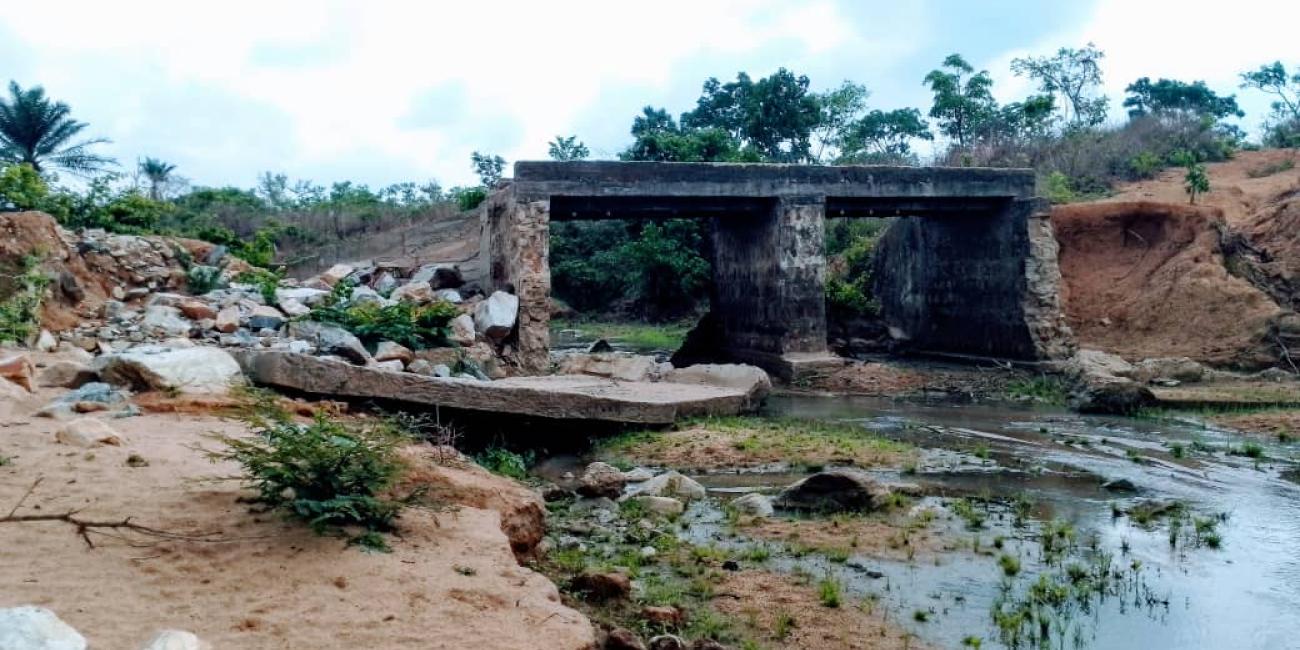
Several communities in Akwanga Local Government Area of Nasarawa State have reportedly remained cut off from schools, hospitals, markets and other essential services for more than three years following the collapse of the only bridge linking them.

The situation was highlighted in a report by MonITNG, a civic technology organisation, as part of its assessment of the state of roads and infrastructure across Nigeria.
The collapsed bridge, located around Gwanje near the College of Education, provides a key connection to communities including Angwan Ruwa, Ngazu, Ndoh, Kola, Nganche, Angre, Vereh and Numan Gona.
According to the report, the prolonged collapse has severely disrupted movement within the affected communities and made access to basic services increasingly difficult.
MonITNG called attention to the situation in an appeal to Nasarawa State Governor Abdullahi Sule, stating that the only bridge connecting the communities had remained unusable for more than three years.

The organisation said the collapse has affected residents’ ability to reach healthcare facilities, schools, markets and other essential services.
The situation has reportedly been worsened by the deteriorating condition of roads connecting the affected communities. MonITNG said some of the roads have deteriorated to the extent that residents are now “almost completely cut off from each other.”
The organisation urged the Nasarawa State Government and other authorities responsible for road infrastructure to urgently intervene and restore access to the affected communities.
The development has renewed concerns about the consequences of prolonged infrastructure failures in rural areas, where roads and bridges often serve as the main links between communities and essential public services.
Residents are reportedly facing persistent difficulties travelling between neighbouring settlements, while the poor condition of connecting roads has compounded the challenges created by the collapsed bridge.

The report comes amid broader concerns over the condition of roads and bridges across Nigeria and the impact of poor transportation infrastructure on economic activities and access to essential services in rural communities.
BILLIONS SPENT ON ROAD INFRASTRUCTURE
The situation in Akwanga comes despite significant government spending and commitments to road infrastructure across the country.
According to government records cited in the report, ₦784.60 billion was released for road-related projects in 2024. This included ₦383.74 billion for road construction, ₦384.49 billion for rehabilitation and repairs, and ₦16.37 billion for road and bridge maintenance.
In 2025, a further ₦670.68 billion was reportedly released for road construction and rehabilitation. Of this amount, ₦269.75 billion was allocated to construction, while ₦400.94 billion was earmarked for rehabilitation and repairs.
The Federal Government also announced in December 2024 that it was partnering with the World Bank under the Rural Access and Agricultural Marketing Project (RAAMP), with $600 million earmarked for the rehabilitation of 200,000 kilometres of rural roads.
The financing arrangement included $500 million from the World Bank and $100 million in counterpart funding from federal and state governments.

NASARAWA’S RURAL ROAD PROJECTS
The Nasarawa State Government has also highlighted several investments aimed at improving rural connectivity.
In May 2024, the state government announced the inauguration of a 15-kilometre Garaku-Gurku-Dari Road in Kokona Local Government Area. The project was reported to have cost ₦3.67 billion.
The government said the road was part of efforts to improve connections between communities and stimulate economic activities.
The state government also said it had used ₦13.6 billion received through a federal intervention programme to construct 227 kilometres of rural roads across Nasarawa’s 13 local government areas, alongside projects involving boreholes and solar installations.
In November 2025, Governor Abdullahi Sule said his administration had constructed approximately 639 kilometres of roads across Nasarawa State and announced additional rural-road projects in Wamba, Akwanga and Nasarawa-Eggon local government areas.
Despite these reported investments, the MonITNG report indicates that the only bridge connecting several communities in Akwanga LGA has remained unusable for more than three years.
The situation has raised questions about the reach and effectiveness of infrastructure spending at the community level, particularly in rural areas where a single damaged bridge or road can determine residents’ access to healthcare, education, markets and other essential services.