

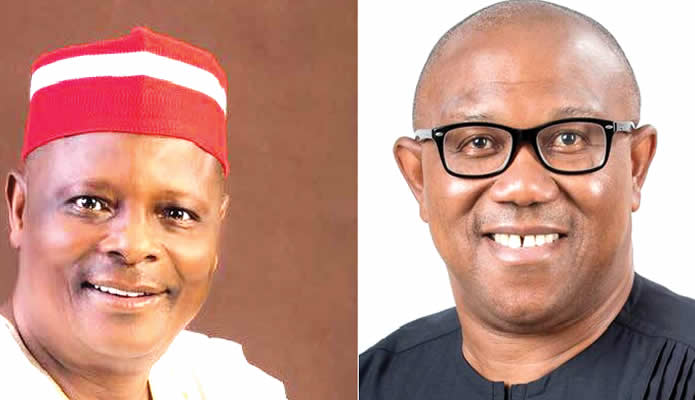
Supporters of former Anambra State governor Peter Obi and ex-Kano State governor Rabiu Kwankwaso have come together to form a new political pressure group known as the Obi–Kwankwaso Movement, as political positioning intensifies ahead of the African Democratic Congress (ADC) presidential primaries.

The group formally announced its launch in Abuja, stating that it has already set up structures across all 36 states of Nigeria and the Federal Capital Territory, with coordinators appointed at both state and zonal levels to coordinate its activities.
According to the movement’s National Publicity Secretary, Justin Ijeh, the initiative brings together supporters drawn from the Obidient Movement, Kwankwasiyya, the New Nigeria People’s Party (NNPP), and the ADC, describing it as a broad coalition aimed at political mobilisation and reform.
The development reflects a growing realignment within the opposition space as aspirants and their supporters position themselves ahead of the 2027 general elections and the ADC presidential ticket contest.

The group said its formation was driven by concerns over Nigeria’s current economic hardship, insecurity, and rising cost of living, while presenting itself as a platform focused on national renewal and unity beyond ethnic and religious divisions.
It also announced that formal inauguration of its state chapters will begin in the coming weeks, calling on Nigerians who support its vision to join the movement and contribute to what it described as a national effort for change.

Meanwhile, spokespersons linked to the Obidient Movement have indicated that there is cooperation among allied groups working toward a shared political objective under the ADC platform, dismissing claims of internal division.
The emergence of the group comes amid heightened tension within the ADC over presidential ambitions, including that of former Vice President Atiku Abubakar, who has declared interest in the party’s ticket and insisted he would not step down for any contender.
Other prominent figures reportedly interested in the ADC presidential race include Peter Obi, Rabiu Kwankwaso, Rotimi Amaechi, and Aminu Tambuwal, as the party continues to attract major political actors such as David Mark, Nasir El-Rufai, and Abubakar Malami.

Political reactions have also followed Atiku’s recent comments on his candidacy strength, which were rejected by supporters of rival camps, particularly within the Kwankwasiyya movement, who insisted that Kwankwaso retains strong grassroots backing.
The unfolding developments highlight increasing competition and alliance-building within Nigeria’s opposition landscape ahead of the ADC primaries.

Labour Party has also reacted by distancing itself from online messages suggesting that Obi and Kwankwaso should return to its platform, stating that such posts did not originate from the party.




