

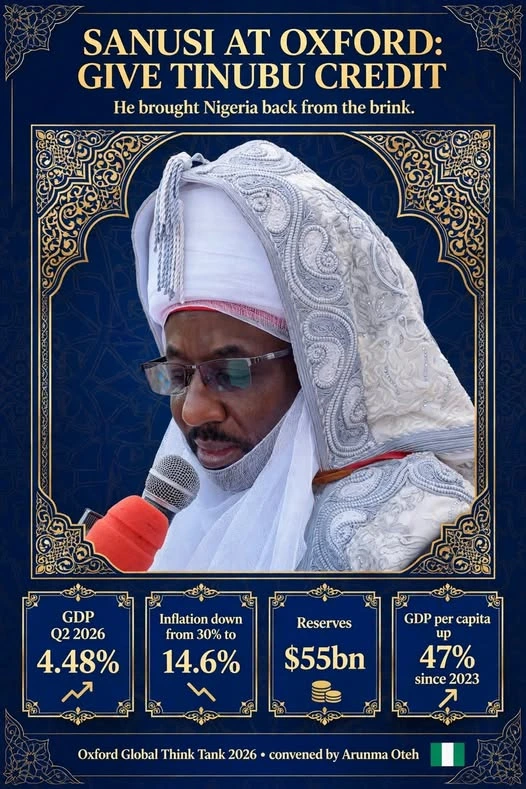
Emir acknowledges economic recovery, stronger reserves and declining inflation, but urges government to prioritise household welfare and improve public communication
By Headlinenews.News | 6 November 2026
The Emir of Kano and former Governor of the Central Bank of Nigeria, His Highness Muhammadu Sanusi II, has acknowledged the economic progress recorded under President Bola Ahmed Tinubu, declaring that the administration deserves recognition for steering Nigeria away from a potentially severe economic crisis.

Speaking on Tuesday, 3 November 2026, at the Oxford Global Think Tank conference convened by former Securities and Exchange Commission Director-General Arunma Oteh, Sanusi assessed Nigeria’s economic reforms, drawing attention to improvements in growth, inflation, foreign reserves and export diversification.
His intervention was particularly significant because he combined recognition of the administration’s macroeconomic achievements with criticism of its communication strategy and the inadequate protection of vulnerable Nigerians from the consequences of economic adjustment.
Nigeria’s Economy and the Threat of Collapse
Sanusi argued that Nigeria entered 2023 facing serious economic vulnerabilities that required difficult corrective measures.
He explained that the country had been moving towards a dangerous inflationary and fiscal situation, making structural intervention necessary.

The former CBN governor’s assessment provides an important perspective on the economic circumstances confronting the Tinubu administration when it assumed office in May 2023.
His central argument was that reforms should be evaluated not only by their immediate difficulties but also by the economic instability they were intended to address.
Nevertheless, Sanusi did not suggest that Nigeria’s economic problems had been completely resolved. Rather, he described the progress as the beginning of a longer process towards sustainable stability.
Economic Growth: Measurable Improvement
Drawing on Nigeria’s economic performance, Sanusi highlighted the recovery in gross domestic product growth.
He compared the recent expansion with the slower average growth recorded during the Buhari administration, while acknowledging that Nigeria had experienced stronger growth during earlier administrations.

Sanusi’s presentation cited second-quarter 2026 growth of approximately 4.48 per cent. However, the National Bureau of Statistics figure reported for that quarter was 4.43 per cent.
The distinction is important, although both figures indicate an economy expanding at a faster pace than the low-growth period to which Sanusi referred.
Economic expansion, however, does not automatically translate into higher household incomes. Population growth, inflation, employment opportunities and the distribution of economic benefits all influence whether citizens experience an improvement in living standards.
Inflation and the Cost of Living
Sanusi also acknowledged the decline in headline inflation from levels exceeding 30 per cent to approximately 14.6 per cent.
Nigeria’s reported September 2026 headline inflation rate was 14.63 per cent.

The decline represents progress in reducing the rate at which prices are rising. It does not mean that food, transport, accommodation and other essential goods have returned to their former prices.
For millions of households, the immediate challenge remains affordability.
Sanusi therefore stressed the importance of connecting economic stabilisation with policies that protect purchasing power, improve employment opportunities and expand access to essential services.
Foreign Reserves and Investor Confidence
The Emir further highlighted the improvement in Nigeria’s external reserves, placing them at approximately $55 billion during his presentation.
He attributed part of the improvement to foreign portfolio investment and favourable external conditions.
Importantly, he warned that portfolio investment can be volatile and may reverse when international interest rates, oil prices or investor expectations change.

His assessment suggests that stronger reserves provide a measure of economic resilience, but sustained stability requires domestic production, investment, export growth and durable foreign-exchange earnings.
Dangote Refinery and Export Diversification
Sanusi also identified the Dangote Refinery as an important contributor to Nigeria’s changing export structure.
He reportedly estimated that products associated with the refinery accounted for approximately one-fifth of Nigerian exports.
That figure should be understood as Sanusi’s reported assessment rather than an independently established annual export share.
Nevertheless, the refinery’s contribution to domestic fuel supply, refined-product exports and industrial capacity illustrates the potential importance of expanding Nigeria’s productive base.

A stronger manufacturing sector, competitive infrastructure and increased domestic value addition would be essential to translating such developments into sustainable employment and economic diversification.
Sanusi Challenges Government’s Communication Strategy
Despite acknowledging the administration’s progress, Sanusi expressed dissatisfaction with how government representatives respond to public criticism.
He argued that suggestions and complaints should not automatically be treated as hostility towards the administration.
His intervention raised an important governance question: how effectively are government policies, implementation milestones and available public assistance programmes being explained to Nigerians?
Economic reforms require public understanding, particularly when citizens are experiencing financial pressure.

Clear communication should explain what has been achieved, what remains incomplete, which institutions are responsible and when measurable benefits can reasonably be expected.
Sanusi’s criticism also underlined the importance of distinguishing genuine public concerns from inaccurate political claims.
The Human Consequences of Reform
Perhaps the most important qualification in Sanusi’s presentation concerned the social consequences of economic adjustment.
He urged policymakers to pay greater attention to poverty, hunger, education, healthcare, maternal mortality and malnutrition.
His position was that macroeconomic indicators, although important, cannot be the only measure of successful governance.
Economic stability must ultimately support improvements in people’s daily lives.

This reinforces the importance of properly funded, accessible and accountable social protection programmes, including support for vulnerable households, education financing, vocational training, healthcare and opportunities for small businesses.
It also highlights the responsibilities of federal, state and local governments in translating public resources into effective services.
From Stabilisation to Sustainable Prosperity
Sanusi’s Oxford intervention offers a useful framework for understanding Nigeria’s economic transition.
His acknowledgement of progress supports the argument that structural reforms have begun to improve certain macroeconomic indicators.
His warnings, however, demonstrate that stabilisation is not the same as prosperity.
The next challenge is to sustain growth, strengthen productive industries, improve security, reduce the burden of essential living costs and ensure that vulnerable Nigerians receive meaningful support.

For the Tinubu administration, the credibility of its reform programme will increasingly depend on whether improvements in national economic statistics are accompanied by measurable progress in employment, household welfare, education, healthcare and public services.
Sanusi’s intervention therefore carries two complementary messages: recognition of the difficult work involved in restoring economic stability, and a reminder that the ultimate purpose of reform is the wellbeing of the Nigerian people.
NATIONAL PATRIOTS COMMEND EMIR SANUSI, PROPOSE DISTINGUISHED STATESMANSHIP AND ECONOMIC REFORM AWARD
The National Patriots commend His Highness Muhammadu Sanusi II, Emir of Kano and former Governor of the Central Bank of Nigeria, for his thoughtful assessment of Nigeria’s economic reforms at the Oxford Global Think Tank conference.

His acknowledgement of the progress made towards economic stabilisation, alongside his call for stronger social protection, reflects the importance of evidence-based public discourse, intellectual integrity and constructive national engagement.
In recognition of his longstanding contributions to economic policy, institutional accountability, public enlightenment and national development, the National Patriots propose to honour His Highness with the National Patriots Distinguished Statesmanship and Economic Reform Award.
The proposed recognition celebrates principled public service, independent economic thought and the importance of assessing national progress through verifiable achievements while acknowledging the challenges still confronting ordinary Nigerians.
Princess Gloria Adebajo-Fraser, MFR
President, National Patriots
Member, APC-PCC Strategic Communications Committee 2027