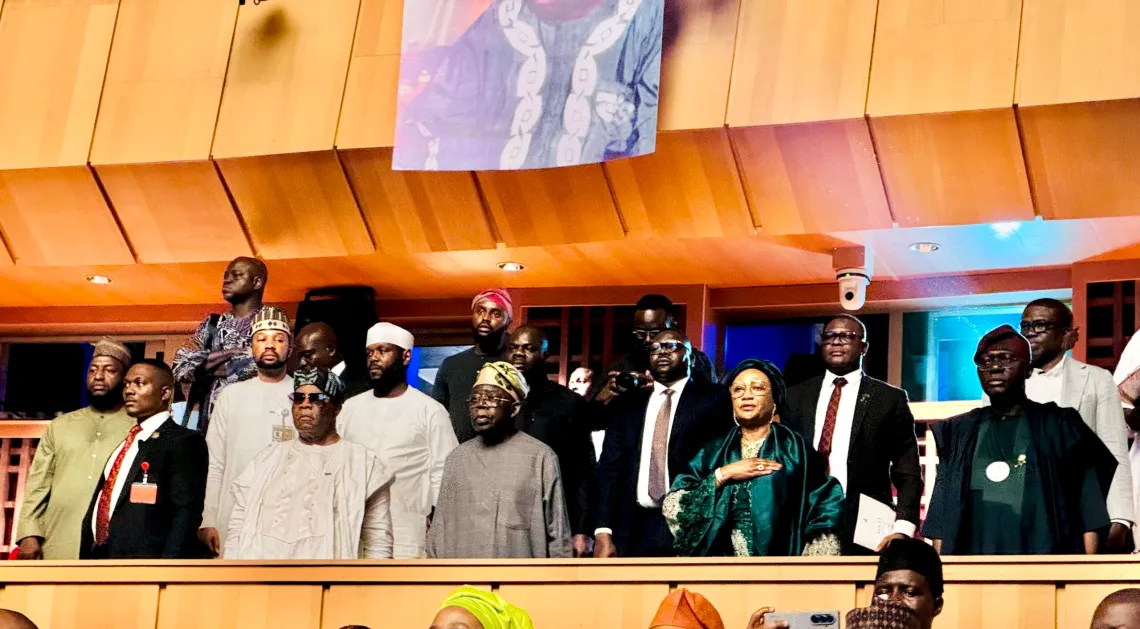
President Bola Ahmed Tinubu, Senate President Godswill Akpabio, Lagos State Governor Babajide Sanwo-Olu and other prominent Nigerians attended the national premiere of MKO, a documentary exploring the life, political career and legacy of the late businessman and politician, Moshood Kashimawo Olawale Abiola.

The premiere was held on Thursday, October 1, at the Wole Soyinka Centre for Culture and Creative Arts in Iganmu, Lagos, as part of activities marking Nigeria’s 66th Independence Anniversary.
President Tinubu served as the Chief Host of the event and attended alongside the First Lady, Oluremi Tinubu.
Other dignitaries at the premiere included Ogun State Governor Dapo Abiodun, Kwara State Governor AbdulRahman AbdulRazaq, Deputy Senate President Jibrin Barau, Deputy Speaker of the House of Representatives Benjamin Kalu, Minister of Art, Culture, Tourism and the Creative Economy Hannatu Musawa, former Ogun State Governor Segun Osoba and Chief of Staff to the President, Femi Gbajabiamila.
The documentary was directed and produced by Nigerian-American filmmaker Ose Oyamendan, who was also present at the premiere.

According to the filmmaker, the documentary examines the events surrounding the June 12, 1993 presidential election, its annulment by the military government and the pro-democracy struggle that followed.
Oyamendan also highlighted Tinubu’s involvement in the pro-democracy movement during the period of military rule. He said the President was among those who supported demands for recognition of the June 12 mandate.
The filmmaker described Tinubu’s decision to serve as Chief Host as significant to the project, noting that the documentary goes beyond the story of Abiola to examine the wider struggle that influenced Nigeria’s democratic development.
DOCUMENTARY EXPLORES ABiola’s POLITICAL LEGACY
MKO chronicles Abiola’s life, political career and legacy, with particular attention to the June 12, 1993 presidential election and the events that followed its annulment.

The documentary also examines Abiola’s detention and the circumstances surrounding his death in custody in 1998.
The film combines archival footage with first-hand accounts from individuals connected to the events of the period.
Those featured include former military leaders Ibrahim Babangida and Abdulsalami Abubakar, former President Olusegun Obasanjo, Nobel laureate Wole Soyinka and Baba Gana Kingibe, Abiola’s running mate in the 1993 presidential election.
Other contributors include former United States Ambassador to Nigeria Walter Carrington, former US Deputy Secretary of State Thomas Pickering, former Canadian High Commissioner Gerald Ohlsen, members of the Abiola family, foreign journalists and Theodore Zadok, who served as Abiola’s security guard during his detention.
President Tinubu also appears in the documentary, reflecting on his involvement in the pro-democracy movement.

FILMMAKER’S PERSONAL CONNECTION TO JUNE 12
Oyamendan also drew on his personal experience of the June 12 crisis while producing the documentary.
The filmmaker worked as a young journalist with Weekend Concord during the period and used archival materials and interviews with key personalities to reconstruct Abiola’s political journey and the events surrounding the annulment of the 1993 election.
He said the extensive archive and testimonies provide an account of one of the most significant periods in Nigeria’s political history.
The 108-minute documentary had its international premiere at the Sheffield International Documentary Festival in the United Kingdom on June 12 before its national premiere in Lagos.

MKO OPENS IN NIGERIAN CINEMAS
Following the national premiere, MKO is scheduled to open in cinemas across Nigeria from Friday, October 2.
Nile Entertainment is handling the film’s theatrical distribution in Nigeria.
The company’s Managing Director, Moses Babatope, said the documentary was significant to him because his father worked at Concord Newspapers, one of the media organisations founded by Abiola.
Babatope said the film would help preserve an important chapter of Nigeria’s political history and make the story accessible to younger Nigerians who did not experience the June 12 crisis.
The choice of October 1 for the national premiere also connected the story of Abiola and the June 12 struggle with Nigeria’s Independence Day celebrations, bringing together different chapters of the country’s political and democratic history.