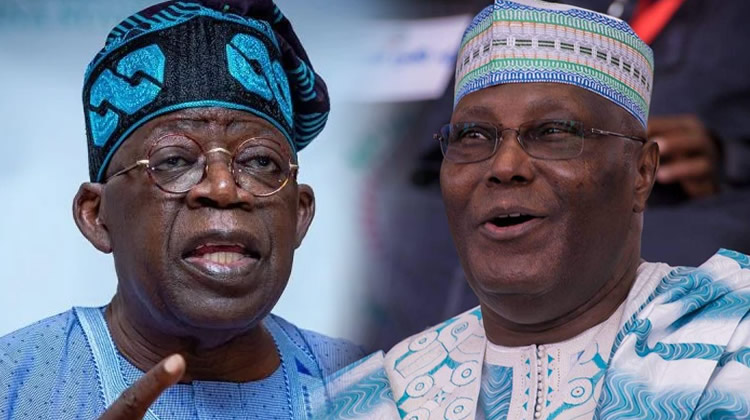
TINUBU AND ATIKU DO NOT AGREE ON PETROL: WHERE KPEROGI’S ARGUMENT FALLS SHORT
By Gloria Fraser, MFR
Affordable mobility is essential, but universal petrol subsidy remains costly, regressive and vulnerable to abuse
Two politicians can recognise that Nigerians are suffering without agreeing on the cure. That distinction is the fault line in Farooq Kperogi’s argument.
President Bola Tinubu’s accelerated compressed natural gas programme and Atiku Abubakar’s proposed production-based petrol subsidy respond to the same affordability crisis, but they are fundamentally different policies. One seeks to replace expensive petrol with a cheaper domestic alternative; the other would use public resources to reduce the cost of petrol produced by domestic refineries.
Kperogi’s column draws justified attention to collapsing purchasing power, prohibitive transport costs and extravagant public expenditure. Nigeria cannot celebrate improving reserves and higher government revenue while millions of households struggle to afford food, transportation, rent and electricity.
However, his conclusion that Atiku forced Tinubu to rediscover cheap petrol—and that both men now effectively agree—is not supported by the policy details or timeline.

TINUBU’S CAMPAIGN PROMISE REQUIRES CONTEXT
Kperogi recalls Tinubu’s January 2023 Abeokuta remarks about bringing down fuel prices and ending the fuel crisis. Those words legitimately expose tension between campaign rhetoric and present prices.
Nigeria was, however, experiencing severe scarcity, hoarding and queues. Tinubu accused political actors of creating an artificial crisis and promised to end it.
More importantly, his published manifesto explicitly promised to phase out petrol subsidy and redirect the resources towards agriculture, welfare, roads, subsidised public transportation, education and healthcare. Reuters
Tinubu’s fundamental shortcoming was therefore not abandoning a consistently pro-subsidy manifesto. It was removing subsidy abruptly before establishing credible protections against the resulting economic shock.
ATIKU’S PLAN REMAINS UNCOSTED
Atiku says he does not intend to restore the former import-based subsidy. His proposal would give qualifying domestic refineries crude oil at preferential prices, subject to verified production, domestic supply and a pricing formula transferring the benefit to consumers.
That is more sophisticated than restoring opaque payments to petrol importers. Nevertheless, it remains a subsidy. Every discounted barrel represents revenue forgone by the Federation.
Atiku has not disclosed the proposed discount, qualifying volume, annual cost, funding source, duration, consumer-price target or enforcement mechanism. Nor has he demonstrated how refinery owners, marketers and politically connected intermediaries would be prevented from capturing the benefit.
Before the proposal can be considered credible, Nigerians require a complete, costed framework—not assurances that the subsidy will “follow the barrel.” Arise News
CNG PREDATES ATIKU’S PROPOSAL
The assertion that Atiku forced Tinubu to discover CNG is contradicted by the timeline.
The Presidential CNG Initiative was approved in August 2023, barely three months after subsidy removal. Implementation has been slower than Nigerians required because a national CNG system needs refuelling stations, gas-distribution networks, imported conversion kits, trained technicians, safety certification and substantial financing.
Tinubu has now directed the addition of 500 refuelling stations, raising the planned network to 1,000. The Government says more than 120,000 vehicles have been converted, while over 100,000 additional kits are being processed. Premium Times
The acceleration may provide an electoral advantage, and citizens should scrutinise its implementation. But a programme initiated in 2023 cannot honestly be described as a policy created in response to Atiku in 2026.
Tinubu and Atiku agree that transportation has become unaffordable. They do not agree on the solution.
THE PURCHASING-POWER WARNING IS WELL FOUNDED
Workers are not better off merely because a nominally full salary is paid if inflation has destroyed what it can purchase.
The average petrol price was approximately ₦144 per litre in 2017. In May 2026, the National Bureau of Statistics placed it at ₦1,596.25 per litre.
At those prices, ₦50,000 bought about 347 litres in 2017, while ₦100,000 bought only about 63 litres in May 2026. The former half salary therefore purchased more than five times as much petrol as the present full salary. Channels Television
However, the assertion that ₦50,000 in 2017 is precisely equivalent to ₦237,000 today requires disclosure of the CPI series, reference month and treatment of Nigeria’s statistical rebasing. The broader conclusion remains valid: wages have generally failed to keep pace with accumulated increases in living costs.
STATE SPENDING REQUIRES ACCOUNTABILITY
The column also draws attention to reports that 33 states spent ₦512.10 billion on Government Houses, governors’ offices, executive administration, travel and transportation during the first half of 2026.
This was not ₦512 billion spent personally by governors. The categories cover wider executive operations and transportation expenditure. The total was also approximately 8.19 per cent lower than the comparable first-half 2025 figure. Punch
Those qualifications do not excuse waste. Governors cannot celebrate increased allocations from subsidy removal while failing to publish transparent accounts showing how additional revenue benefits citizens.
INTERNATIONAL COMPARISONS MUST COMPARE LIKE WITH LIKE
Governments in Europe, Canada and Latin America support transportation, but they commonly subsidise buses, trains and concessions for students, pensioners and low-income passengers—not petrol for every private vehicle.
European governments frequently impose high petrol taxes while financing alternatives to private-car use. This protects mobility without indiscriminately subsidising fuel consumption.
The Iowa example is incomplete. Governor Terry Branstad initially resisted a petrol-tax increase but signed a 10-cent-per-gallon increase in 2015 to finance roads and bridges. Governing
Likewise, the frequently cited $15 “true cost” of American gasoline was a 2011 estimate incorporating pollution, public health and other social costs. It was not proof that the US Government paid motorists the difference between $15 and the pump price.
Public-transport subsidies, environmental externalities, tax concessions and universal petrol subsidies are not interchangeable concepts.
WHY THE OLD SUBSIDY FAILED
In 2022, NNPCL recorded ₦4.39 trillion in petrol-subsidy expenditure and made no remittance to the Federation Account. Reuters
The subsidy was also regressive. The poorest 40 per cent of Nigerians consumed less than three per cent of the petrol supply, while wealthier households owning more vehicles received the greatest direct benefit.
The system encouraged smuggling, inflated consumption claims and opaque under-recovery calculations. Restoring broad price support would again subsidise wealthy motorists and cross-border smugglers while delivering the smallest direct benefit to the poorest.
NATIONAL PATRIOTS’ POSITION
National Patriots rejects the false choice between defending every aspect of Tinubu’s implementation and restoring the failed subsidy regime.
Subsidy removal was economically necessary but poorly sequenced. Transportation support, food-security measures, credible social protection and transparent savings accounts should have preceded or accompanied the reform.
Nigeria now needs rapid deployment of CNG and electric buses, subsidised commercial-vehicle conversions tied to enforceable fare reductions, and transport concessions for students, workers, pensioners and vulnerable citizens.
Any refinery-production support must be capped, budgeted, time-bound and independently audited. Government must also publish a monthly Subsidy Reform Fiscal Statement showing additional revenue, debt costs, transfers to every tier of government and the projects financed.
Kperogi has correctly returned public attention to affordability. Where his argument falls short is in treating CNG expansion as evidence of agreement with Atiku and implying that affordable mobility requires another universal petrol subsidy.
Nigeria needs compassion disciplined by evidence—not cruelty disguised as reform, and not populism disguised as economic rescue.
Princess Gloria Adebajo-Fraser MFR.
President, The National Patriots.
Former Special Adviser to President Goodluck Jonathan.
Vice-Chairman, Strategic Communications Committee, Buhari PCC 2019.