

The United Kingdom has announced plans to impose sanctions on illegal Israeli settlements in the occupied West Bank, accusing the Israeli government of failing to prevent what it described as the forced displacement of Palestinians by settlers.

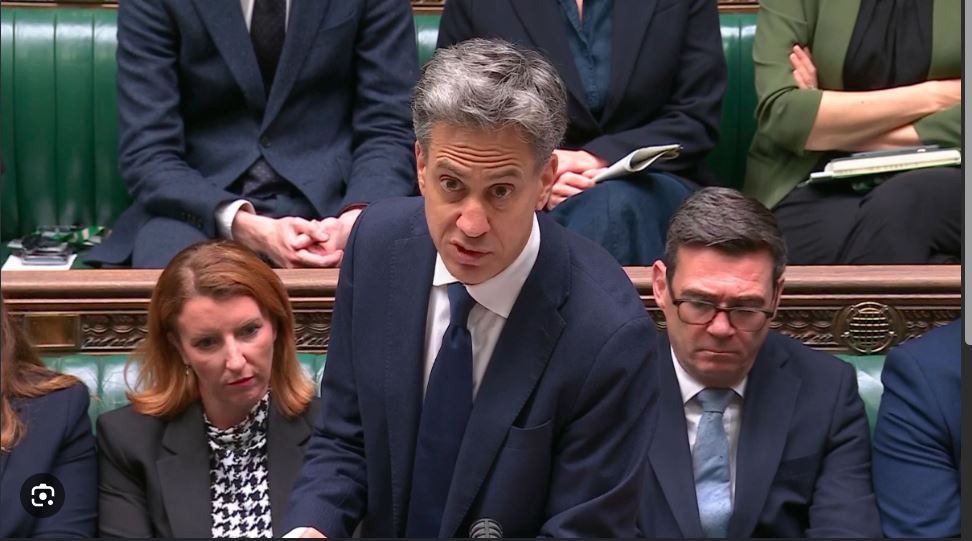
Foreign Secretary Ed Miliband said the measures represented a new direction in Britain’s approach to the Israeli-Palestinian conflict, arguing that the UK must respond to what it considers serious violations rather than simply condemn them.
The planned sanctions will target goods produced in Israeli settlements, as well as companies and individuals involved in providing services that support settlement expansion. Britain will also prohibit advertising for illegal West Bank settlements within the UK.

Miliband said the measures were directed at settlements and their expansion rather than Israel itself, adding that Britain would establish a comprehensive sanctions framework over the next six to nine months.
The announcement was made jointly with France and Canada, which said the measures were intended to strengthen efforts to preserve the possibility of a two-state solution.
Israel strongly rejected Britain’s position. Foreign Minister Gideon Saar accused Miliband of making what he described as a serious false accusation against Israel and announced retaliatory measures, including the closure of Britain’s consulate in East Jerusalem.
Saar also said 11 British lawmakers would be barred from entering Israel, including former Labour leader Jeremy Corbyn, Diane Abbott and five serving Green Party MPs. He accused them of anti-Israel and antisemitic activities.

Israel further announced plans to remove British representatives working from the International Gaza Support Center in southern Israel and end British activities supporting the training of Palestinian Authority security forces in the West Bank.
The diplomatic dispute comes after Israel opened tenders for about 1,200 new settlement homes in the E1 area east of Jerusalem. The proposed development has attracted international criticism because of concerns that construction there could divide Palestinian territory and make the creation of a viable Palestinian state more difficult.
Miliband said the planned E1 development could seriously undermine the prospects of a two-state settlement.
He also addressed the war in Gaza, acknowledging Israel’s right to protect its citizens following the Hamas-led October 7, 2023 attack but arguing that this right does not permit violations of international humanitarian law.
He said there was growing evidence from international investigations that possible war crimes had been committed and that the relevant legal processes should determine responsibility. He added that international courts should decide whether Israel’s actions in Gaza amount to genocide.
Israel has repeatedly rejected accusations of genocide, war crimes and crimes against humanity, maintaining that its military operations comply with international law.
The British government’s decision has also generated criticism within the UK. Chief Rabbi Sir Ephraim Mirvis described the announcement as a deeply troubling development for British Jews, while the Board of Deputies of British Jews expressed regret over the sanctions.
The Conservative opposition also criticised the government’s approach, although it agreed that Israeli settlements in the occupied West Bank are illegal.

Israel’s President Isaac Herzog said the British measures would have negative consequences and urged foreign governments to pursue dialogue rather than sanctions.
The United States has also indicated that it does not intend to follow Britain’s approach. US Secretary of State Marco Rubio said Washington would not take the same action, while the US ambassador to Israel, Mike Huckabee, warned that Washington could respond to the sanctions.
The Palestinian leadership, however, welcomed Britain’s decision, describing it as an important step against Israel’s settlement policies and what it called violations against Palestinians.
Britain also announced separate sanctions targeting the financing arm of Hezbollah in Lebanon, along with additional measures against Iran.
The UK has maintained that its approach is aimed at supporting a two-state solution, while Israel opposes establishing a Palestinian state without a negotiated settlement.
Israel has established around 160 settlements in the West Bank and East Jerusalem since capturing the territories in the 1967 Middle East war. The settlements are home to roughly 700,000 Israelis, alongside an estimated 3.3 million Palestinians living in the West Bank.




