

President Bola Ahmed Tinubu has explained that his decision to sign the South East Development Commission (SEDC) Bill into law was motivated by his belief that the economic progress of the South-East is essential to Nigeria’s overall prosperity.
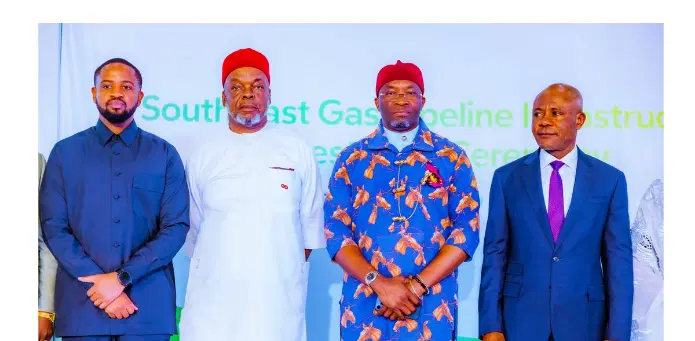
The President made this known on Tuesday during the South-East Gas Pipeline Infrastructure Investment Ceremony in Enugu. He was represented at the event by the Deputy Speaker of the House of Representatives, Benjamin Kalu.

Tinubu recalled that he assented to the SEDC legislation in July 2024, describing the commission as an important institution for coordinating reconstruction, rehabilitation and long-term development across the South-East.
According to him, Nigeria cannot achieve its full economic potential if any region is unable to develop its industries and maximise its productive capacity.
He cited the commercial and industrial activities in Aba, Nnewi and Onitsha as examples of how economic growth in the South-East could benefit the wider Nigerian economy.

The President explained that the commission was established to deliver practical results rather than simply create another layer of bureaucracy. He said its performance should be measured by the investments it attracts, the infrastructure it supports, the jobs it generates and the improvements it brings to people’s lives.
Tinubu also commended the SEDC leadership for its work and identified the South-East Vision 2050 initiative, supported by the Federal Government and state governors, as an important framework for coordinated regional development.
TINUBU APPROVES SOUTH-EAST INVESTMENT COMPANY
The President disclosed that he had approved the establishment of the South-East Investment Company as part of his administration’s strategy to attract private investment and accelerate economic growth.
He said government resources should be deployed strategically to support viable projects capable of attracting additional funding from private investors.

Tinubu explained that development institutions should identify promising economic opportunities, prepare credible projects and use public funds responsibly to mobilise investment on a larger scale.
He maintained that this approach would help the region pursue major development projects without relying solely on government budgets.
PRESIDENT REAFFIRMS COMMITMENT TO INFRASTRUCTURE
Tinubu reiterated his administration’s commitment to improving transport infrastructure across the South-East, highlighting the Enugu–Onitsha and Enugu–Port Harcourt road corridors, supporting infrastructure around the Second Niger Bridge and the Eastern railway corridor.
He said efficient transport networks would reduce the cost of doing business, improve the movement of goods and services, expand access to markets and create more opportunities for businesses.
The President added that ongoing electricity-sector reforms were creating opportunities for state governments and private investors to improve power supply across the region.
He stressed that infrastructure projects must deliver measurable economic benefits rather than remain limited to contract awards and official announcements.
SOUTH-EAST GAS PIPELINE PROJECT TO SUPPORT INDUSTRIAL GROWTH
Addressing the proposed South-East Gas Distribution Pipeline Project, Tinubu described natural gas as a key resource for strengthening the region’s industrial competitiveness.
He explained that the project aims to establish a regional gas distribution network serving industrial and commercial customers in Abia, Anambra, Ebonyi, Enugu and Imo states.
The President noted that Nigeria’s gas resources would create greater value when used to power factories, support manufacturing and generate employment.

He said improved gas access could strengthen manufacturing activities in Aba, support industrial clusters in Nnewi and Onitsha, encourage new investments in Enugu and expand agro-processing and manufacturing opportunities in Ebonyi.
According to him, the region’s five states should not approach economic development as separate efforts but should recognise their shared economic interests.
Tinubu argued that gas infrastructure should connect industries and markets across state boundaries to promote regional integration and improve productivity.
TINUBU URGES SOUTH-EAST GOVERNORS TO COOPERATE
The President called on governors in the South-East to sustain their cooperation and work with the Federal Government, investors and private-sector organisations to translate development plans into tangible results.
He maintained that no individual state could fully realise the benefits of regional infrastructure without collaboration with neighbouring states.

Tinubu also invited investors to explore the South-East’s industrial potential, urging them to commit their capital, expertise and long-term support to the region.
He acknowledged the resilience of manufacturers and entrepreneurs, adding that government had a responsibility to create an environment where business success would depend more on productivity than on overcoming inadequate infrastructure.
Addressing young people in the region, the President said the initiatives were intended to create a future in which their skills would be valued, businesses could expand and limited economic opportunities would no longer restrict their ambitions.

He charged the SEDC and its partners to develop clear implementation plans, establish measurable milestones and demonstrate tangible progress.
Tinubu said the success of the gas pipeline initiative and other development projects should ultimately be judged by the factories they power, the investments they attract and the employment opportunities they create.
He reaffirmed the Federal Government’s commitment to supporting infrastructure and economic development that would enable the South-East to maximise its contribution to Nigeria’s prosperity.