The Federal High Court in Abuja has granted an application allowing a prosecution witness to testify under protective conditions in the ongoing trial of an army general and five others accused of plotting a failed coup against President Bola Tinubu last year.

Headlinenews.news reports that the ruling was made on Wednesday by Justice Joyce Abdulmalik after the prosecution argued that the measure was necessary on security grounds as the trial commenced.
The case involves Mohammed Ibrahim Gana, a retired major-general; Erasmus Ochegobia Victor, a retired navy captain; Ahmed Ibrahim, a police inspector; Zekeri Umoru, an electrician at the Presidential Villa; Bukar Kashim Goni; and Abdulkadir Sani, a Zaria-based Islamic cleric.
The defendants were arraigned on April 22 and all pleaded not guilty when the charges were read in open court.
During the trial on Wednesday, the prosecution counsel Rotimi Oyedepo (SAN) informed the court that four witnesses were present and ready to testify.
Three witnesses drawn from Jaiz Bank, SunTrust Bank and Providus Bank were subsequently called. They testified and tendered letters obtained from the Economic and Financial Crimes Commission (EFCC) as evidence. The documents were admitted by the court, and the witnesses were cross-examined by defence counsel.

However, when the fourth witness was called, Oyedepo applied for protective measures, urging the court to shield the witness’s identity to prevent “unnecessary attack” and ensure the witness’s safety.
He relied on Section 232 of the Administration of Criminal Justice Act (ACJA), arguing that the law permits such protective measures in cases involving security and terrorism-related allegations.
The defence lawyers did not oppose witness protection in principle, but insisted that the defence must still know the identity of the witness to ensure fair hearing.
They argued that while shielding the witness from the public may be justified, full anonymity from the defence would undermine the right to fair trial and prevent proper testing of credibility.
They further submitted that Section 232 of the ACJA allows protective measures but does not eliminate the requirement for basic identification within proceedings.

They urged the court to balance securiyty concerns with fair hearing rights, suggesting that only sensitive aspects of the proceedings be restricted from public access if necessary.
In response, Oyedepo maintained that full protection was necessary, stating that the witness is a serving officer who could face security risks if exposed.
He added that the law permits the use of initials or other non-identifying methods to protect witnesses.
Ruling on the application, Justice Abdulmalik held that the request was justified, particularly as one of the counts involves terrorism.
“The law permits protective measures, including non-disclosure of names, addresses and contact details where the court is satisfied that security concerns exist,” She was quoted by PREMIUM TIMES saying.
The judge relied on Section 232 of the ACJA and cited judicial precedents supporting witness protection in appropriate circumstances.
She subsequently granted the application and ordered that the witness’s identity be shielded, directing that the name must not appear in court records or proceedings accessible to parties or the public.
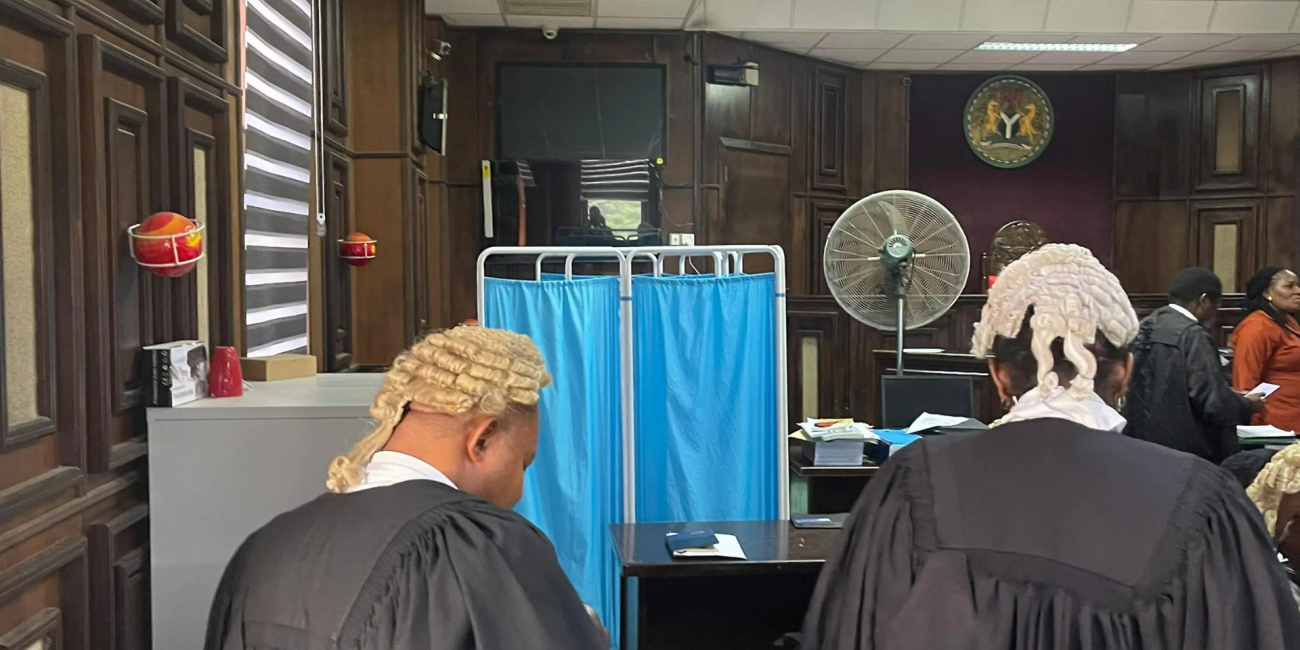
The matter, which began at about 11 a.m., was paused around 2 p.m. to allow for the installation of protective screening before the witness proceeded to testify.
SaharaReporters had earlier reported Justice Abdulmalik of the Federal High Court, Abuja, on Monday ordered an accelerated hearing in the case.
The judge fixed April 29, April 30, May 4 and May 5 for the commencement of trial as well as the hearing of bail applications filed by the defendants.

In a related matter, SaharaReporters had earlier reported that armed security operatives barred journalists from accessing the venue of a high-profile court-martial involving 36 military personnel, also accused of plotting to overthrow President Tinubu’s administration.
The court-martial, convened by the Defence Headquarters, was held under tight security at the Scorpion Mess in Asokoro, Abuja, with proceedings conducted behind closed doors.
Journalists were denied entry without explanation, while security officials also banned the use of mobile phones and recording devices within the vicinity, raising concerns over transparency in the military justice system.
The Defence Headquarters had constituted a General Court Martial to try the personnel drawn from different arms of the Nigerian Armed Forces, in what observers describe as one of the largest military trials in recent years.