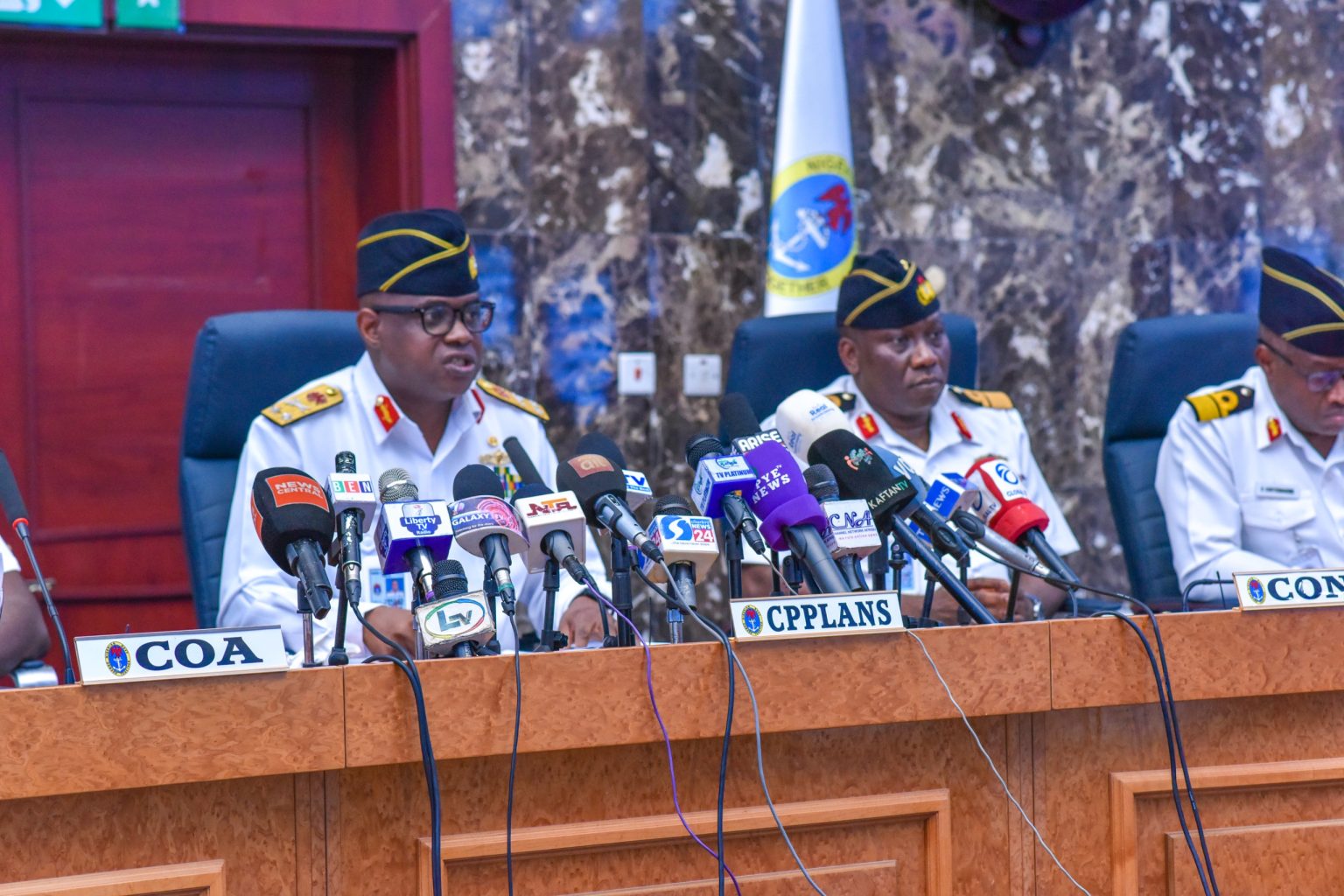
The Nigerian Navy has identified technology and research development as some of the major challenges it has faced over the past 70 years.
The Chief of Policy and Plans at the Naval Headquarters, Rear Admiral Akinola Olatunde, disclosed this on Thursday during an international press briefing held in Abuja to mark the Navy’s 70th anniversary celebration.
Speaking with journalists, Olatunde explained that the Nigerian Navy has evolved significantly over the decades, moving beyond basic policing duties to include diplomatic and military responsibilities.
According to him, the Navy has grown from a modest coastal security outfit into a strong force for national defence, regional stability and maritime security through resilience and strategic adaptation.
The Nigerian Navy was established on June 1, 1956, as the Naval Defence Force with about 250 officers and men, alongside 11 ships inherited from the Colonial Marine Department of the Royal Navy.

In 1958, it became known as the Royal Nigerian Navy before the “Royal” title was dropped in 1963 after Nigeria became a republic. The Navy was later formally established as a branch of the Armed Forces through Act No. 21 of 1964.
Olatunde noted that the first Nigerian to head the Navy was Commodore J.E.A Wey in 1964.
He said modern security threats now require the Navy to improve its technological capabilities, especially in areas such as cyber security, surveillance and intelligence gathering.
He pointed out that criminal activities have become more sophisticated, including the movement of illegal drugs through neighbouring countries into Nigeria’s waters.

The rear admiral also spoke about evolving military technologies such as drones and autonomous systems, stressing that the Navy constantly evaluates emerging threats before making decisions on acquiring new equipment.
According to him, underwater threats are not currently considered a top priority for Nigeria, but the Navy continues to monitor developments globally as part of its long-term strategic assessment leading up to 2030.
“We would have loved to be further ahead in terms of technology and research development,” he said.
Olatunde recalled that one of the major lessons from the Nigerian Civil War was the importance of self-reliance in military production.
He explained that there was a period when Nigeria struggled to procure military equipment due to restrictions from foreign countries, forcing the military to depend on alternative sources.
He added that the Armed Forces are now working towards becoming more self-sufficient, not only in shipbuilding but also in weapons systems and other advanced military technologies.