
By Princess G. Fraser. MFR. Defence Consultant.
Modern warfare has changed. Terrorists hiding in forests, deserts and remote villages are no longer defeated only by thousands of exhausted soldiers trekking through dangerous terrain. Across the world, technology, artificial intelligence, drones, satellites and digital command systems are rapidly replacing traditional battlefield methods.
In Burkina Faso, military leader Captain Ibrahim Traoré has embraced a more aggressive technology-driven strategy against insurgency and terrorism, shifting emphasis toward drones, aerial surveillance, rapid-response systems and centralized monitoring infrastructure. The message is simple: fight terrorists from the sky before they strike on the ground.
For decades, African nations have suffered devastating losses from insurgency, banditry and cross-border terrorism. Nigeria alone has spent billions of dollars combating Boko Haram, ISWAP, bandits and kidnappers. Thousands of soldiers and civilians have died, millions displaced, farms abandoned and communities destroyed.
Yet despite huge military expenditures, insecurity remains one of the greatest threats to economic growth and national stability.
The uncomfortable truth is that terrorism has evolved faster than many African security systems.
Today’s insurgents use satellite phones, encrypted communications, motorcycles, drones, GPS systems and sophisticated smuggling routes stretching across the Sahel. Some groups operate across borders with alarming speed, exploiting weak surveillance systems and difficult terrain.
This is why the next phase of Africa’s security architecture cannot rely only on conventional troop deployment.
Technology must become the centrepiece of modern counterterrorism.
Reports and military analyses indicate that Burkina Faso has expanded its use of Turkish, Chinese and Russian-linked drone capabilities while strengthening centralized command systems for intelligence gathering, border monitoring and rapid aerial strikes. Like several countries confronting insurgencies, the country increasingly relies on unmanned aerial systems to track movements in remote regions where conventional patrols are dangerous and costly.
While some public claims circulating online about exact numbers of command centres, “red dot” targeting systems or near-total replacement of soldiers cannot presently be independently verified, the broader direction is undeniable: digital warfare is redefining security operations globally.
From Ukraine to Israel, from the United States to China, modern militaries are investing heavily in autonomous systems, satellite intelligence, precision air power and integrated command-and-control infrastructure.
The United States military alone plans to spend tens of billions of dollars annually on unmanned systems, AI-enabled warfare and next-generation surveillance technologies. China has become one of the world’s largest producers of affordable military drones, while Türkiye’s Bayraktar TB2 drones changed the battlefield equation in conflicts from Libya to Nagorno-Karabakh.
The lesson for Africa is obvious.
Technology multiplies military power.
One drone can monitor what would normally require hundreds of soldiers. One command centre can coordinate operations across multiple regions simultaneously. Real-time aerial surveillance can detect terrorist convoys before they attack villages. Thermal imaging can identify movement at night. Precision strikes can reduce the exposure of troops to ambushes and landmines.
Nigeria, with over 220 million people and one of Africa’s largest economies, cannot afford to remain trapped in outdated security models while insurgents modernize.
The country faces multiple security pressures simultaneously — terrorism in the Northeast, banditry in the Northwest, pipeline vandalism in the Niger Delta, separatist tensions in the Southeast, piracy in the Gulf of Guinea and kidnapping networks spreading nationwide.
This requires more than bravery from soldiers.
It requires technological dominance.
Nigeria possesses the financial capacity, engineering talent, military manpower and strategic relevance to establish a nationwide digital counterterrorism architecture if the political will exists.

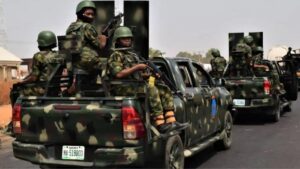
A serious modern security framework should include:
• Nationwide command-and-control centres connected digitally across all geopolitical zones.
• High-altitude surveillance drones for border monitoring.
• Armed tactical drones for precision operations.
• Satellite-assisted intelligence systems.
• AI-assisted threat identification.
• Thermal and facial recognition systems in high-risk areas.
• Real-time battlefield communications networks.
• Integrated military-police intelligence databases.
• Indigenous drone assembly and long-term domestic production capabilities.
Nigeria already spends enormous sums yearly on security operations, military logistics and emergency responses. Redirecting part of those resources toward technological superiority could fundamentally change the security equation.
The economic benefits would also be enormous.
Safer highways would boost trade. Farmers could return to abandoned lands. Foreign investment confidence would improve. Insurance costs would decline. Tourism and aviation would expand. Rural economic activity would revive. National productivity would rise.
No serious economy grows under widespread insecurity.
Countries that master security infrastructure attract investment faster than those trapped in instability.
Critics may argue that advanced drone warfare raises ethical and civilian protection concerns. Those concerns are legitimate and must be addressed through proper legal oversight, intelligence verification and operational accountability. Technology without discipline can become dangerous. However, refusing to modernize because of fear is not a strategy.
The real danger is allowing terrorists to dominate ungoverned spaces while governments react slowly with overstretched manpower.
Africa must stop depending entirely on foreign military rescue frameworks before taking decisive action to defend its territories.
National sovereignty demands national capability.
Nigeria does not need to wait endlessly for external approval before protecting its citizens. Strategic partnerships may help, but dependence cannot become doctrine. The future belongs to nations capable of securing themselves independently through innovation, intelligence and rapid response capacity.
The battlefield of the future will not be won merely by the country with the largest number of soldiers.
It will be won by the country with the best intelligence, fastest response systems, strongest digital infrastructure and most effective air superiority.
This is no longer science fiction.
It is already happening.
And Africa must not be left behind.
Princess Gloria Adebajo-Fraser MFR
President the National Patriots.