

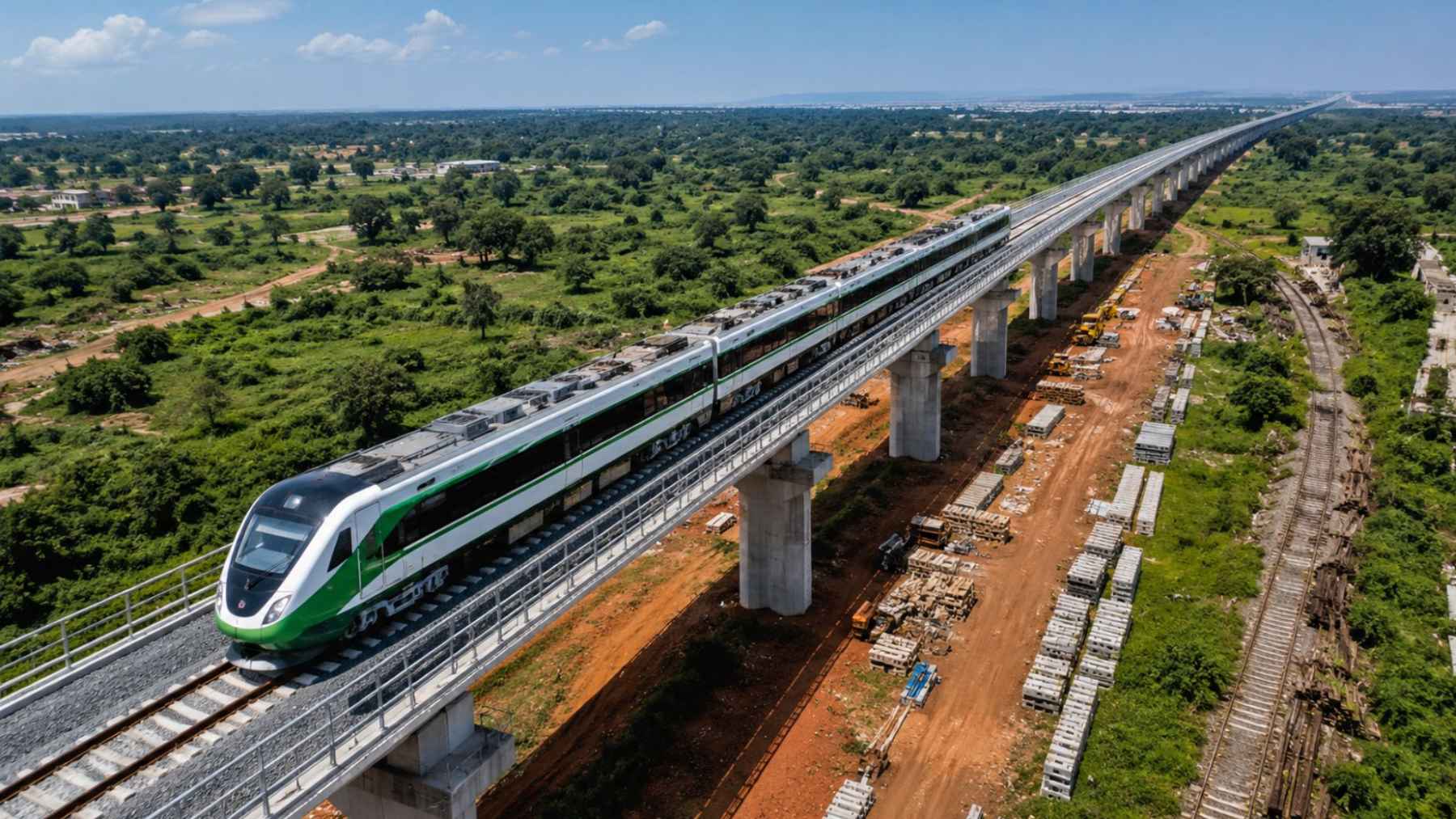
Nigeria is undergoing a major rail transformation with support from China, as the country works to replace its ageing colonial-era railway system with a modern standard-gauge network designed to improve freight and passenger movement across key economic corridors.

At the centre of the project is the Lagos–Kano rail line, an over 800-mile route intended to connect the country’s busiest seaport in Lagos with major inland commercial centres, strengthening trade links between the coast and northern Nigeria.
The existing rail infrastructure, largely built during the colonial era, was designed mainly for transporting raw materials to ports rather than supporting a modern industrial economy. As a result, Nigeria has relied heavily on road transport, which currently accounts for over 90 percent of cargo and passenger movement, contributing to congestion and logistics inefficiencies.

The rail modernisation programme is being driven through a partnership with China, involving financing from Chinese policy banks and construction by China Civil Engineering Construction Corporation (CCECC). The Lagos–Ibadan segment, one of the key completed phases, was funded through a $1.267 billion loan from China Exim Bank, alongside Nigerian government contributions.
The Lagos–Ibadan rail line, which was inaugurated for commercial operations in 2021, is part of a broader plan to integrate the Apapa Port complex with inland logistics hubs, allowing goods to be transported directly from the port to other regions by rail.
A major feature of the project is the shift from the old Cape gauge system to standard gauge rail technology, which allows for faster trains, heavier cargo capacity, and improved efficiency across long distances.

Other key sections include the Abuja–Kaduna line and the planned Kano–Kaduna extension, which received additional financing of about $254.76 million from China Development Bank in 2025. Once completed, the network is expected to provide continuous rail connectivity between Lagos, Abuja, and Kano.
Despite the infrastructure benefits, concerns have been raised about Nigeria’s long-term repayment obligations tied to these loans. Many of the agreements include multi-decade maturities, grace periods, and revenue-linked repayment structures that place pressure on the railway system to generate sufficient income.
Analysts note that while the rail projects could significantly reduce transport costs, ease congestion at ports, and improve national logistics, their success will depend on efficient operations, strong passenger and cargo usage, and sustainable financial management.
Ultimately, the rail expansion represents both an opportunity to modernise Nigeria’s transport system and a financial commitment that will require careful oversight to ensure long-term benefits outweigh debt risks.




