

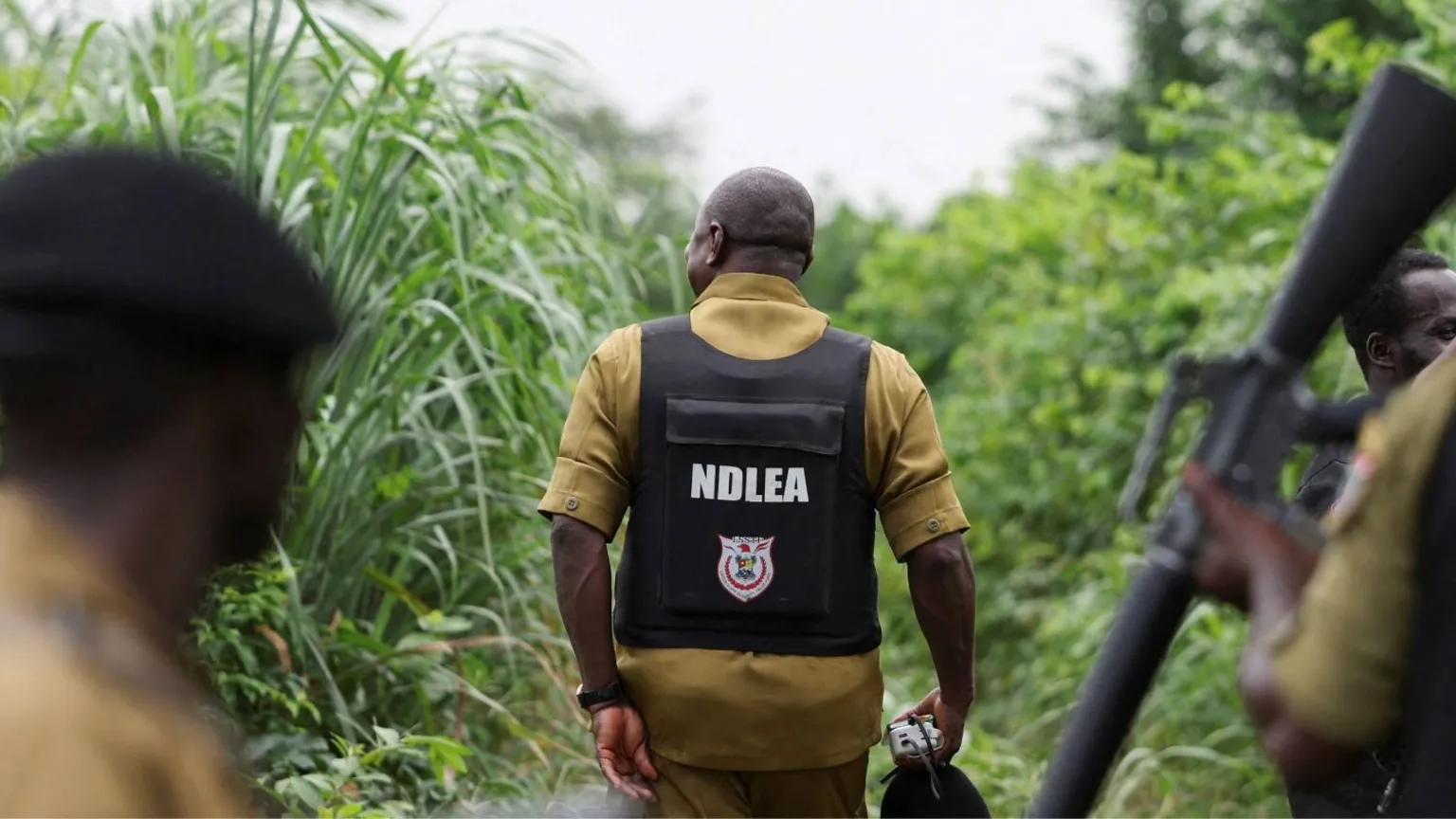
Nigeria’s anti-drug authorities are intensifying efforts to combat the growing production of synthetic drugs after a Federal High Court held an unusual court session inside an alleged methamphetamine laboratory hidden in a forest, highlighting the scale of illegal drug manufacturing in the country.
The hearing took place at the suspected drug production site, where three Mexican nationals and seven Nigerians appeared before Justice Musa Kakaki over allegations that they operated one of the country’s largest methamphetamine laboratories.

During the inspection, the court examined chemicals, industrial equipment, and substances allegedly used in producing methamphetamine, commonly known as meth or crystal meth. Investigators also pointed to large quantities of liquid and unprocessed forms of the drug found at the facility.
The makeshift laboratory contained gas cylinders, chemical containers, and other materials believed to have been used in the manufacturing process.

The National Drug Law Enforcement Agency (NDLEA) said relocating the court proceedings to the site allowed the judge to directly assess the scale of the operation. Following the arrests in May, the agency described the discovery as Nigeria’s largest methamphetamine seizure, with more than two tonnes of the drug recovered and valued at approximately $360 million.
Authorities said the operation dealt a significant blow to what they described as a sophisticated drug manufacturing network involving Nigerian and Mexican suspects.
A month after the initial raid, NDLEA operatives uncovered another suspected methamphetamine laboratory concealed in a forest in Oyo State, where five additional suspects, including another Mexican national believed to be a meth production specialist, were arrested.

The discoveries reflect a growing trend in which West Africa is increasingly becoming a production base for synthetic drugs rather than serving only as a transit route for international trafficking.
Security officials say Mexican drug manufacturing experts are now working alongside local collaborators in several African countries, including Nigeria, Kenya, Mozambique, and South Africa, to establish clandestine drug laboratories.
James Griego, who oversees counter-narcotics operations for the United States Africa Command (AFRICOM), said methamphetamine production has become increasingly advanced over the years, with Mexican criminal groups widely recognized for producing highly potent versions of the drug.
According to him, intelligence shared by AFRICOM has helped African law enforcement agencies identify and dismantle several illegal laboratories across the continent.
Reports indicate that intelligence agencies have linked some of the laboratories to Mexico’s Sinaloa Cartel and the Jalisco New Generation Cartel, two of the country’s most powerful drug trafficking organizations.

Officials have also raised concerns over growing cooperation between drug trafficking networks and armed groups operating in parts of Africa, warning that proceeds from the illegal drug trade may be strengthening criminal and extremist organizations.
Experts explained that unlike cocaine or heroin, synthetic drugs such as methamphetamine can be manufactured almost anywhere provided the required chemicals, equipment, and technical expertise are available.
Authorities warn that methamphetamine poses serious health risks, including cardiovascular complications, severe addiction, mental health disorders, malnutrition, and difficult withdrawal symptoms.
The NDLEA said West Africa remains attractive to international drug syndicates because of its vast forested areas, strategic shipping routes, porous borders, and growing youth population, which can provide both labour and potential markets.
The agency also expressed concern that domestic drug consumption could increase if production continues to expand.
To counter the threat, Nigerian authorities say they are strengthening intelligence gathering, surveillance, and enforcement operations while working with international partners to dismantle drug production networks before they can distribute narcotics within Nigeria or abroad.
The NDLEA maintained that its recent operations demonstrate Nigeria’s commitment to preventing the country from becoming a safe haven for international drug cartels.




