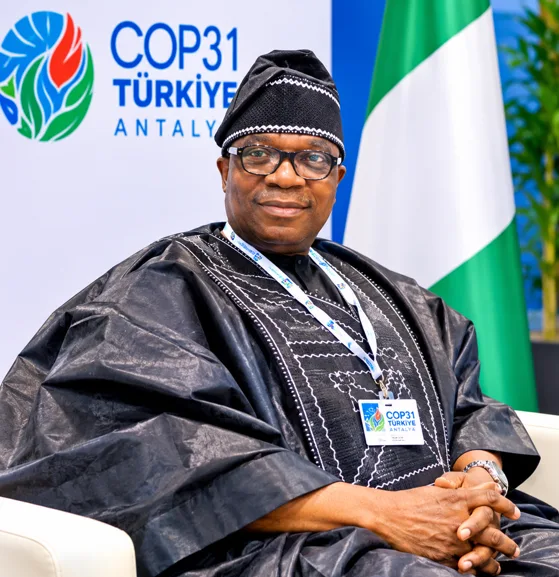
The Federal Government has reaffirmed Nigeria’s commitment to achieving net-zero emissions, stressing that the country’s shift towards cleaner energy must align with its economic development priorities and national interests.
The Minister of State for Foreign Affairs, Ambassador Sola Enikanolaiye, said Nigeria would not abandon its petroleum resources without securing viable alternatives capable of protecting government revenue, industrialisation, energy security and economic growth.

He made the position known during an interview on the sidelines of the 31st United Nations Climate Change Conference (COP31) in Antalya, Türkiye, following the announcement of a new energy transition partnership between Nigeria and the United Kingdom.
Enikanolaiye explained that although Nigeria was making progress towards cleaner energy, the country still needed revenue from fossil fuels to finance the transition to alternative energy sources.
He maintained that Nigeria was advocating a fair and sustainable transition that would not undermine its development objectives, particularly those outlined in its Nationally Determined Contribution 3.0.
The minister stressed that Nigeria must have a voice in international discussions concerning its energy future, warning that developed countries should not impose transition policies without considering the economic circumstances of developing nations.
He noted that the agreement with the United Kingdom would create opportunities for cooperation involving both governments, private investors, civil society organisations and host communities.

According to him, Nigeria is also pursuing economic diversification to reduce its dependence on petroleum revenue, with agriculture, technology, digital trade, financial technology and other service sectors identified as important areas of growth.
He said the administration of President Bola Tinubu was implementing broader economic reforms aimed at creating additional revenue sources and strengthening the country’s economy beyond oil and gas.
Addressing the challenges associated with balancing climate commitments and domestic energy needs, Enikanolaiye highlighted the importance of international diplomacy in protecting Nigeria’s interests.

He cited global conflicts, including the Russia-Ukraine war and tensions involving Iran and the United States, as examples of developments that could affect international energy supplies and petroleum prices.
The minister also acknowledged the contribution of the Dangote Petroleum Refinery to improving petroleum supply and supporting energy availability across Nigeria and other African markets.
He maintained that Nigeria remained committed to achieving zero emissions but insisted that the process must be gradual and take into account the different development levels of participating countries.
Enikanolaiye further challenged international partners to support developing countries through climate financing, infrastructure development and technology transfer rather than simply demanding an immediate departure from fossil fuels.
He also pointed to the Federal Government’s compressed natural gas (CNG) bus programme as part of efforts to expand cleaner transportation alternatives and reduce energy costs.
Under the UK-Nigeria Energy Security and Transition Partnership, both countries are expected to strengthen cooperation in reducing methane emissions across the oil and gas, agriculture and waste sectors.
The collaboration will also focus on improving methane monitoring and reporting, detecting and repairing leaks, and reducing gas flaring and venting.