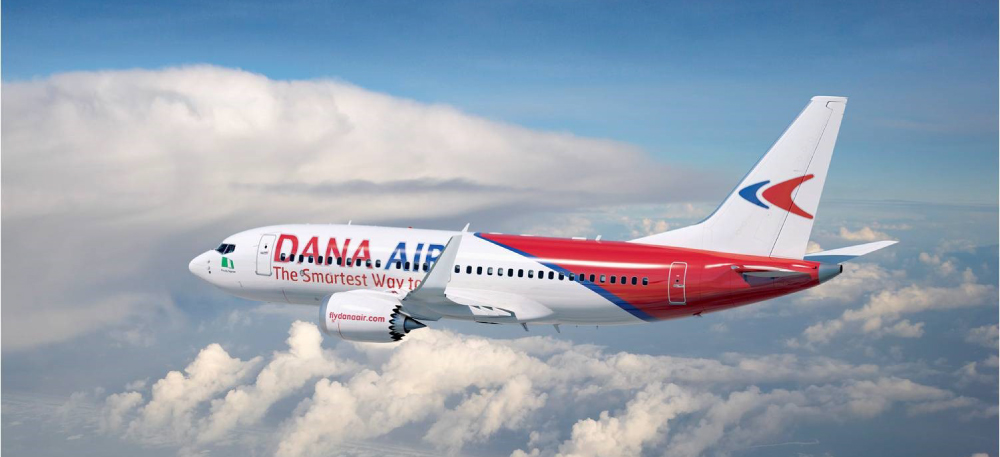
A Federal High Court has ruled that Dana Air breached its contractual obligation to a passenger after repeatedly delaying his Abuja-Lagos flight in 2018, holding that the airline failed to provide sufficient evidence to justify the disruption.
The case was filed by Mr Idowu, who booked Dana Air Flight 9J-356 from Abuja to Lagos, scheduled to depart at 12:33 p.m. on July 5, 2018. The flight was initially rescheduled to 2:04 p.m. before being postponed several more times.
Idowu told the court that about 70 passengers were affected by the delay. He said that despite repeatedly approaching the airline’s sales and boarding desks for explanations, officials only asked passengers to remain patient without giving a clear reason for the postponements.
Although he eventually arrived in Lagos at about 11:10 p.m., Idowu said neither Dana Air nor its officials provided passengers with an adequate explanation for the prolonged delay.
He subsequently sought compensation from the airline. When his efforts failed, he petitioned the then Consumer Protection Council, now known as the Federal Competition and Consumer Protection Commission.

The dispute remained unresolved, prompting him to institute the suit in November 2019.
Idowu asked the court to declare that Dana Air had breached its contract of carriage and sought compensation under Section 48(2) of the Civil Aviation Act 2006, which incorporates the Montreal Convention into Nigerian law.
He also sought damages for psychological trauma, solicitor’s fees and litigation costs.
During the proceedings, Idowu said he only learnt months later, following correspondence between his lawyer and Dana Air, that the airline attributed the delay to regulatory safety checks.
Dana Air denied liability and filed a counterclaim.
The airline’s Legal Officer, Chigozie Igbonugo, told the court that the delay resulted from safety advice issued by the Nigerian Civil Aviation Authority. He maintained that passengers were informed through email notifications and airport announcements.
He also argued that the airline’s conditions of carriage did not guarantee specific departure times.
Court’s Findings
In his judgment, Justice Bogoro held that there was no dispute that the flight had been delayed.
The judge noted that once an airline accepts a passenger’s ticket, it assumes a contractual obligation to transport that passenger in accordance with the agreed terms.
However, he rejected Dana Air’s explanation that the disruption was caused by NCAA safety directives, noting that the airline failed to produce documentary evidence supporting the claim or demonstrating that it had taken reasonable measures to prevent the delay.
The court also found that Dana Air failed to establish that the reason for the delay had been properly communicated to Idowu.
Relying on Section 48(2) of the Civil Aviation Act and the Montreal Convention, the court held that airlines may be liable for damage caused by delays unless they can demonstrate that they took all necessary measures to prevent the damage or that it was impossible to do so.

Justice Bogoro consequently held that Dana Air failed to discharge the burden placed on it and declared that the airline had breached its contract of carriage with Idowu.
The court also accepted the passenger’s claim that the prolonged delay caused him psychological trauma and awarded damages accordingly.
Dana Air’s Counterclaim Dismissed
The court further dismissed Dana Air’s counterclaim, in which the airline sought a declaration that it had not breached the Civil Aviation Act, the Nigerian Civil Aviation Regulations or the Montreal Convention.
Dana Air had also sought N10 million in general damages, arguing that the lawsuit and media reports surrounding the dispute damaged its reputation, reduced patronage and caused financial losses.
Justice Bogoro rejected the claims, holding that the airline failed to establish that Idowu instigated or initiated the media reports or that the publications caused any measurable financial loss.
The judge noted that court proceedings are public and may be reported by journalists without the involvement or direction of the parties.
He also found that Dana Air failed to provide evidence connecting the publications it relied upon to any decline in patronage or financial hardship.
The counterclaim was therefore dismissed in its entirety.
How the Dispute Started
According to the court documents, Idowu had booked Flight 9J-356 from Abuja to Lagos for July 5, 2018, with departure scheduled for 12:33 p.m.
Days before the journey, Dana Air began notifying him of changes to the departure time. After the flight was moved to 2:04 p.m., it was postponed several more times.
Idowu said he repeatedly approached the airline’s personnel throughout the day seeking an explanation but was only asked to remain patient.

After eventually reaching Lagos, he sought compensation from the airline. His unsuccessful efforts led him to approach the consumer protection authorities before filing the lawsuit.
The judgment adds to a growing body of Nigerian judicial decisions affirming the rights of air passengers in disputes involving delayed and cancelled flights.
Under the Civil Aviation Act, which incorporates the Montreal Convention into Nigerian law, airlines can be held liable for damage resulting from flight delays unless they demonstrate that they took all reasonable measures to prevent the disruption or that such measures were impossible.
The Nigerian Civil Aviation Regulations also require airlines to keep passengers adequately informed during delays and, depending on the circumstances and duration of the disruption, provide appropriate care such as refreshments and communication.