
CHANNELS TELEVISION’S POVERTY GRAPHIC REQUIRES IMPORTANT CONTEXT
The figures reflect serious hardship, but they do not prove that the Tinubu administration alone pushed 28 million Nigerians into poverty
By Gloria Fraser, MFR
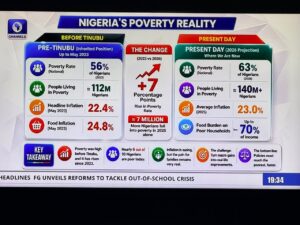
A Channels Television graphic titled “Nigeria’s Poverty Reality” presents a disturbing comparison: Nigeria’s poverty rate supposedly increased from 56 per cent—or approximately 112 million people—in 2023 to 63 per cent, representing more than 140 million people, under the present administration.
The broad conclusion that poverty and economic hardship worsened after President Bola Ahmed Tinubu assumed office is supported by World Bank modelling and the visible decline in household purchasing power. However, the graphic is methodologically weak and politically misleading in several respects.
It combines projections, estimates, rounded inflation figures and different periods without adequately explaining their sources. More importantly, it encourages viewers to attribute the entire increase to President Tinubu, although the World Bank says that about three-quarters of the longer-term rise in poverty occurred before the reforms introduced in mid-2023.

VERDICT: PARTLY ACCURATE BUT MISLEADING
Nigeria’s poverty crisis is real. The 63 per cent figure is broadly consistent with recent World Bank projections. However, it is not the result of a new nationwide household survey conducted in 2026 and should not be presented as a direct count of poor Nigerians.
The graphic also does not establish that the Tinubu administration created the entire difference between 112 million and 140 million poor Nigerians.
WHERE DID THE FIGURES COME FROM?
The likely source of the current poverty estimate is the World Bank’s poverty analysis and Nigeria Development Update.
In October 2025, the World Bank estimated that approximately 139 million Nigerians were living below the national poverty line. It projected that poverty would remain above 60 per cent in 2026.
Crucially, World Bank poverty estimates after 2024 are described as “nowcasts”—statistical projections based on earlier household surveys, population growth, inflation and estimated changes in household consumption. They are not equivalent to interviewing or counting 140 million people.
Nigeria’s latest comprehensive official monetary-poverty benchmark remains rooted in the 2018/19 Nigeria Living Standards Survey. That survey found that 40.1 per cent, or approximately 82.9 million Nigerians, were below the national monetary poverty line.
Nigeria also recorded 63 per cent multidimensional poverty in the 2022 Multidimensional Poverty Index survey, representing 133 million people. However, that is a different measurement. Multidimensional poverty covers deprivation in education, health, employment, living conditions and security—not merely income or household consumption.
The monetary-poverty and multidimensional-poverty figures cannot be substituted for each other without explanation. The Channels graphic fails to identify its poverty line, survey base or modelling method.
THE 56 PER CENT “INHERITED POSITION”
The graphic labels a 56 per cent poverty rate and approximately 112 million poor Nigerians as the “Pre-Tinubu inherited position” up to May 2023.
This figure appears to be a World Bank projection rather than the result of a new national survey completed immediately before Tinubu took office. Describing it as the inherited position is acceptable only if the projection methodology and poverty line are disclosed.
The World Bank’s October 2025 analysis found that average household consumption declined by approximately 6.7 per cent between 2019 and 2023. It also reported that around three-quarters of the rise in poverty between 2019 and 2025 occurred before 2023.
That finding substantially changes the political interpretation. Nigeria’s poverty deterioration did not begin on 29 May 2023. It was already being driven by weak per-capita growth, the COVID-19 shock, insecurity, declining agricultural production, unemployment, currency weakness, high food inflation, inadequate electricity and infrastructure, rapid population growth and ineffective social protection.
President Tinubu therefore inherited an established and worsening poverty trajectory. Nevertheless, subsidy removal and exchange-rate liberalisation placed additional pressure on households, particularly because adequate safety nets were not implemented before or alongside the reforms.
Both realities must be acknowledged.
DID POVERTY RISE BY SEVEN PERCENTAGE POINTS?
The movement from 56 to 63 per cent represents an increase of seven percentage points—not merely seven per cent.
But these figures are projections for different years, not results from two directly comparable nationwide household surveys. The precision suggested by the graphic is therefore greater than the underlying evidence permits.
The increase in the number of poor people—from approximately 112 million to around 140 million—would be roughly 28 million, not seven million.
The separate claim that approximately seven million more Nigerians fell into poverty in 2025 alone may have been derived from a projected increase in the poverty rate combined with population growth. However, the graphic provides no source, calculation or applicable poverty line.
Population growth is important. Even if the poverty rate remained unchanged, the number of poor Nigerians could still increase because the country adds several million residents annually. A rising headcount does not necessarily mean that the same number of previously non-poor adults personally fell into poverty during the year.
THE INFLATION CLAIMS
The May 2023 inflation figures are essentially correct after rounding. The National Bureau of Statistics reported headline inflation of approximately 22.41 per cent and food inflation of 24.82 per cent.
The graphic rounds these figures to 22.4 and 24.8 per cent.
Its reported 2025 average inflation rate of approximately 23 per cent may also be consistent with Nigeria’s rebased Consumer Price Index. Nevertheless, direct comparisons require caution because the NBS rebased the CPI and changed the reference period and consumption weights.
Furthermore, falling inflation does not mean prices are falling. It means prices are increasing more slowly. Families may remain under severe pressure even after the inflation rate declines because previous price increases have not been reversed.
The claim that poor households spend up to 70 per cent of their resources on food is broadly consistent with World Bank findings. The Bank reported that the cost of a basic food basket increased fivefold between 2019 and 2025, with the poorest households devoting as much as 70 per cent of their spending to food.
WHAT CAN FAIRLY BE ATTRIBUTED TO TINUBU?
It would be dishonest to deny that the administration’s early reforms intensified hardship.
Removing the petrol subsidy without first establishing effective transportation support, food interventions and reliable safety nets increased transportation and production costs. Exchange-rate liberalisation raised the naira cost of imported food, medicine, fuel, machinery and raw materials.
The absence of an adequately coordinated relief system was a major policy shortcoming.
Nevertheless, it is equally misleading to treat every Nigerian presently classified as poor as someone newly impoverished by Tinubu. Tens of millions were already poor before he assumed office, while much of the deterioration after 2019 occurred under the preceding administration.
The World Bank has also acknowledged improvements under the reforms, including stronger government revenue, increased external reserves, an improved current-account balance, greater exchange-rate stability and stronger economic growth. Nigeria’s economy grew by approximately 3.9 per cent in the first half of 2025, while external reserves rose above $42 billion.
These gains matter, but they do not cancel the hardship. Macroeconomic stability becomes meaningful to ordinary citizens only when it produces affordable food, rising real incomes, jobs, reliable public services and protection for vulnerable households.
CONCLUSION
The Channels graphic identifies a genuine national emergency, but its framing is too simplistic to constitute a fair assessment of the Tinubu administration.
Its central weakness is not necessarily the 63 per cent projection. It is the failure to explain that the number is modelled rather than directly measured, its use of different poverty concepts without clarification and its implication that the entire increase occurred after May 2023.
The defensible conclusion is clear: poverty was rising sharply before President Tinubu took office. His reforms initially worsened household hardship because adequate safety nets were not implemented alongside them. However, the available evidence does not prove that his administration alone pushed approximately 28 million additional Nigerians into poverty.
Channels Television should disclose the precise World Bank table, poverty line, population assumptions and calculations behind its graphic. Without that information, the presentation makes powerful television—but remains incomplete economic analysis.

NATIONAL PATRIOTS’ POSITION
The National Patriots acknowledges Nigeria’s severe poverty crisis but cautions against presenting projections as verified census figures or blaming President Tinubu for a deterioration that largely predated his administration. The Government must now convert reform gains into affordable food, jobs, transport relief and credible safety nets. Media organisations must disclose sources, methods and assumptions when reporting politically sensitive economic statistics responsibly.
Princess Gloria Adebajo-Fraser MFR.
President, The National Patriots.
Former Special Adviser to President Goodluck Jonathan.
Vice Chairman, Strategic communications committee, Buhari PCC 2019.