

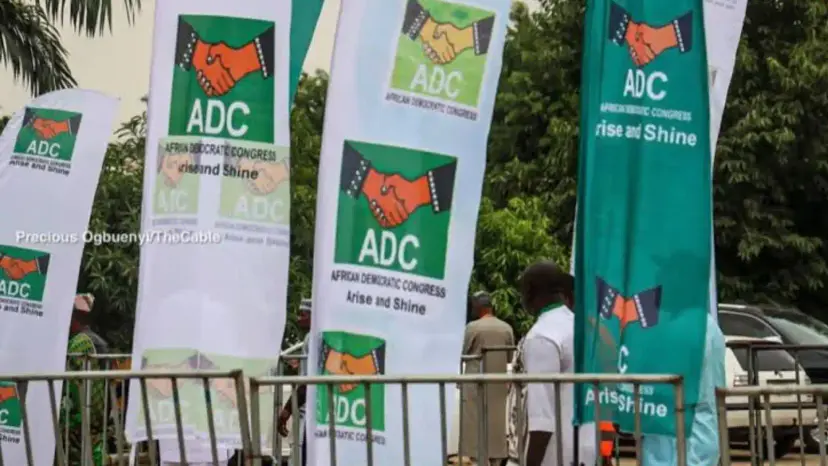
Sokoto rally sparks competing political claims as longstanding ADC litigation raises questions about coalition strategy, candidate nominations and the alternatives available to Atiku.
ABUJA, NOVEMBER 5, 2026
The African Democratic Congress (ADC) has accused the All Progressives Congress (APC) of engineering Thursday’s Federal High Court judgment against its leadership, claiming that the ruling party became alarmed by the turnout at former Vice-President Atiku Abubakar’s Sokoto campaign rally.

However, the accusation has not been accompanied by evidence connecting President Bola Ahmed Tinubu, the APC or any government official to Justice Peter Lifu’s decision.
The judgment arose from a leadership dispute that began in 2025, long before the November 4 rally.
This raises a more immediate question: why did an opposition coalition comprising experienced politicians adopt a party whose leadership arrangements were already contested?
THE SOKOTO RALLY AND THE APC ACCUSATION
In its statement, the ADC portrayed the Sokoto turnout as evidence of growing national support and suggested that the judgment was intended to weaken its presidential campaign.
But the number of people attending a rally does not establish their voting intentions, the geographical spread of support or the outcome of a national election.
Nigeria’s presidential election requires both sufficient votes and constitutionally prescribed geographical distribution.
The ADC is entitled to celebrate its supporters. It has not, however, demonstrated that the APC influenced the judgment or that the rally prompted the court’s decision.
WHY ADOPT A PARTY WITH UNRESOLVED LEADERSHIP QUESTIONS?
The coalition’s decision to use the ADC as its political platform exposed it to disputes concerning the authority of party officials and the validity of subsequent decisions.
Nafiu Bala Gombe challenged the emergence of David Mark and Rauf Aregbesola as national officers, claiming that the leadership transition violated the party constitution.

The litigation proceeded through the appellate courts before returning to the Federal High Court for substantive determination.
By the time Atiku emerged as the ADC presidential candidate in May 2026, the leadership controversy had become a matter of public record.
The coalition’s strategic calculation therefore deserves examination.
Why proceed through a party facing unresolved litigation rather than pursue an alternative political platform?
The proposed All Democratic Alliance (ADA) was among the political associations seeking registration. Its registration status and ability to meet the electoral timetable would have affected its usefulness as an alternative.
There is insufficient verified evidence that ADA formally offered Atiku an immediately available, legally registered platform. Nevertheless, the broader question remains: what legal due diligence did the coalition undertake before committing its presidential ambitions to the ADC?

ATIKU’S ELECTORAL HISTORY
Atiku has extensive experience of presidential contests.
He lost the 2007 presidential election as the Action Congress candidate, the 2019 election as the Peoples Democratic Party candidate and the 2023 election, when he received 6,984,520 votes against Tinubu’s 8,794,726.
He also unsuccessfully contested presidential nominations within major political parties.
These results establish a history of unsuccessful presidential bids, although they do not establish the outcome of any future election.
His political experience makes the coalition’s decision to proceed amid unresolved leadership litigation a legitimate subject of scrutiny.
It would, however, require evidence to conclude that he deliberately selected the ADC to create an excuse for a future electoral defeat.
THE QUESTION OF SOUTHERN SUPPORT
Atiku’s Sokoto rally also raises questions about his electoral organisation beyond the North.
Nigeria’s constitutional geographical-spread requirement makes support across multiple regions an important element of presidential campaigns.
Atiku must therefore demonstrate meaningful political structures and voter support across the South-West, South-East and South-South, as well as Northern Nigeria.
The size of one Northern rally cannot establish whether that requirement will be met.
THE JUDICIAL ISSUE REMAINS DISTINCT
The ADC has cited Justice Musa Liman’s July 2 judgment as grounds for challenging Justice Lifu’s ruling.
That argument concerns whether the judgments addressed overlapping issues and whether the later decision conflicts with an existing order of a court of coordinate jurisdiction.
It is a legal question for the appellate courts, not proof that the APC controlled the judiciary.

The ADC retains its right to appeal, while INEC must comply with applicable judicial orders.
The controversy ultimately presents two separate questions: whether the ADC leadership and nomination processes were lawful, and whether its allegations of political interference can be substantiated.
Neither question can be answered by the attendance figures from Sokoto.
NATIONAL PATRIOTS POSITION
The National Patriots maintain that allegations of APC interference require credible evidence. The ADC leadership dispute preceded Atiku’s Sokoto rally, and the opposition coalition must account for its decision to adopt a contested party structure. Judicial independence, lawful appeals and constitutional electoral procedures must take precedence over inflammatory political accusations.
THE NATIONAL PATRIOTS