

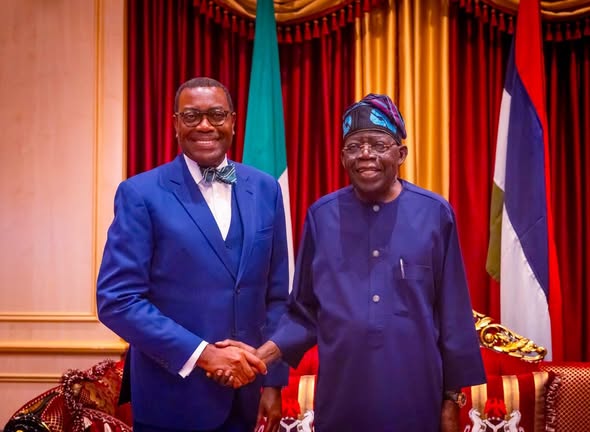
Former President of the African Development Bank (AfDB), Akinwumi Adesina, has expressed his willingness to contribute to Nigeria’s development in any capacity deemed appropriate by President Bola Ahmed Tinubu.
Adesina made this known on Tuesday after meeting with Tinubu at the Presidential Villa in Abuja. He clarified, however, that he was not seeking a government appointment but was prepared to offer his experience and expertise whenever the country needed his services.

The meeting provided an opportunity for the former AfDB president to formally inform Tinubu that he had completed his 10-year tenure at the continental financial institution and to present a report on the achievements recorded during his leadership.
Adesina explained that it was customary for him to return home after completing his tenure and brief the Nigerian president on the institution’s activities and contributions to the country.
He said Tinubu was pleased with the report and the development support the bank had provided to Nigeria during his time in office.
AFDB PROVIDED NIGERIA WITH $7 BILLION IN TEN YEARS
Adesina disclosed that the African Development Bank provided approximately $7 billion in financing to Nigeria between 2015 and 2025.

He compared this figure with the $11.1 billion the bank had provided to Nigeria cumulatively since it began operating in the country in 1971.
According to him, the financing delivered during his decade-long leadership accounted for about 63 per cent of the bank’s total historical support to Nigeria at the time.
He said the scale of the funding demonstrated the bank’s commitment to supporting Nigeria’s development across different sectors of the economy.
The former bank president added that Tinubu expressed satisfaction with the institution’s contributions and the outcomes achieved during his tenure.
ADESINA COMMENDS TINUBU’S ECONOMIC REFORMS
During the meeting, Adesina praised the Tinubu administration for implementing major economic reforms, particularly the removal of the petrol subsidy and the harmonisation of foreign exchange windows.

He acknowledged that the policies had been difficult but argued that they were beginning to produce some positive results.
According to him, foreign exchange availability had improved, portfolio investors were returning to the Nigerian market, and inflation was showing a downward trend.
He nevertheless recognised that the cost of goods and services remained high, despite the reported decline in inflation.
Adesina also pointed to assessments by international credit rating agencies, noting that some had assigned Nigeria stable or positive outlooks.
He said these developments suggested a change in how international financial markets and institutions viewed the Nigerian economy.
However, the former AfDB president emphasised that stabilising the economy should not be the government’s final objective.

NIGERIA MUST MOVE FROM STABILISATION TO ECONOMIC TRANSFORMATION
Adesina argued that the next phase of Nigeria’s economic agenda should focus on structural transformation, sustainable growth and improved prosperity for citizens.
He stressed that economic reforms must translate into tangible improvements in productivity, industrial development and living standards.
According to him, the country needs to move beyond stabilisation measures and implement policies that create the foundation for long-term economic expansion.
He said this was an important stage in Nigeria’s development and noted that Tinubu was focused on moving the country in that direction.

Adesina’s comments highlight the need to ensure that the gains expected from economic reforms are reflected in increased business activity, stronger productive capacity and better opportunities for Nigerians.
‘I AM NOT LOOKING FOR A JOB’
When asked about the role he could play in supporting Nigeria, Adesina said he was ready to serve in any capacity the president considered suitable.
He stressed that his willingness to help was driven by patriotism and a sense of responsibility rather than an interest in securing public office.
“My heart is always at home,” he said, explaining that he remained committed to contributing to his country’s progress.
Adesina added that he was not looking for a job or seeking a particular position but was simply prepared to make his knowledge and experience available to Nigeria.

He maintained that serving the country was both a duty and a responsibility he was willing to fulfil.
ADESINA’S RECORD IN AGRICULTURE AND DEVELOPMENT FINANCE
Before becoming president of the African Development Bank, Adesina served as Nigeria’s Minister of Agriculture and Rural Development from 2011 to 2015 under former President Goodluck Jonathan.
He became the first Nigerian to lead the AfDB when he assumed office in 2015 and was subsequently re-elected for a second five-year term in 2020.
His leadership at the institution focused on priorities including agricultural development, food security, electricity access, industrialisation and regional integration.

His tenure ended in 2025, after which Dr Sidi Ould Tah succeeded him as president of the bank.
Adesina’s meeting with Tinubu marks his return to Nigeria following the completion of his decade-long leadership of the institution.
Although no specific government appointment was announced after the meeting, he reaffirmed his readiness to support the country’s development whenever his expertise could be useful.
He maintained that his commitment to Nigeria remained strong and that he was prepared to contribute to building a more prosperous nation.