

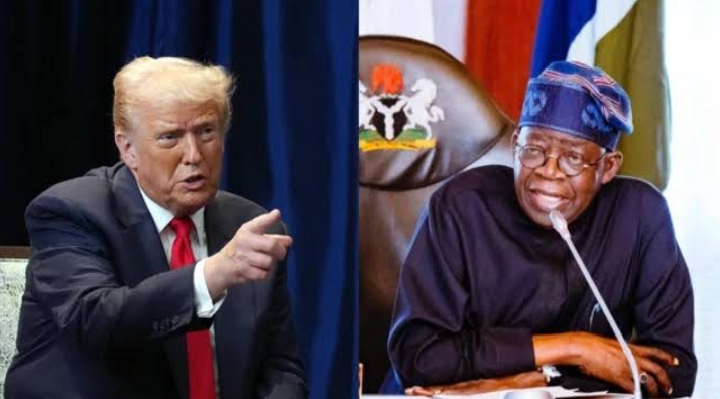
However, political observers have cautioned against treating the Republican Party’s defeat as an indication of what could happen to Tinubu, arguing that the political, economic and electoral circumstances in both countries are fundamentally different.

In an opinion article, Kayode Akinmade argued that although the American election offers important lessons about public accountability and government performance, its outcome cannot automatically predict the result of Nigeria’s next presidential election.
According to him, the Republican defeat represents a significant political setback for Trump, particularly as Democrats secured control of both chambers of Congress, reflecting dissatisfaction among sections of the American electorate with the administration.
One of the major factors identified as contributing to the Republican Party’s poor performance was the controversial conflict involving the United States and Iran.
The conflict reportedly increased pressure on energy markets, contributed to rising fuel prices and heightened concerns among American households already struggling with the cost of living.

Trump reportedly acknowledged that the conflict contributed to his party’s electoral difficulties, while Vice President JD Vance was quoted as saying that the war was responsible for the defeat.
Akinmade argued that these circumstances were specific to America’s foreign policy decisions and should not be directly linked to Tinubu’s political fortunes.
He noted that Nigeria neither initiated the conflict nor determined America’s military involvement in Iran, making it unreasonable to interpret the Republican Party’s electoral setback as a direct political verdict on the Nigerian president.
He also highlighted the differences between American midterm elections and Nigeria’s general elections.
While American midterm elections are conducted halfway through a president’s four-year tenure to determine the composition of Congress, Nigeria’s 2027 election will involve a direct contest for the presidency.

According to the article, the two elections have different political structures, electoral considerations and circumstances, making direct comparisons unreliable.
TINUBU’S ECONOMIC REFORMS AND THE COST-OF-LIVING CHALLENGE
Beyond the American political developments, Akinmade argued that Nigeria’s economic difficulties predate the Tinubu administration, pointing to longstanding structural problems such as petrol subsidy payments, multiple exchange rates, weak revenue generation, infrastructure deficits and excessive dependence on imports.
He noted that the Tinubu administration introduced several economic reforms, including petrol subsidy removal, foreign exchange adjustments and fiscal restructuring, in an attempt to address these challenges.
However, he acknowledged that the reforms have imposed considerable hardship on Nigerians, with increased food, transportation and electricity costs placing pressure on households and businesses.

The article maintained that the economic difficulties should be examined alongside the structural problems that necessitated the reforms.
It also argued that the government must be assessed on whether its policies are addressing those problems effectively and whether the resulting benefits are reaching ordinary Nigerians.
Citing government economic figures, Akinmade said Nigeria recorded real Gross Domestic Product growth of 4.43 per cent in the second quarter of 2026, compared with 4.23 per cent during the corresponding period in 2025.
He also cited a decline in headline inflation from 23.14 per cent in August 2025 to 15.39 per cent in August 2026, while external reserves reportedly increased to approximately $54.7 billion as of September 18, 2026.
Federation Account revenue also reportedly rose from about ₦15.2 trillion in 2024 to ₦21.9 trillion in 2025, representing an increase of approximately 44 per cent.

Nevertheless, he cautioned that improvements in economic indicators do not necessarily translate into immediate improvements in citizens’ living conditions.
He explained that lower inflation does not mean prices have returned to previous levels but indicates that the pace of price increases has slowed.
The article argued that the administration must translate its reported economic gains into affordable food, improved electricity supply, employment opportunities, lower production costs, better security and stronger social protection.
INFRASTRUCTURE AND GOVERNMENT PERFORMANCE
Akinmade also argued that Tinubu’s performance should not be judged solely by the cost-of-living situation, noting that infrastructure development, transportation, food production, education and improvements to the business environment are equally important considerations.
He identified projects such as the Lagos-Calabar Coastal Highway and Sokoto-Badagry Superhighway as examples of the administration’s infrastructure ambitions.

However, he stressed that the success of such projects should ultimately be determined by their completion, quality, economic impact and benefits to communities and businesses.
According to him, announcing major projects is not sufficient to establish the success of an administration, just as economic performance cannot be measured solely by the price of essential commodities.
OPPOSITION CHALLENGED TO PRESENT ALTERNATIVES
The article further challenged Nigeria’s opposition parties to move beyond celebrating Trump’s electoral setback and present practical solutions to the country’s economic challenges.
Akinmade argued that political criticism alone does not constitute a credible alternative government.

He questioned whether opposition parties would restore petrol subsidies, return to the previous multiple exchange-rate arrangements or introduce different policies to tackle inflation, strengthen the naira, improve food security and create employment.
He also argued that opposition parties must explain how they would finance essential infrastructure without returning the country to unsustainable borrowing and fiscal practices.
According to him, Nigerians deserve concrete policy proposals rather than political comparisons with developments in another country.
TINUBU AND APC WARNED AGAINST COMPLACENCY
Despite defending the need to assess the administration’s economic reforms within their broader context, Akinmade also warned the ruling All Progressives Congress (APC) against assuming that previous electoral victories or political loyalty would guarantee success in 2027.

He argued that the American experience demonstrates that voters can withdraw their support when government policies fail to meet their expectations.
The article maintained that Tinubu and the APC cannot rely solely on explaining why difficult economic decisions were necessary.
Instead, the administration must demonstrate measurable results, address public dissatisfaction and ensure that economic improvements become visible in the daily lives of Nigerians.
It also warned against dismissing legitimate criticism as opposition propaganda, stressing that citizens experiencing rising living costs, insecurity and unemployment deserve practical responses from the government.

Ultimately, Akinmade argued that the 2027 presidential election would depend on the records, policies, leadership capacity and public confidence of the candidates.
He concluded that although Trump’s midterm defeat offers lessons about electoral accountability, it cannot determine Tinubu’s political future.
According to him, the responsibility rests on both sides: the government must demonstrate results, while the opposition must convince Nigerians that it has the capacity and workable alternatives to govern.
He maintained that American voters would judge Trump based on their own experiences, while Nigerians would independently decide Tinubu’s fate at the ballot box in 2027.