

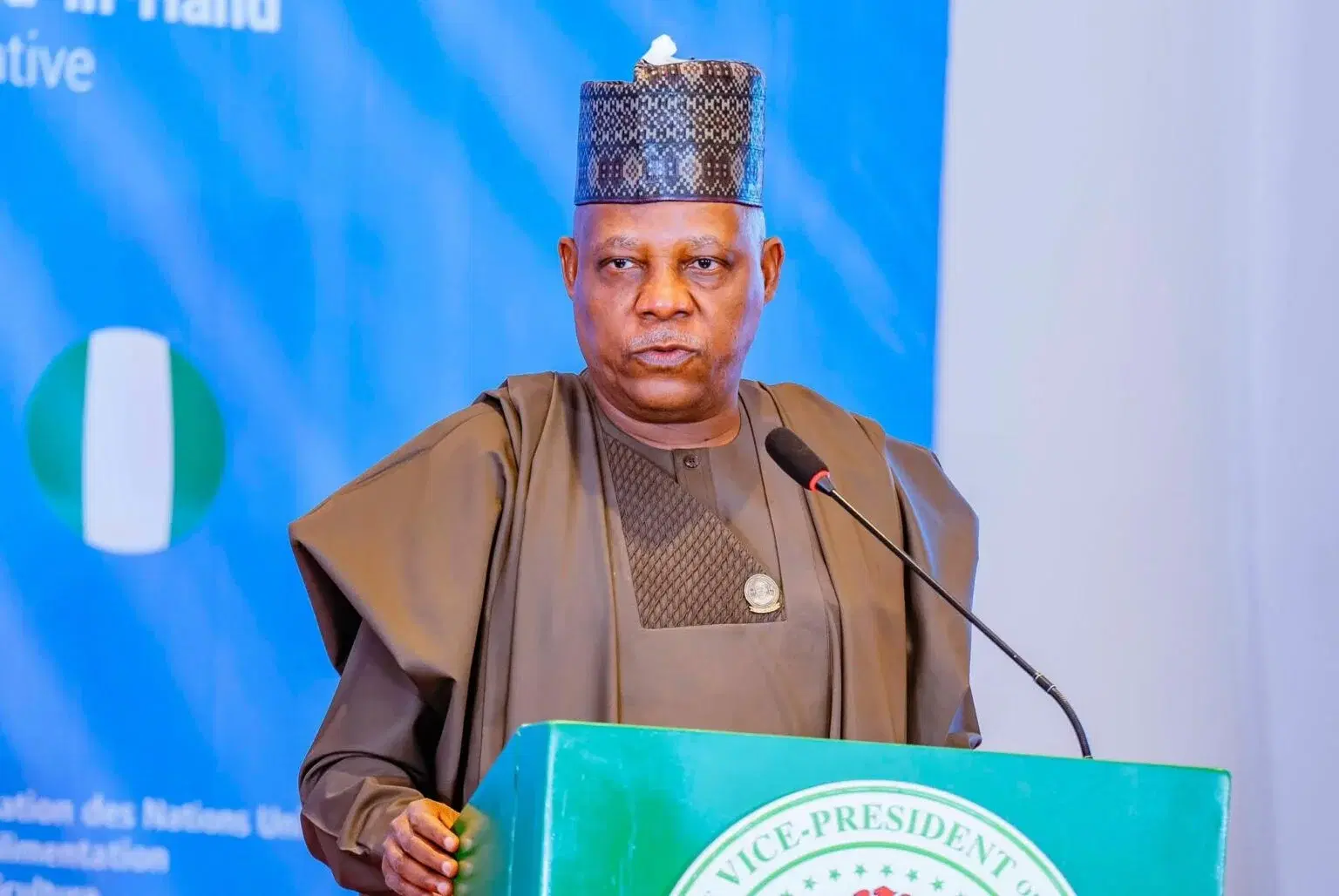
Vice President Kashim Shettima has reaffirmed the Federal Government’s commitment to maintaining strong collaboration with the private sector, stating that no government can fully understand the economy without engaging employers and business owners.
Speaking through the Special Adviser to the President on General Duties and former Minister of the Federal Capital Territory, Dr. Aliyu Modibbo Umar, at the 5th Nigerian Employers’ Summit in Abuja on Monday, Shettima said the government remains focused on removing obstacles to doing business and digitising public services to ensure reforms are felt across the country.

He noted that Nigeria is at a critical stage where economic reforms require open discussions on issues such as production costs, taxation, exchange rates, access to credit and investment.
According to the Vice President, businesses can only thrive in an environment supported by reliable infrastructure, stable policies, fair taxation and dependable energy supply rather than goodwill alone.
Shettima praised President Bola Tinubu for taking difficult economic decisions, stressing that lasting prosperity is achieved through bold reforms backed by clear vision and decisive leadership.

He explained that the administration inherited significant economic challenges, including an unsustainable fuel subsidy, a fragmented foreign exchange market, weak government revenue and declining investor confidence.
The Vice President said the Renewed Hope Agenda was introduced to address these structural issues, noting that sustainable economic growth cannot be achieved while businesses continue to struggle with multiple taxes, poor logistics, insecurity and foreign exchange uncertainty.
He added that the removal of fuel subsidies and reforms in the foreign exchange market are aimed at creating a more transparent and stable business environment, while ongoing fiscal and tax reforms seek to simplify tax administration, reduce the number of taxes, encourage compliance, support small businesses and generate more revenue for infrastructure development.

Shettima also emphasized that reducing bureaucratic delays and streamlining government procedures remain priorities, allowing businesses in every part of Nigeria to benefit from government reforms without unnecessary obstacles.

In his remarks, the Director-General of the Nigeria Employers’ Consultative Association (NECA), Adewale Oyerinde, said the Employers’ Summit has, over the past five years, produced valuable policy recommendations that have helped shape government decisions and strengthened cooperation between the public and private sectors.
Oyerinde also announced that beginning in 2027, the Nigerian Employers’ Summit will be expanded into the International Employers’ Summit, reflecting its growing influence across Africa and beyond.




