

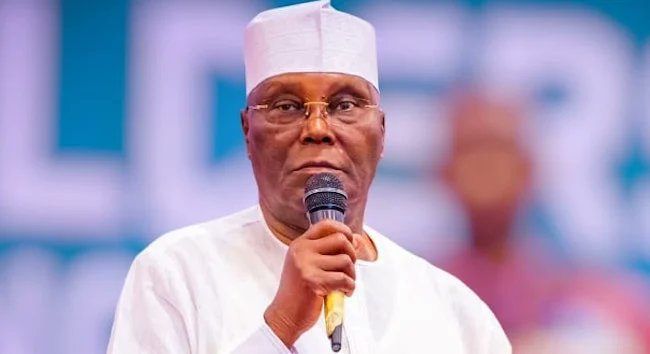
A former Vice President of Nigeria, Atiku Abubakar, has called for the immediate suspension and public review of a “Technical Equity Partnership” announced by the Nigerian National Petroleum Company Limited (NNPC), involving two Chinese firms, Sanjiang Chemical Company Limited and Xingcheng (Fuzhou) Industrial Park Operation and Management Co. Ltd.

In a statement issued through his spokesperson, Phrank Shaibu, Atiku described the agreement as a “risky and opaque arrangement” that could endanger Nigeria’s economic interests.
He criticised the federal government under President Bola Tinubu, alleging that critical national assets were being exposed to questionable partnerships lacking transparency and proven technical expertise.
Atiku argued that the deal should be suspended pending full public scrutiny, insisting that Nigerians deserved clarity on agreements involving strategic national infrastructure such as refineries.

He questioned the technical capacity of the two Chinese firms, stating that available records do not show evidence of experience in managing large-scale crude oil refinery operations similar to those in Port Harcourt and Warri.
According to him, Sanjiang Chemical’s core operations are largely in petrochemical processing rather than full refinery rehabilitation, while Xingcheng (Fuzhou) Industrial Park Operation and Management Co. Ltd. is primarily focused on industrial park and infrastructure management.
He further claimed that neither company demonstrates the kind of global track record typically required for complex refinery rehabilitation projects.

Atiku also raised concerns about the financial strength of one of the firms, alleging signs of weak profitability and debt exposure that may affect its capacity to execute such a large-scale project.

He warned that the arrangement could repeat past failures in refinery turnaround projects, which he described as costly and poorly managed over the years.
The former vice president insisted that Nigeria should prioritise globally recognised engineering and refinery experts rather than what he called uncertain and unverified partners.
He concluded that national assets such as Nigeria’s refineries are too important to be subjected to what he described as experimental or opaque agreements.




