

BREAKING: State Police Near Reality As Senate Moves To Amend Constitution, Transmission To States Next
By Headlinenews.news Special Report
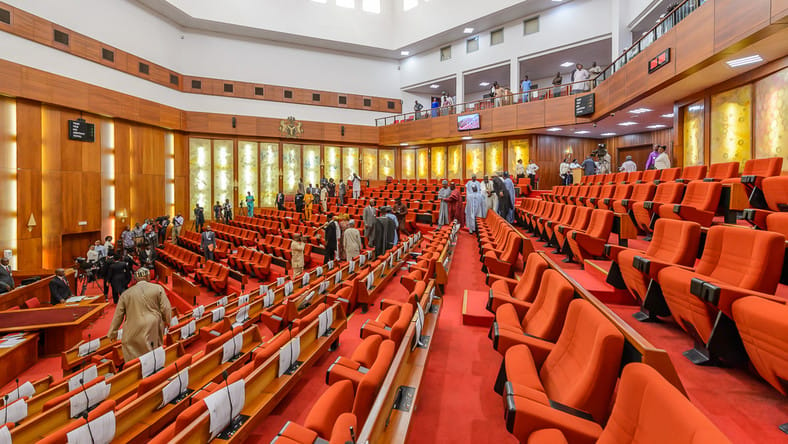
Nigeria may be on the verge of one of the most significant constitutional and security reforms since the return to democracy in 1999, as the Senate this week begins deliberations on constitutional amendments that will pave the way for the establishment of state police.
Senate Leader, Senator Opeyemi Bamidele, disclosed that the National Assembly would commence legislative consideration of the proposal this week, revealing that President Bola Ahmed Tinubu, state governors and major stakeholders across the federation were largely aligned on the necessity of decentralising policing.
According to Bamidele, extensive consultations had already taken place involving the Office of the Attorney-General of the Federation, Chief of Staff to the President, Rt. Hon. Femi Gbajabiamila, the Inspector-General of Police, Kayode Egbetokun, and other critical stakeholders, with confidence growing that the bill was ripe for passage.
Once approved by the National Assembly, the constitutional amendment will be transmitted to the 36 state Houses of Assembly. Under Section 9 of the 1999 Constitution, at least 24 state legislatures—representing two-thirds of the federation—must endorse the amendment before it returns to President Tinubu for assent.
The move comes amid mounting security challenges across the country. Nigeria currently has roughly 370,000 police personnel serving a population estimated at over 230 million people, translating to approximately one police officer for every 620 citizens. Although this ratio appears close to the United Nations recommendation of one officer to 450 persons, analysts argue that fewer than half of the officers are actually available for core policing duties due to deployments to VIP protection and administrative assignments.
With 36 states and 774 local government areas spread across a vast territory, critics have long argued that a highly centralised police structure has become overstretched and increasingly ineffective in responding to kidnappings, banditry, terrorism and communal conflicts.
For decades, calls for state police generated fears of political abuse and the possibility that governors could weaponise local police formations against opponents. However, worsening insecurity and the emergence of armed groups operating across forests and rural communities have shifted the national conversation from whether Nigeria should have state police to how such a system should be structured and regulated.
Comparative experience across the world supports decentralised policing. The United States operates more than 18,000 law enforcement agencies comprising federal, state, county and municipal police departments. Canada maintains provincial police services alongside federal policing under the Royal Canadian Mounted Police. Germany’s policing responsibilities are largely exercised by state governments, while India, the world’s most populous democracy, places law enforcement under state authorities with federal agencies playing supportive roles.

Even within Africa, South Africa operates a decentralised security architecture involving provincial governments and metropolitan police departments. Security experts argue that localised policing enables quicker intelligence gathering, improved community trust and faster response times.
Former Inspector-General of Police Mohammed Abubakar once noted that “policing is local and effective intelligence comes from the communities.” Several retired military officers and security experts have also repeatedly argued that the complexity of Nigeria’s security threats requires a structure that combines federal coordination with local intelligence capabilities.
Supporters of state police believe governors, who are constitutionally designated as Chief Security Officers of their states but currently lack operational control over security agencies, would be better positioned to tackle criminal networks with local knowledge and rapid intervention mechanisms.

However, concerns remain over funding, recruitment standards, inter-state coordination and constitutional safeguards against abuse. Experts have proposed independent state police commissions, federal oversight mechanisms, standardised training, judicial review and constitutional provisions to prevent misuse by political office holders.
President Tinubu himself had consistently supported the concept long before assuming office. Since taking office, his administration has repeatedly indicated that Nigeria’s current security realities demand innovative reforms beyond the traditional centralised structure inherited from colonial administration.
Should the amendment secure approval from at least 24 state assemblies and eventually receive presidential assent, it would mark one of the most far-reaching changes to Nigeria’s security architecture in over six decades.
For many Nigerians living under the daily threat of terrorism, kidnapping and violent crime, the debate is no longer merely constitutional.

It is existential.
And this week, history may begin to turn in favour of a new policing order.
The National Patriots commend the Senate and the National Assembly for advancing the constitutional amendment to establish state police. Nigerians should remain optimistic and support the bold reforms being undertaken by President Bola Ahmed Tinubu to address insecurity. Beyond military operations, institutional reforms are essential for lasting peace. State police, improved intelligence, forest guards, technology and greater collaboration among all levels of government will strengthen national security and help restore confidence. These reforms require patience, unity and sustained national support.
Dr. Ameeda Fraser MFR
Headlinenews.news Special Report




