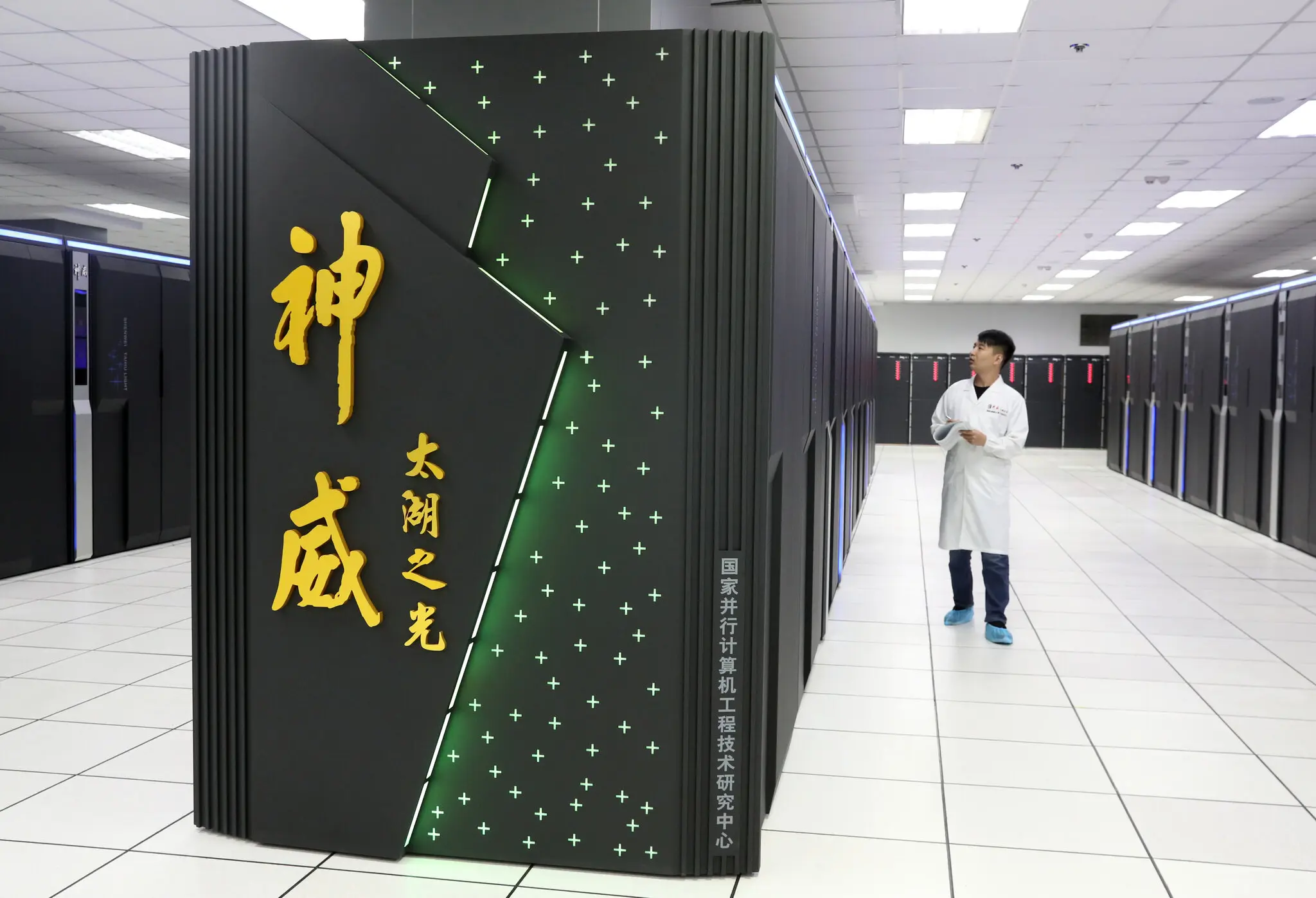
China has regained the title of home to the world’s fastest supercomputer, ending years of U.S. dominance and highlighting Beijing’s growing technological capabilities despite ongoing American restrictions on advanced chip exports.

The breakthrough came after China’s newly unveiled supercomputer, known as LineShine, secured the top position in the latest TOP500 global rankings of the world’s most powerful computing systems. The achievement marks the first time since 2017 that a Chinese machine has occupied the number one spot.
Developed at the National Supercomputing Centre in Shenzhen, LineShine surpassed the U.S.-based El Capitan supercomputer, which had previously held the crown. The Chinese system achieved a performance of 2.198 exaflops, enabling it to perform more than two quintillion calculations per second.
What has drawn particular attention from industry experts is that LineShine relies entirely on domestically developed technology and operates using conventional central processing units (CPUs) rather than the graphics processing units (GPUs) that power many of today’s leading high-performance computing and artificial intelligence systems.
The development is being viewed as a significant milestone for China’s push toward technological self-sufficiency, especially in the face of U.S. export controls aimed at limiting Beijing’s access to advanced semiconductor technologies.

Supercomputers play a critical role in scientific research, weather forecasting, energy exploration, medical discoveries, defence simulations and other computationally intensive tasks. They are often seen as a measure of a nation’s technological strength and innovation capacity.
While LineShine now leads the global rankings for raw computing power, experts note that the TOP500 list primarily measures traditional high-performance computing capabilities and does not necessarily determine leadership in artificial intelligence, where specialised AI-focused systems continue to dominate.
Nevertheless, China’s return to the top of the rankings underscores the intensifying technological competition between Beijing and Washington as both nations invest heavily in advanced computing, artificial intelligence and next-generation semiconductor development.