

The Midstream and Downstream Gas Infrastructure Fund (MDGIF) has assured Nigerians that transportation costs associated with Compressed Natural Gas (CNG)-powered vehicles are expected to decline as more refuelling stations become operational across the country.
The Executive Director of the fund, Oluwole Adama, gave the assurance during the commissioning of a Liquefied Compressed Natural Gas (LCNG) facility in Hotoro, Tarauni Local Government Area of Kano State.

Adama was responding to concerns that some commercial transport operators using CNG-powered vehicles continue to charge passengers the same fares as drivers operating petrol-powered vehicles.
He attributed the situation to the early advantage enjoyed by existing CNG operators, explaining that limited competition had allowed some operators to maintain their current prices.
According to him, the expansion of refuelling infrastructure and the entry of additional operators into the market would create competition and eventually force transportation costs down.

He said: “It is a first-comer advantage they have. We talk about demand and supply. So, when we are opening more of this, very soon they won’t have a place. Competition will drive it down.”
Adama expressed confidence that the benefits of increased competition would eventually reach ordinary Nigerians through more affordable transportation.
KANO COMMISSIONS THREE NEW GAS FACILITIES
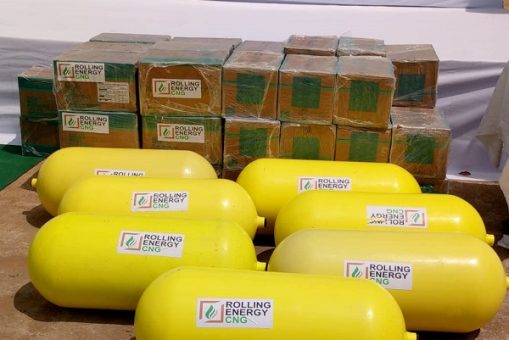
The assurance came as the Minister of State for Petroleum Resources (Gas), Ekperikpe Ekpo, commissioned three gas infrastructure facilities developed by Rolling Energy Limited with support from the MDGIF.

The facilities include an LCNG distribution hub and retail station at Tamburawa, in Dawakin Kudu Local Government Area, as well as an LCNG daughter and retail station at Hotoro, in Tarauni Local Government Area of Kano State.
Speaking at the commissioning, Ekpo described the projects as an important step towards expanding domestic gas utilisation, improving access to cleaner energy and supporting the country’s transition to alternative fuels.
He said the facilities would strengthen gas distribution in Kano and surrounding areas while providing additional energy options for transport operators, businesses and other consumers.
The Tamburawa distribution hub has a capacity of 300,000 standard cubic metres of gas per day and is equipped with LNG storage, regasification and CNG distribution facilities.
The Hotoro station, meanwhile, has a capacity of 21,000 standard cubic metres per day and is expected to improve access to gas for vehicle owners and commercial transport operators.
MDGIF HIGHLIGHTS POTENTIAL SAVINGS FROM CNG
Adama said the new infrastructure would help reduce the operating expenses of transport businesses, particularly those relying on cars, tricycles, buses and heavy-duty trucks.
He explained that CNG could offer significant savings compared with petrol, using the prevailing prices in Kano to illustrate the difference.
According to him, petrol was selling for approximately ₦1,420 per litre, while the equivalent energy from CNG cost about ₦600.
Using a commercial tricycle operator as an example, he said a driver consuming the equivalent of 10 litres of petrol daily would spend about ₦14,200 on petrol, compared with approximately ₦6,000 on CNG.

This would amount to a potential daily saving of ₦8,200, although actual savings would depend on fuel consumption and operating conditions.
Adama said such savings could improve the financial position of transport operators, allowing them to meet household expenses and reinvest in their businesses.
NEW FACILITIES TO SERVE TRUCKS AND COMMERCIAL VEHICLES
The MDGIF executive director also disclosed that the newly commissioned facilities were designed to support heavy-duty vehicles involved in transporting agricultural produce and manufactured goods across the country.
He said the combined facilities could refuel up to 2,500 cars and tricycles daily, while also supporting the refuelling of as many as 200 trucks.
According to him, improved access to CNG would help reduce the operating costs of businesses transporting goods from Kano to other parts of Nigeria, including Lagos, Port Harcourt and Maiduguri.
He noted that the expansion of the infrastructure network was essential to ensuring that the benefits of Nigeria’s natural gas resources translated into practical economic gains for citizens.
ROLLING ENERGY SPEAKS ON EXPANSION PLANS
The Chief Executive Officer of Rolling Energy Limited, Mubarak Umar Danbamta, said the company’s expansion into Kano followed earlier projects in Ilorin, Kwara State, and Abuja.
He explained that the company was working with the MDGIF to develop additional facilities that would improve the distribution and availability of natural gas for transportation and other commercial uses.
Danbamta added that the newly commissioned facilities were equipped to handle LNG regasification and CNG dispensing, strengthening the supply chain for gas-powered vehicles.

GOVERNMENT EXPECTS COMPETITION TO IMPROVE AFFORDABILITY
The Federal Government has continued to promote CNG as an alternative to petrol and diesel, particularly following the removal of the petrol subsidy and the resulting increase in transportation and operating costs.
Through the MDGIF and other government-backed initiatives, efforts are being made to attract private-sector investment and expand the country’s gas distribution infrastructure.
However, the MDGIF’s latest assurance suggests that increased availability alone may not be sufficient to guarantee lower transport fares. Greater competition among operators will also be necessary to encourage price reductions.
While Adama expects the expansion to eventually make CNG-powered transportation more affordable, passengers may have to wait for more facilities and operators to enter the market before experiencing significant reductions in fares.