

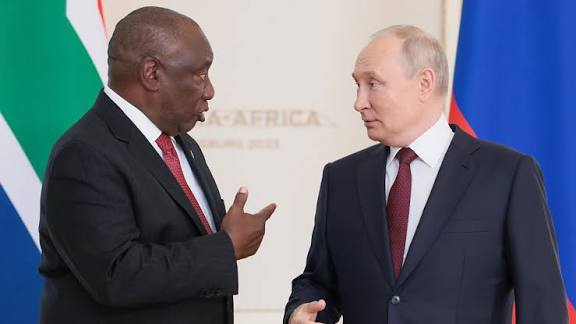
President Cyril Ramaphosa has expressed gratitude to Russian President Vladimir Putin for facilitating the safe return of South African men who were deceived into fighting alongside Russian forces in Ukraine.

Four of the men arrived back in South Africa last week, with 11 others expected to return soon, while two remain in Russia—one hospitalised in Moscow and the other still being processed for travel.
The South African government disclosed in November 2025 that it had received “distress calls” from 17 men (aged 20–39) trapped on the front lines in Ukraine’s Donbas region after being tricked into joining mercenary forces.

In a statement released on Tuesday, February 24, 2026, the presidency said: “President Cyril Ramaphosa has welcomed the return of the South African men who were lured into the battle lines between Russia and Ukraine by South African elements that remain under investigation.”
“The South African government, working closely with the Russian government, has secured a safe return of the men. This followed receipt of distressed calls for assistance to return home from seventeen (17) South African men.”

President Putin pledged support during a telephone call with Ramaphosa on February 10, 2026.
“The South African embassy in Moscow will continue to monitor the individual that is in hospital until he has fully recovered to travel,” the statement added.

The investigation into the recruitment of these men into mercenary activities remains ongoing.
South African law prohibits citizens from fighting for a foreign army without government authorisation.
The Russia–Ukraine war, which began with Russia’s invasion in 2022, has drawn foreign mercenaries to both sides. Ukraine’s foreign minister reported in November 2025 that over 1,400 citizens from 36 African countries had been identified among Russian ranks.

Journalists from Agence France-Presse recently interviewed four Kenyans who returned from Russia and said they were deceived by a Nairobi recruitment agency promising well-paid jobs.
The issue has also sparked political controversy in South Africa. A daughter of former president Jacob Zuma resigned from parliament after claims she was involved in recruiting men to join Russian mercenaries.

Earlier on Tuesday, the European Union ambassador to Nigeria raised concerns over reports that Russia was recruiting Nigerians and other Africans to fight in Ukraine.
Gautier Mignot described the practice as “extremely crude” and harmful to people with no connection to the conflict.

Speaking on Channels Television’s The Morning Brief, Mignot said civil society organisations had reported a growing trend of Africans being lured to Russia with false job promises.
“There is another important phenomenon which is impacting Africa, which is recruitment of African men and women by Russia. Women to be sent and work in military plants in Russia and men to be sent as cannon fodder on the front. Of course they are being lured with job promises,” he said.
The EU ambassador said Russia is resorting to recruiting from Africa because it is running out of soldiers.

“Russia is running out of soldiers, so they have been growingly doing that including with Nigerians, and it’s extremely crude sending these people who have absolutely nothing to do with this war to die on the front,” he added.
Recently, a 32-year-old Nigerian man previously reported dead in the Ukraine war was found alive after being captured by Ukrainian troops in January 2026.
Balogun Adisa Ridwan, who travelled to Russia seeking employment, was listed among Nigerians allegedly killed in the conflict alongside three others: Adam Anas, Akinlawon Tunde Kuyum, and Abugu Stanley Onyeka.

According to United24Media, Balogun had been taken prisoner near Lyman in the Donetsk region on January 13, 2026, after surrendering at the front lines. From captivity, he learned he had been declared dead back home.
He had travelled on a tourist visa hoping to work as an engineer but was redirected to a military base, signed documents he could not understand due to language barriers, and was deployed to the battlefield after minimal training.
In a related development, a confidential briefing by Kenya’s National Intelligence Service (NIS) to Parliament revealed that more than 1,000 Kenyans had been drawn into the Russia Ukraine conflict, many deceived by fraudulent recruitment agents promising lucrative jobs abroad.




