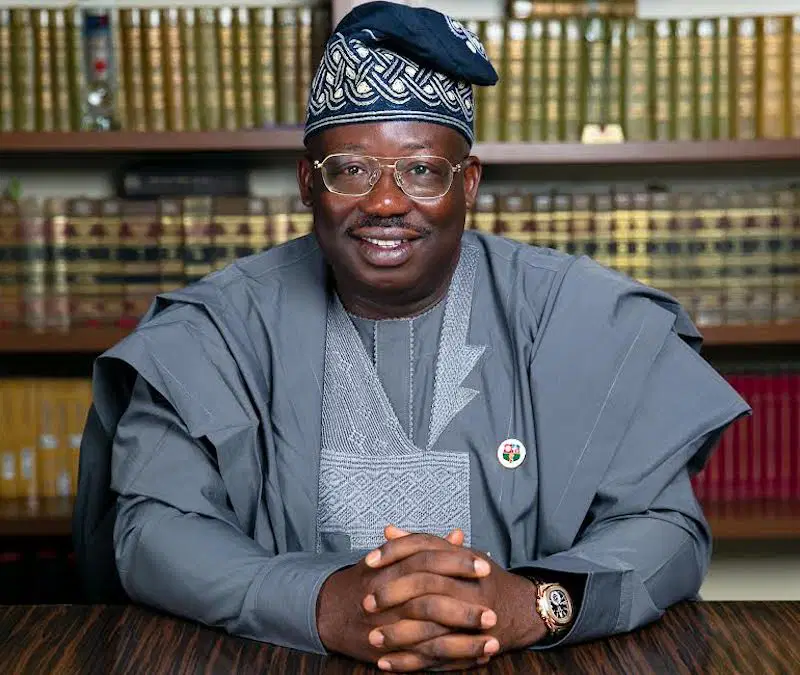
Hon. Dele Kelvin Oye, former National President of the Nigerian Association of Chambers of Commerce, Industry, Mines and Agriculture (NACCIMA) and past Chairman of the Organised Private Sector of Nigeria, has called for a fundamental rethink of how government engages with the economy, warning that Nigeria’s current system is heavily tilted towards rent-seeking rather than real production.
Oye, who is also Chairman of the Alliance for Economic Research and Ethics LTD/GTE and the Nigeria–Türkiye Business Council, delivered a keynote paper at the 2026 Vanguard Economic Discourse in Lagos titled “The Government as Facilitator, Not Operator: A New Paradigm for Nigeria’s Livestock Industry.”

In the paper, he argued that Nigeria’s $74 billion livestock sector risks becoming another abandoned national project if the country repeats past mistakes of direct government participation in business.
“The government should facilitate, not operate. Whenever government tries to run businesses, the outcome has consistently been failure,” he warned, pointing to long-standing industrial projects such as Ajaokuta Steel as examples of wasted investments and misplaced priorities.
Speaking on Nigeria’s economic situation, Oye said the country stood on the edge of fiscal crisis as of 2023, noting that debt servicing had consumed a dangerously high share of government revenue while inflation, unemployment, and subsidy costs placed enormous pressure on public finances.
He acknowledged recent reforms under President Bola Tinubu’s administration, including fuel subsidy removal and exchange rate unification, describing them as painful but necessary steps that have begun to stabilise the macroeconomic environment.

However, he cautioned that macroeconomic stability alone does not translate into improved living standards.
“GDP may be growing, but poverty is also rising. That is the paradox we must confront,” he said, referencing estimates that place over 130 million Nigerians below the poverty line.
According to him, Nigeria’s growth pattern remains skewed towards sectors such as finance and telecommunications, while agriculture, manufacturing, and livestock—the largest employers of labour—remain underfunded and underdeveloped.
Oye also criticised the banking sector’s increasing preference for investing in government securities over lending to productive industries, arguing that this has deepened structural weaknesses in the economy.
“It is more profitable for banks to buy government bonds than to finance farmers or manufacturers. That is why the real economy is starving while financial profits are rising,” he said.
He noted that Nigeria’s food import bill, estimated at trillions of naira annually, is evidence of the country’s failure to invest in domestic production systems.
Turning specifically to livestock, Oye described the sector as a major untapped opportunity capable of transforming Nigeria’s economy if properly structured.
He estimated that Nigeria’s livestock industry currently contributes tens of billions of dollars to GDP but remains largely informal, underproductive, and dependent on outdated practices.

According to him, the sector could become a major driver of export earnings, job creation, and food security if government focuses on enabling infrastructure, policy stability, and private sector participation rather than direct ownership.
He also linked the persistent farmer–herder conflict to weak resource governance, arguing that clear land-use systems and structured investment in ranching and livestock value chains could significantly reduce tensions.
Oye concluded by urging policymakers to adopt a facilitator model of governance, where government sets rules, provides infrastructure, and ensures regulation, while private sector actors drive production and investment.
“Nigeria has the resources, the market, and the population. What we lack is a system that allows productivity to thrive without unnecessary state interference,” he said.