

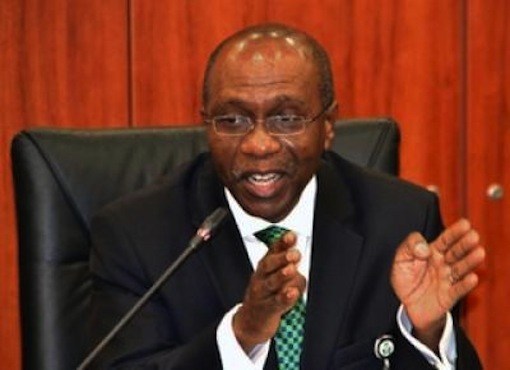
The Economic and Financial Crimes Commission (EFCC) has urged an Abuja High Court to dismiss a no-case submission filed by former Central Bank of Nigeria (CBN) Governor, Godwin Emefiele, insisting that the evidence presented by the prosecution is sufficient to require him to enter his defence.
The application was argued on Tuesday, October 20, 2026, before Justice Hamza Mu’azu of the Federal Capital Territory High Court sitting in Maitama, Abuja.

Emefiele is facing an amended 20-count charge involving allegations of criminal breach of trust, forgery, abuse of office, conspiracy and obtaining money by false pretence. The charges include the alleged fraudulent withdrawal of $6.23 million from the CBN and the alleged granting of undue advantage in the award of bank contracts.
Representing the prosecution, the Director of Public Prosecutions of the Federation, Rotimi Oyedepo, SAN, argued that the evidence presented during the trial had established a prima facie case against the former CBN governor.
Oyedepo explained that a no-case submission was intended to determine whether the prosecution had presented sufficient evidence to warrant a defendant entering a defence, rather than to establish guilt or assess the credibility of witnesses at that stage.

He maintained that requiring Emefiele to defend himself would not amount to compelling him to prove his innocence but would provide an opportunity to respond to the allegations supported by the prosecution’s evidence.
EFCC QUESTIONS CBN CONTRACT AWARDS
Addressing the contract-related charges, the prosecution argued that the evidence linked Emefiele’s approval of contracts to companies allegedly associated with members of his family and other associates.
Oyedepo referred to approval documents bearing Emefiele’s signatures and corporate records relating to companies, including Architekon Nigeria Limited, which the prosecution alleged had connections to the former governor’s relatives.
He also raised questions about contracts allegedly awarded to April 1616 Investment Limited, which the prosecution linked to Sa’adatu Ramalan Yaro, an associate of Emefiele.

According to the EFCC, contracts valued at between $6 million and $10 million were processed without the required scrutiny of the CBN’s Major Contracts Tender Board.
Oyedepo told the court that contracts exceeding $1 million were expected to undergo review by the board before recommendations were forwarded to the governor for approval.
He argued that bypassing the board prevented the necessary checks, including scrutiny of whether CBN employees held directorship positions in companies seeking contracts from the bank.
The prosecution further relied on testimony from a procurement department staff member, identified as PW10, who reportedly stated that multiple companies submitted bids for the contracts but that officials were allegedly instructed to favour a particular company.

Oyedepo also alleged that the favoured company had access to the CBN’s internal pricing information and submitted bids matching the bank’s prices, potentially undermining fair competition.
He maintained that the central issue was whether the procurement process was fair, arguing that the completion of the contracts did not automatically invalidate the allegations.
The prosecution also contended that the company in question had not secured similar contracts before Emefiele became CBN governor but subsequently received all 45 contracts under consideration.
Oyedepo further cited alleged transfers from Emefiele’s personal account to the company’s account as evidence that the former governor knew about the company and its directors.
He argued that approving contracts was different from merely accepting recommendations from officials, insisting that Emefiele should have referred the contracts back to the appropriate board if the required procedures had not been followed.

ALLEGED $6.23 MILLION WITHDRAWAL
The prosecution also addressed the allegation that $6.23 million was withdrawn from the CBN under the purported authorisation of former President Muhammadu Buhari and former Secretary to the Government of the Federation, Boss Mustapha.
According to the EFCC, the funds were released in 2023 for an alleged foreign election observer mission, based on letters that investigators contend were forged.
Oyedepo relied on testimony from witnesses, including Mustapha and a forensic analyst, to argue that the documents used to facilitate the release of the money were not genuine.
The prosecution also cited testimony from PW15, who reportedly told the court that an automatic notification was triggered for Emefiele when the relevant account went into debit following the transaction.

Oyedepo argued that the former governor’s alleged failure to act on the notification raised questions about possible criminal negligence and breach of trust, given his position and responsibilities at the bank.
The prosecution further alleged that the money was released to an individual on Emefiele’s instructions, with part of the funds reportedly used to renovate one of his properties. The remaining money was said to have been recovered from the recipient.
On the defence’s argument that the allegations were speculative, Oyedepo maintained that inferences drawn from admissible evidence should not be confused with speculation.
He also argued that the absence of a forensic examination of Emefiele’s signature did not, by itself, defeat the forgery allegations, submitting that the court could consider the disputed signatures in accordance with the law.

DEFENCE SEEKS DISCHARGE
Emefiele’s lead counsel, Mathew Burkaa, SAN, urged the court to discharge his client, arguing that the prosecution had failed to establish the essential ingredients of the alleged offences.
Burkaa maintained that the evidence presented did not demonstrate that Emefiele personally benefited from the contracts or manipulated the CBN’s tender process to favour his associates.
He also argued that the prosecution had not sufficiently established that the former governor conferred undue advantage on his wife or other associates.
The defence questioned the reliance on Emefiele’s approval of contracts, maintaining that approval alone did not establish the alleged criminal conduct.

The EFCC, however, insisted that the totality of the evidence, including witness testimony and documentary exhibits, justified requiring Emefiele to respond to the charges.
Emefiele had earlier pleaded not guilty to the amended charges. The prosecution subsequently called 15 witnesses and tendered documentary evidence before closing its case in July 2026.
After hearing arguments from both sides, Justice Mu’azu stated that the date for delivering a ruling on the no-case submission would be communicated to the parties through their lawyers.
The court’s forthcoming decision will determine whether Emefiele must enter his defence or whether the case can be dismissed at this stage. The allegations remain subject to judicial determination.