

HeadlineNews.News | Economic Governance | May 2025
State Debt Falls by 32% Nationwide: How Tinubu’s Economic Reforms Are Reshaping Nigeria’s Fiscal Landscape
By HeadlineNews.News Editorial Desk
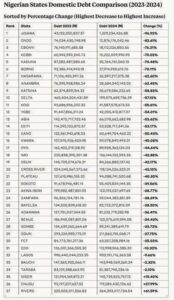
In a fiscal turnaround unprecedented since the return of democracy in 1999, Nigerian states have recorded a combined debt reduction of over 32% within one year, driven largely by sweeping economic reforms implemented by President Bola Ahmed Tinubu.
The reforms, including the removal of fuel subsidy, adoption of a market-driven foreign exchange system, and a strategic overhaul of federal revenue distribution, have drastically improved federation allocation (FAAC) disbursements, empowering states to pay off debts and ramp up infrastructure investment without resorting to borrowing.

Alex Otti: A Case Study in Strategic Fiscal Management
Nowhere is this transformation more evident than in Abia State, where Governor Alex Otti, a former banker and economist, has paid off N72 billion in state debt in under two years.
“We spent N36 billion on a road that had been abandoned for three decades. We did not borrow. The money came from increased FAAC receipts,” Otti stated during a recent policy forum.
Critics questioned whether Otti supported the federal subsidy removals, but economic observers argue that it would be illogical to expect a seasoned finance expert to oppose the very policies that have empowered him to revamp a debt-ridden state without loans.

Delta State: From Bailouts to Budget Surplus
Delta State repaid a staggering N265.83 billion in 2024 alone and exceeded its internally generated revenue (IGR) target by 197%, according to figures from the State Ministry of Finance. Delta, previously reliant on federal bailouts during the Buhari administration, is now investing in industrial hubs, roads, and social services.
“The President gave states a new lease of life. There’s no denying it,” said Dr. Raymond Okonkwo, a development economist. “What we’re seeing is a fiscal liberation of states.”

A New Economic Reality for Subnationals
Between 2015 and 2022, most states struggled with liquidity crises, accumulated unpaid salaries, stalled infrastructure projects, and dependence on federal bailouts. But following Tinubu’s reforms:
FAAC allocations rose by over 60% in real terms
Over 20 states reduced their debt portfolios
Many states reported surpluses in Q4 2024 for the first time in a decade
The Nigerian Governors Forum (NGF) has largely refrained from publicly criticizing Tinubu’s fiscal policies, reflecting what many analysts interpret as quiet approval.
“Governors who once lobbied for federal bailouts are now back in surplus,” noted Prof. Zainab Ahmed, former finance minister. “That’s why they sing ‘On Your Mandate’ with renewed fervor.”
“This is not magic, it’s strategy,” added Dr. G. Fraser, MFR, a fiscal policy analyst. “The subsidy reform freed critical funds for the states. Instead of spending on inefficiencies, governors are now repaying debts, investing in roads, and planning wage increases. It’s a smart national shift.”

A Sacrifice That Changed the Game
President Tinubu took what observers have described as the “biggest political bullet” in modern Nigerian economic history by ending fuel subsidies—a move long avoided by his predecessors. Though it resulted in temporary inflation spikes and public discontent, it also freed up over N4 trillion annually, allowing the federal and state governments to stabilize finances.
From Crisis to Confidence
States that once owed months of salary arrears are now paying contractors, servicing debts, and investing in infrastructure without new borrowing.
This economic redirection may well define Tinubu’s legacy.
“The governors know the truth,” said columnist Abdulrahman Bello. “And come 2027, the political support they offer Tinubu will reflect that truth.”
Editor’s Note: For comments and contributions, contact: editor.headlinenews@gmail.com





DISSENTING OPINION.
Comments from Experts & Stakeholders.
I learnt today that you can’t transfer FX in between accounts in a bank for instance zenith to zenith account. Unless the money is resident in an oil company. So In short to make an FX transaction best to transfer the money abroad then send it back to Nigerian bank. What we are witnessing is the dollarization of the Nigerian economy which is very bad. Also during Buhari time one thing that was guaranteed FX could not leave the economy so people were investing in the Nigerian economy. Tinubu s economics makes you send money abroad and the money isn’t coming back it is going to dubai to buy real estate. This is very bad!!! How much more of this can Nigeria take?
This is a spin FAAC is more because there is more Naira which is as a result of the increase price of crude. Also coupled with this is the net increase in borrowing which is strange while they say they have paid off IMF they have new loans which is creating surplus in the economy because of the exchange rate it is a spin. Borrowing from Peter to pay paul and this is all for 2027
Headlinenews.news would like the government agencies responsible for this to look into it. These little things make life more difficult for entrepreneurs and small scale businesses. Thank you for working on this.
Please email us on any aspect of this administration you feel could be corrected. Thanks.
editor.headlinenews@gmail.com