

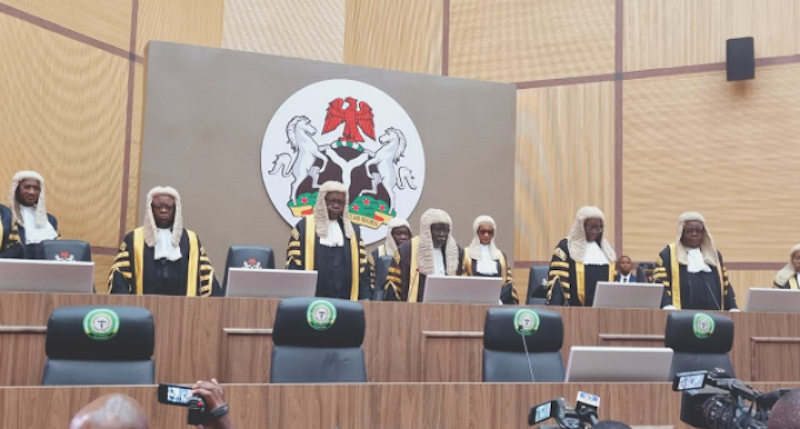
The Supreme Court of Nigeria has delivered a landmark ruling reinforcing the constitutional right to fair hearing, overturning a controversial decision that raised serious concerns about justice and legal fairness.
The case revolved around an unusual legal situation in which a claimant in a debt recovery dispute attempted to indirectly control both sides of the case. This was done through a receiver appointed by the claimant, who was positioned to determine the legal representation of the defendant companies involved in the same dispute.

In its earlier ruling, the Court of Appeal had disqualified the lawyers chosen by the companies and instead recognised the receiver as the sole authority to appoint their legal counsel. This decision sparked widespread concern, as it effectively gave one party influence over both the prosecution and defence in the case.
However, in a unanimous judgment, the Supreme Court rejected this position, describing it as flawed and a violation of fundamental legal principles. The apex court held that allowing a receiver—whose appointment was itself being challenged in court—to control the legal representation of the companies created a clear conflict of interest.

According to the court, such an arrangement undermines the essence of fair hearing, which guarantees every party the right to choose their own legal representation without interference. It stressed that the issues before the trial court were central to determining the validity of the receiver’s appointment, making it inappropriate for the same receiver to influence the defence.
The ruling emphasised that no party should be placed in a position to dominate or manipulate legal proceedings to its advantage. By restoring the companies’ right to appoint their own lawyers, the Supreme Court reaffirmed the independence of legal representation as a cornerstone of justice.

Legal experts have welcomed the judgment, noting that it protects the integrity of the adversarial system, where each party must be free to present its case independently. They also described the earlier decision as a serious threat to constitutional rights, particularly the right to fair hearing.
The case also highlighted broader concerns about the misuse of ex parte orders—legal actions taken without notifying the opposing party. Critics argued that such orders were excessively used in the dispute, raising questions about procedural fairness and judicial overreach.

The Supreme Court’s intervention has now set a strong precedent, making it clear that legal processes cannot be manipulated to give one side undue advantage. It sends a clear message that constitutional protections must always take precedence over procedural tactics.
Ultimately, the judgment restores confidence in the justice system by reaffirming that fairness, transparency, and equality before the law must remain central to all legal proceedings in Nigeria.





https://shorturl.fm/dVpOq
This post is a fantastic resource for anyone wanting a reliable overview. The focused explanations and completely neutral approach make it a pleasure to read, and I will certainly be keeping this page bookmarked for any future reference I might need.
Casinos online cuenta rut