The recent political controversy surrounding the International Monetary Fund’s (IMF) observations on Nigeria’s public finances has once again demonstrated why facts must always take precedence over political rhetoric.
Former Vice President Atiku Abubakar has described the matter as a “constitutional emergency,” alleging that the Tinubu administration secretly spent approximately ₦8.8 trillion outside Nigeria’s official budget and beyond democratic accountability.
The allegation has understandably generated widespread public interest. Nigerians have every right to demand transparency, accountability and prudent management of public resources. Every kobo of public expenditure should ultimately be traceable, properly documented and subject to constitutional oversight.
However, there is an equally important obligation in every democracy: political actors must accurately represent what independent institutions actually say.
That distinction is where this debate becomes important.
The IMF did raise concerns about Nigeria’s fiscal reporting. But it did not declare a constitutional crisis. It did not accuse the Federal Government of stealing ₦8.8 trillion. It did not conclude that the expenditure was illegal. Nor did it state that the President violated the Constitution. Those are political conclusions that go beyond the IMF’s published findings.
Speaking in Lagos, the IMF Resident Representative in Nigeria, Christian Ebeke, explained the issue in technical fiscal terms.
According to him:
“So far we think that there are about 2% of GDP of expenditure that were not reported that should be reported and should be recorded, so that this statistical discrepancy will disappear.”
That single sentence is perhaps the most important in the entire controversy.
Notice carefully what the IMF actually said.
It spoke about expenditure that was not reported.
It recommended that such expenditure should be reported and recorded.
It identified a statistical discrepancy between Nigeria’s reported fiscal deficit and its financing needs.
What the IMF did not say is equally important.
It did not describe the expenditure as stolen.
It did not say the funds disappeared.
It did not accuse the government of operating an illegal treasury.
It did not declare that the expenditure violated Nigeria’s Constitution.
It did not recommend impeachment or describe Nigeria as facing a constitutional emergency.
Those descriptions originated from political commentary—not from the IMF.
Reuters, which first reported the IMF official’s remarks, similarly described the issue as one of public spending not recorded in recent official budgets, resulting in a gap between the reported fiscal deficit and the government’s actual financing requirements. Reuters did not characterise the matter as proof of corruption or constitutional breach.
The distinction matters because IMF Article IV Consultations are technical economic assessments, not criminal investigations.
Around the world, the IMF routinely recommends improvements in fiscal transparency, debt reporting, contingent liabilities, off-budget entities and statistical accounting. Countries as diverse as Ghana, Kenya, South Africa, Brazil, India and even advanced economies have received recommendations to strengthen fiscal reporting and budget credibility.
Such recommendations are designed to improve public financial management—not to determine criminal liability.
Indeed, the same IMF Article IV Consultation that highlighted the reporting gap also commended Nigeria’s difficult macroeconomic reforms.
The IMF acknowledged improvements in foreign exchange market functioning, stronger investor confidence, increased resilience of the economy and progress in restoring macroeconomic stability, while also warning that many Nigerians have yet to feel the full benefits of the reforms and urging government to strengthen governance, transparency and inclusive growth.
Unfortunately, much of the political debate has quoted only the criticism while omitting the commendations contained in the same report.
This selective presentation risks misleading the public.
None of this means Nigerians should ignore the IMF’s concerns.
Far from it.

The IMF’s observations deserve serious attention.
If expenditures equivalent to about two per cent of GDP were not fully reflected in official budget documents or implementation reports, government owes Nigerians a comprehensive explanation.
Parliament should exercise its constitutional oversight.
The Auditor-General should continue independent scrutiny.

Budget documentation should become more comprehensive.
Procurement procedures should remain transparent.
Public confidence depends upon these institutions functioning effectively.
Demanding those explanations is entirely legitimate.
However, demanding explanations is fundamentally different from declaring guilt before the facts have been fully established.
The Federal Government has maintained that the issue relates to the presentation and consolidation of fiscal accounts rather than unlawful expenditure. Officials argue that some expenditures relate to multi-year infrastructure projects, statutory transfers, supplementary appropriations and other financing mechanisms that require fuller reflection in consolidated fiscal reporting. Whether that explanation ultimately satisfies Nigerians is a matter for evidence, parliamentary oversight and independent audit—not political assumption.
In every democracy, opposition parties have both the right and the responsibility to question government spending.
Likewise, governments have the obligation to answer those questions transparently.
But responsible democratic discourse also requires that international institutions are quoted accurately and in context.
Transforming a technical IMF observation into proof of constitutional misconduct without independent legal or forensic findings risks politicising what is fundamentally a public finance issue.

Nigeria benefits when accountability is pursued through facts rather than assumptions.
The real questions Nigerians should now ask are straightforward.
Which specific expenditures were omitted from the reported fiscal accounts?
Were they authorised under existing Appropriation Acts, Supplementary Appropriation Acts or other statutory provisions?
Why were they not fully reflected in official budget implementation reports?

What reforms are required to eliminate such discrepancies in future budgets?
Those are the questions that strengthen democratic governance.
Ultimately, transparency should never be sacrificed for politics, but neither should politics replace evidence.
The IMF asked Nigeria to improve fiscal reporting and eliminate statistical discrepancies. It did not pronounce a constitutional emergency, declare ₦8.8 trillion missing or accuse the Federal Government of unlawful expenditure.
Democracy is strengthened when governments answer legitimate questions openly, institutions perform their constitutional duties independently and political leaders resist the temptation to convert technical findings into predetermined political verdicts.
Nigeria deserves complete transparency.
Nigeria also deserves complete accuracy.
The two are not mutually exclusive—they are the twin pillars upon which public trust is built.
The National Patriots urges Nigerians to critically examine public issues before embracing politically charged narratives. The IMF raised concerns about fiscal reporting and transparency, while also acknowledging Nigeria’s macroeconomic progress, and the Federal Government has provided its response. Technical fiscal observations should not be weaponised for partisan advantage or distorted into conclusions not reached by the IMF itself. Political parties should allow government to govern and reserve electioneering for the appropriate time under INEC’s electoral timetable. Nigerians deserve facts, not sensationalism.
ATIKU ABUBAKAR SPEAKS
Atiku Abubakar Declares A “Constitutional Emergency”, As IMF Alerts World Leaders, Exposes President Bola Tinubu’s Federal Government For Secretly Spending ₦8.8 Trillion Outside Nigeria’s Official Budget, With No Official Democratic Accounting, No Audit And Completely Hidden From The Nigerian Public
The entire country may be forced to chase the ruling All Progressives Congress, APC, out of the Aso Rock Presidential Villa, Abuja, even before the 2027 general elections, following the International Monetary Fund’s, IMF, latest assessment of Nigeria’s public finances under President Bola Ahmed Tinubu’s administration.
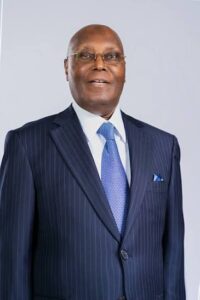
The controversy stems from the IMF’s latest Article IV Consultation, published by Reuters, on July 1, which highlighted that public expenditures equivalent to about 2 percent of Nigeria’s Gross Domestic Product, GDP, were executed outside recent official budget documents.
The report quickly came to limelight, after His Excellency, former Vice President and 2027 African Democratic Congress, ADC, Presidential Candidate, Atiku Abubakar, on Saturday, accused the President Tinubu administration of operating what he described as a “parallel fiscal universe”.

Atiku said in reaction to the report: “My attention has been drawn to a deeply troubling report by the International Monetary Fund… which reveals that the Tinubu-led APC administration failed to record public expenditures amounting to approximately two percent of Nigeria’s Gross Domestic Product in recent official budgets.”
Using Nigeria’s estimated GDP, Atiku put the value of the expenditure at ₦8.8 trillion, alleging that the funds were spent “outside the statutory framework of Nigeria’s official budget documents, unaccounted for, unaudited and hidden from the Nigerian people”.
To many discerning minded Nigerians, Atiku’s claims go beyond the IMF’s findings, but have amplified a debate that extends far beyond partisan politics.

The issue is off-budget spending, that the government undertook outside the annual Appropriation Act approved by the National Assembly.
For Nigerians, the timing could hardly be more sensitive, following the fact that the President Tinubu administration is known notorious for spending without democratic appropriation.
Against this backdrop, questions over whether trillions of naira were spent outside the country’s formal budget process, and why, are certain to resonate with both citizens and Investors.

The IMF has repeatedly urged President Tinubu to improve budget credibility, strengthen public financial management and ensure that all government expenditures are fully reflected in official fiscal accounts.
For Atiku and millions of Nigerians, those spendings without appropriation, amount to a Constitutional crisis.
He stated: “The Tinubu administration is awarding multi-trillion naira contracts, moving massive public capital, and commissioning infrastructure projects entirely beyond the reach of the Auditor-General, the nation’s Procurement Laws, and the legitimate oversight of the National Assembly.”

Budget transparency is more than an accounting exercise. It is one of the primary measures by which Investors, Development Partners and International Financial Institutions assess a government’s credibility. Any perception that significant public expenditures are escaping Legislative scrutiny, risks undermining confidence in fiscal governance, particularly as Nigeria seeks foreign investments and negotiates mounting debt obligations.
Atiku, therefore, consequently demanded emergency hearings by the National Assembly, a comprehensive audit by the Auditor-General of the Federation and full public disclosure of every expenditure referenced by the IMF.

“The revelation of ₦8.8 trillion in unrecorded public expenditures is a Constitutional emergency”, he declared.
Princess Gloria Adebajo-Fraser MFR
President, The National Patriots.
Special Adviser to Former President Goodluck Jonathan.