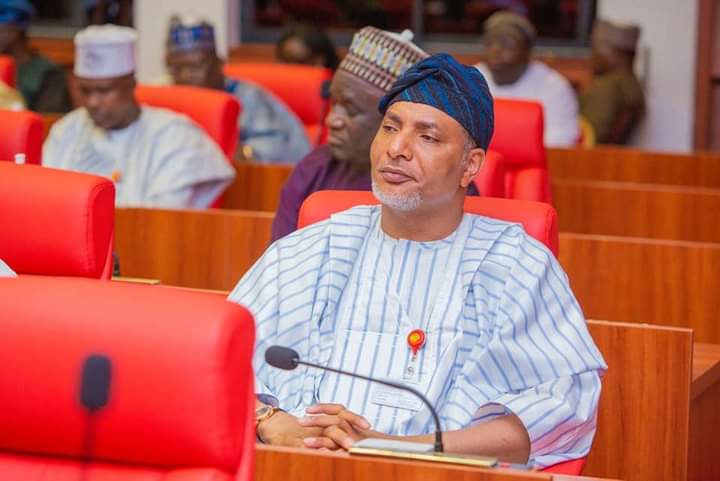
The political future of Senator Saliu Mustapha, who represents Kwara Central in the National Assembly, has become a major talking point following recent developments within the All Progressives Congress (APC) ahead of the 2027 general elections.
When Mustapha joined the APC governorship race, many supporters believed that regardless of the outcome, he would remain one of the party’s biggest beneficiaries in its succession arrangement.
However, events since the governorship primary have altered that expectation.
With Speaker Yakubu Danladi Salihu emerging as the APC governorship candidate and Governor AbdulRahman AbdulRazaq now listed by INEC as the party’s candidate for the Kwara Central Senatorial District, attention has shifted to what lies ahead for one of the state’s most prominent politicians.
Mustapha entered the governorship race as one of the leading contenders.
Before the primary, he had built an extensive campaign network across Kwara State, and many of his supporters believed years of political preparation would finally culminate in securing the party’s ticket.

Even after Governor AbdulRazaq publicly endorsed Ambassador Abdulfatai Yahaya Seriki, Mustapha remained in the contest, insisting that his ambition was solely to become governor and dismissing reports linking him with the Senate seat.
The primary eventually produced Speaker Danladi as the APC flag bearer, ending Mustapha’s governorship bid.
As is common after fiercely contested primaries, discussions quickly turned to reconciliation.
Within APC circles, many believed unsuccessful governorship aspirants would be accommodated in order to preserve party unity. Governor AbdulRazaq had also indicated that those who contested would be compensated with appointments.
For Mustapha, many party members expected the easiest path to reconciliation would be his return to the Senate, where he currently serves as a first-term senator representing Kwara Central.
That expectation, however, has diminished.
Governor AbdulRazaq’s emergence on INEC’s list as the APC senatorial candidate for Kwara Central has significantly changed the political equation.
If the situation remains unchanged, Mustapha could leave office in 2027 without securing either the governorship ticket or a return to the Senate.
The development has sparked fresh debate within the APC and among political observers.
It has also revived discussions about Mustapha’s relationship with Governor AbdulRazaq.
In the months leading to the primary, reports suggested a strained relationship between both men, with supporters on both sides openly disagreeing on political matters. Allegations also surfaced that some constituency projects associated with Mustapha experienced challenges within the state, although many of those claims were never officially confirmed.

Against that backdrop, some observers now view the Senate ticket as part of a broader contest over political influence within the Kwara APC after Governor AbdulRazaq leaves office in 2027.
Mustapha remains one of the party’s most influential figures.
Before becoming a senator, he built a strong political base through scholarships, empowerment programmes, grassroots mobilisation and sustained support for party members. His election to the Senate in 2023 further strengthened his political profile and positioned him as a leading contender for the governorship.
With both opportunities now appearing uncertain, attention has shifted to his next political move.
Meanwhile, Mustapha and other members of the G15 group have continued to reject the outcome of the governorship primary, insisting that the process is not yet concluded.
The G15, which comprises leading governorship aspirants and prominent APC stakeholders, including Ambassador Yahaya Seriki, Senator Oloriegbe and Bashir Omolaja Bolarinwa (BOB), maintains that the primary that produced Danladi did not reflect earlier agreements reached before the exercise.
The group continues to insist that one of its members should emerge as the APC governorship candidate.
One of the coalition’s leaders, Salman Jawondo, recently told Daily Trust that the struggle would continue until September 19, the deadline for the substitution of candidates.
Asked what would happen if Danladi remained the party’s candidate after that date, he said the group would decide its next steps at the appropriate time.
His comments suggest that despite Danladi’s emergence as APC candidate, internal disagreements within the party remain unresolved.
Responding to recent developments, Mustapha’s aide, Alabi Abdulkareem, said the senator’s next political decision would be determined by consultations within the G15 coalition and engagements with his supporters and political associates across Kwara State.
He described Mustapha as one of the state’s foremost political stakeholders whose role in the 2027 political transition would remain significant.
According to him, Mustapha’s future political direction would be guided by the collective decisions of the G15 and consultations with his own political structure rather than personal ambition alone.
“Senator Saliu Mustapha remains one of the foremost stakeholders in the political landscape of Kwara State. With the 2027 general election shaping up to be a defining moment, his role in the succession process will remain significant.

“By the grace of God, regardless of the current developments within the Kwara APC, Senator Mustapha will continue to be a relevant force and an active participant in shaping the future of Kwara State.
“He is also a key member of the coalition of APC stakeholders under the banner of the G15, a group advocating far-reaching reforms and a return to the ideals of inclusive, transparent and responsible leadership in Kwara State.
“Their engagement is driven by a shared commitment to strengthening the party, safeguarding the values of the Otoge movement and ensuring that the 2027 political transition reflects the collective aspirations of party members and the people of the state.
“Accordingly, Senator Mustapha’s political decisions ahead of the 2027 elections will be guided by two overriding considerations: the collective direction ultimately adopted by the G15 coalition following ongoing consultations with critical stakeholders, and the outcome of consultations with his political structure, supporters and associates across Kwara State. It is these collective deliberations, rather than personal ambition alone, that will shape his eventual political direction for 2027, by the will of God,” he said.
President of the Nigerian Society of International Affairs (NSIA), Prof. Hassan Ajisafe Saliu, believes the political space is gradually narrowing for Mustapha and other G15 members to realise their ambitions, although he did not entirely rule out last-minute developments before the September 19 substitution deadline.
He noted that many had expected the crisis within the Kwara APC to be resolved through reconciliation, but recent events suggest that possibility is fading.

“All along, the expectation was that some miracle would happen and somebody would be reconciled with somebody. But now that the miracle has failed to happen, it means we have to take it from there,” he said.
According to him, although the G15 still hopes for changes before September 19, every passing day reduces the likelihood of such an outcome.
“Let us not rule out any possibility. But if anything will happen, it will happen within the remaining months. The longer nothing happens, the more difficult it becomes to expect any major change,” he added.
Saliu also observed that opportunities outside the APC appear limited because major opposition parties have already produced their candidates, making it difficult for aggrieved APC aspirants to secure fresh governorship or legislative tickets elsewhere.
He suggested that aligning with another political platform may eventually become the most realistic option if reconciliation within the APC fails.
Asked whether the G15 leaders would remain in the APC, he said it was premature to draw conclusions because the coalition still believes the contest is not over.
“For now, there is a coalition, there is an agreement and there is an alliance among them, believing that the door is not yet closed. They are entitled to that belief. But when the chips are finally down, we may witness a different political scenario,” he said.

Indications have also emerged that Mustapha and members of the G15 are already exploring alternatives beyond the APC.
The group has reportedly begun engaging with another political platform known as TOP ahead of the 2027 elections.
The move provides the aggrieved stakeholders with another possible avenue for political engagement should their efforts within the APC fail to produce the outcome they seek.
While the coalition insists its struggle within the APC continues, the emergence of TOP signals that its members are preparing for multiple political possibilities beyond the September 19 substitution deadline.
For Mustapha, the coming weeks may prove decisive.
Whether he eventually remains in the APC, secures accommodation through reconciliation or joins a broader political realignment could depend on the outcome of ongoing consultations within the G15, developments before the substitution deadline and the direction ultimately taken by TOP and its allies.
What is increasingly evident is that Mustapha’s political future has moved beyond the outcome of the APC governorship primary.
With his Senate return now uncertain, the G15 broadening its political options and internal negotiations continuing, the weeks ahead are expected to determine whether the crisis ends in reconciliation, renewed internal contest or a wider political realignment in Kwara State.