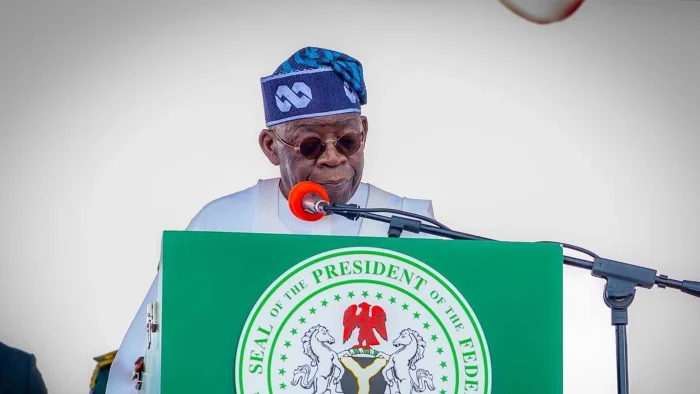
President Bola Ahmed Tinubu has said Nigeria is entering a new phase of economic development in which the Federal Government will focus on reducing the cost of living, creating jobs and ensuring that the benefits of economic growth reach more Nigerians.
Tinubu made the declaration in his Independence Day address to mark Nigeria’s 66th anniversary. In the address, titled “From Reform to Prosperity,” the President defended the economic reforms introduced by his administration and called on Nigerians to remain committed to the process.

According to Tinubu, the country has reached a turning point after what he described as a difficult period of economic reforms. He said the government had moved beyond correcting longstanding economic problems and was now concentrating on translating economic growth into improved living conditions for citizens.
The President described the reforms as painful but necessary measures to address structural weaknesses that had accumulated over several decades.
He argued that previous governments had often postponed difficult economic decisions and maintained arrangements that were becoming increasingly unsustainable.
Tinubu said his administration instead chose to confront what he described as the underlying problems in the economy, acknowledging that the process had created hardship for many Nigerians.
He maintained, however, that the economic difficulties experienced during the reform period should not be attributed entirely to the policies introduced by his administration.

“Our reforms did not create the weaknesses in our economy. They confronted them,” the President said, while warning against returning to policies that he described as unsustainable subsidy arrangements.
Tinubu said economic indicators were beginning to show signs of improvement, citing economic growth of more than four per cent, contributions from both the oil and non-oil sectors, reduced oil theft and a decline in inflation from its peak.
He also pointed to stronger foreign reserves and a more stable foreign exchange market as signs of progress.
According to the President, Nigeria recorded more than $6 billion in non-oil export revenue in 2025, which he described as the country’s highest-ever figure.
He further said foreign direct investment was continuing to increase, arguing that the changes in the Nigerian economy were being observed by international institutions and other stakeholders.

FOCUS SHIFTS TO COST OF LIVING
Tinubu said the next phase of his administration would focus more directly on improving the welfare of Nigerians.
He said the government’s understanding of prosperity goes beyond economic growth figures and should be reflected in the daily lives of citizens.
According to him, farmers should be able to produce at lower costs and earn reasonable returns, manufacturers should have access to dependable electricity, businesses should be able to obtain credit and young Nigerians should have access to productive employment.
The President identified the reduction of living costs as an immediate priority.
He said the government would pursue this objective by reducing the cost of producing and transporting goods across the country.
Tinubu acknowledged that millions of Nigerians were still struggling with the rising costs of food, education, healthcare and transportation.

He attributed many of these difficulties to longstanding issues including low productivity, inadequate infrastructure, limited economic opportunities and weak institutions.
He said the challenges could not be eliminated within a single four-year administration because many had accumulated over generations.
“We cannot erase in four years what accumulated over generations. But we can change its course,” Tinubu said.
He also said the government would work towards reducing poverty while ensuring that vulnerable Nigerians were not left without support.
CONCERNS OVER GOVERNANCE AND LIVING CONDITIONS
The President’s speech came amid concerns from civil society organisations, political figures and development experts over Nigeria’s economic and social conditions.
The Human Rights Writers Association of Nigeria (HURIWA), for instance, said poor governance, weak institutions and insecurity continued to affect the country’s prospects for economic prosperity and social development.
The organisation’s National Coordinator, Emmanuel Onwubiko, argued that rising living costs, unemployment, underemployment and high energy and commodity prices were continuing to put pressure on households.

HURIWA also called for greater transparency and accountability in the management of public resources and expressed concern about the government’s reliance on borrowing.
Other commentators similarly raised concerns about leadership, corruption, infrastructure, security and the management of the country’s resources.
CALLS FOR STRONGER INSTITUTIONS
National Chairman of Igbo Agenda Dialogue, Dr Chekwas Okorie, said Nigeria needed stronger institutions and reforms capable of improving the economy, security and infrastructure.
He also expressed concern about ethnic and religious divisions and their potential influence on political discussions ahead of the 2027 elections.
Activist and former Labour leader Osmond Ugwu attributed many of the country’s challenges to poor leadership and corruption.
Ugwu argued that Nigeria could achieve stronger economic development if it had institutions focused on accountability, citizens’ rights and productive economic activity.
He also called for credible elections and greater participation in the democratic process.
Law Professor Olu Ojedokun of Lead City University, Ibadan, said economic and institutional problems would take time to reverse.
He called for improvements in the security system, adequate funding for security institutions and a tax system capable of generating sufficient resources for public services.
He also advocated greater decentralisation to bring government closer to citizens at the state and local levels.

DEVELOPMENT EXPERTS DEMAND BETTER PLANNING
Dr Adebukola Ayoola of the Department of History and Diplomacy at the University of Ilesa said Nigeria possesses the human and material resources needed to build a safer and more prosperous society.
She, however, identified the mismanagement of the country’s natural and human resources as a major obstacle to development.
Former Deputy National Chairman of the Peoples Democratic Party, Bode George, also called for greater national reflection on Nigeria’s development since independence.
He raised questions about issues including population census, political representation and the structure of local governments.
For Dr Otive Igbuzor, Founding Executive Director of the African Centre for Leadership, Strategy and Development, the central challenge is the failure to make development a consistent priority in government planning.

He argued that government policies, budgets and programmes should be deliberately designed around measurable development goals in areas such as housing, water, education, healthcare and transportation.
Igbuzor also urged citizens to become more involved in governance and pay closer attention to government budgets and how public resources are used.
He said stronger leadership, active citizenship and greater public awareness could help accelerate Nigeria’s development.
TINUBU CALLS FOR CONTINUED FOCUS ON REFORMS
Tinubu maintained that Nigeria had moved through the most difficult stage of its economic reforms and was now positioned to pursue broader prosperity.
He urged Nigerians to look beyond the sacrifices associated with the reform process and focus on the opportunities that could emerge from a more stable economy.
“The age of reform has done its work. Now begins the age of prosperity,” the President said.
He acknowledged that achieving lower living costs, widespread employment and sustained prosperity would require time, discipline and continued economic growth.
Tinubu concluded by urging Nigerians to remain focused on the country’s future, saying the government’s objective was to build an economy capable of creating opportunities and improving living standards across the country.