


Tinubu, Reform and the Making of a New Nigeria.
By Gloria Fraser, MFR
History has never rewarded nations that mistake comfort for progress. Every great country eventually reaches a defining moment when difficult decisions become unavoidable. At such moments, leaders either choose the easier path of postponement or the harder path of reform. The first wins applause in the present but often mortgages the future. The second attracts criticism today but may lay the foundation for tomorrow’s prosperity.
Nigeria stands at such a moment.
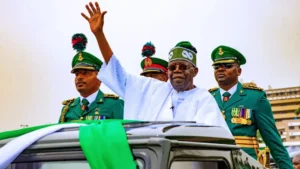
The conversation dominating our national life is often reduced to personalities, party affiliations and election calculations. Yet the real issue before the country is far more profound. The defining question is not whether one supports or opposes President Bola Ahmed Tinubu. It is whether Nigeria is finally prepared to confront structural challenges that have accumulated over decades or whether it will once again postpone difficult decisions and leave an even heavier burden for future generations.
History rarely judges nations by the popularity of their leaders. It judges them by whether they had the courage to change course when the old path had clearly become unsustainable.
No honest assessment of Nigeria’s present circumstances can begin in May 2023. The country’s economic and institutional challenges were decades in the making. Long before the present administration assumed office, Nigeria was grappling with declining oil production, heavy dependence on crude exports, mounting public debt, foreign exchange pressures, inadequate infrastructure, chronic electricity shortages, widespread insecurity and a subsidy regime that many economists had argued for years was becoming increasingly difficult to sustain.
These realities did not emerge overnight, and they could never have been resolved overnight.
Every administration inherited part of the problem and contributed, in different ways, to the nation’s journey. Some reforms were attempted. Others were postponed because they carried significant political costs. Each delay increased the complexity of the next decision. Eventually, Nigeria reached a point where maintaining the status quo became almost as costly as changing it.
That was the country President Tinubu inherited.
Within days of assuming office, his administration removed fuel subsidies and moved toward exchange-rate reforms that previous governments had hesitated to implement fully. Those decisions immediately altered the direction of economic policy. They also triggered painful consequences that millions of Nigerians continue to experience.
Transport costs rose sharply. Food prices climbed. Businesses struggled with higher operating expenses. Families found their incomes stretched by inflation. These hardships are genuine, and any serious discussion of reform must begin by acknowledging them.
But another question deserves equal attention.

Could Nigeria realistically have continued indefinitely with the policies it had followed for years?
That question lies at the heart of the national debate.
Throughout history, countries facing deep structural problems have often discovered that there are no painless solutions. India liberalised its economy in 1991 during a severe financial crisis. Indonesia undertook major reforms following the Asian Financial Crisis. Vietnam transformed its economy through gradual but sustained market reforms. Rwanda rebuilt institutions after one of the darkest periods in its history and pursued long-term governance reforms.
Each country’s circumstances were different. Nigeria cannot simply copy another nation’s experience. Nevertheless, they all demonstrate a common principle: meaningful national transformation rarely begins with comfortable decisions. It begins when leaders accept the political cost of confronting realities that can no longer be ignored.
For too long, Nigeria attempted to finance consumption while underinvesting in productivity. Roads required expansion. Ports required modernisation. Power generation remained inadequate. Agriculture struggled with low productivity. Manufacturing battled high costs. Public revenues consistently fell short of national ambitions. Every year that structural weaknesses remained unresolved made the eventual adjustment more painful.
This is the reality that every reforming nation eventually confronts.
No nation has ever achieved lasting prosperity by postponing difficult reforms indefinitely.
Democracy rightly encourages citizens to question government decisions. It is entirely legitimate to ask whether reforms are producing measurable improvements. Nigerians have every right to demand transparency, accountability, efficient public spending, better security and a higher standard of living. These are not unreasonable expectations. They are the essence of democratic governance.
At the same time, democratic debate should distinguish between inherited structural problems and the policies introduced to address them. It should also recognise that reforms are judged not only by the discomfort they create today but by the institutions, opportunities and stability they leave behind tomorrow.
History reminds us that leadership has never been measured solely by popularity. It is measured by whether difficult decisions ultimately strengthened the nation.
That does not mean every reform succeeds.
Nor does it mean every government deserves praise.
Governments must earn public confidence through results. Inflation must eventually come under control. Investment should increase. Infrastructure should improve. Security should become more effective. Institutions should grow stronger. Ordinary citizens should experience tangible improvements in their daily lives. Those are the standards by which any administration should be judged.
Equally, those who oppose reform should also answer an important question. If not these reforms, then what alternative path offers a more sustainable future for Nigeria? Every policy choice involves trade-offs. Preserving the status quo also carries costs, even when those costs are less immediately visible.
The future of Nigeria cannot be built on political slogans alone. It must be built on productivity, discipline, institutional strength, responsible public finance, investment, innovation and national unity. These objectives demand consistency over time. They cannot be achieved through abrupt policy reversals driven solely by electoral considerations.
The story of Nigeria has always been larger than the story of any president. It is the story of a resilient people blessed with extraordinary resources and immense potential, yet repeatedly challenged by structural weaknesses that have limited national progress. The opportunity before this generation is to begin changing that story.
Whether President Tinubu’s reforms ultimately succeed or fail will not be determined by campaign speeches, partisan loyalties or social media arguments. They will be judged by evidence. If the reforms contribute to stronger institutions, a more competitive economy, improved infrastructure, greater investment, enhanced security and better living standards, history will acknowledge their significance. If they do not, history will record that with equal honesty.
History has no permanent favourites.
It has only permanent records.
That is why the national conversation should rise above personalities and politics. The question before Nigeria is not simply who occupies Aso Rock today. The greater question is whether the country is finally prepared to confront challenges that previous generations repeatedly postponed.
Some decisions define governments.
Others define nations.
Nigeria now stands before one of those defining moments. The easiest path is to return to familiar habits and postpone difficult choices once again. The harder path is to remain committed to reforms while insisting on accountability, transparency and measurable progress.
Future generations will not remember who shouted the loudest in today’s political debates.
They will remember whether this generation had the courage to rebuild Nigeria when history placed that responsibility in its hands.
That—and not the noise of the moment—will be the true verdict of history.
Princess Gloria Adebajo-Fraser MFR.
Special Adviser to Former President Goodluck Jonathan.
President, The National Patriots.




