

A credible alternative must explain what changes, what it costs and how Nigerians benefit
Headlinenews.News | Policy Analysis | November 10, 2026
A presidential programme must explain more than what Nigerians need. It must establish what government will deliver, when, at what cost and with whose money.
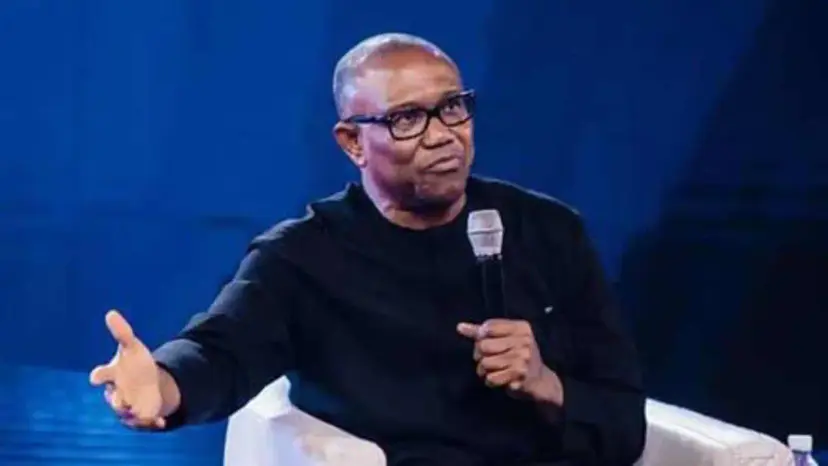
Peter Obi’s announced 2027 agenda identifies some of Nigeria’s urgent problems but has yet to demonstrate why his proposed solutions would deliver better results than programmes already underway with the Tinubu administration.
The central weakness in Obi’s presentation is the missing connection between ambition, financing and execution: what would change, what would it cost, and when would Nigerians eventually benefit?

Speaking in Jos, the Nigeria Democratic Congress candidate outlined priorities spanning unity, security, displaced communities, production, enterprise finance, education, healthcare and accountability.
Several overlap with existing Tinubu administration interventions or commitments in the APC’s 2027–2031 programme. Overlap partly invalidates a proposal. It places the burden on the challenger to demonstrate additional value.
This critique assesses publicly reported proposals, not a complete authenticated 2027 manifesto. Details absent from the presentation should be made available like APC Tinubu led manifesto.
The distinction between a town-hall address and a manifesto matters. A speech can introduce priorities without detailing every mechanism. Nevertheless, once those priorities are presented as grounds for changing government, questions about feasibility become legitimate. The campaign should make the supporting documentation accessible, which has not been done in this case.

SECURITY NEEDS MORE THAN ASSURANCE
Obi’s concern for bereaved families is understandable. However, assurances suggesting no family will suffer further violence exceed what any president can credibly guarantee.
Effective protection requires intelligence, personnel, equipment, coordination and prosecutions. What changes would he make to command arrangements? How would recruitment, training and continuing deployment be financed?
Tinubu’s second-term proposals include 28,000 additional military personnel and 50,000 police officers. These are future commitments, but provide numerical benchmarks.
Obi needs comparable detail. Determination to pursue kidnappers cannot replace an operational plan explaining how security agencies would perform better.

DISPLACEMENT: RESTORE LIVES, NOT SIMPLY CLOSE CAMPS
Obi’s ambition to return displaced Nigerians home addresses a humanitarian emergency. Treating the existence of any camp as absolute governmental failure is less defensible.
Conflict and natural disasters can generate displacement under any administration. Closing camps without restoring safety, housing and livelihoods would relocate vulnerability.
UNHCR emphasises voluntary, dignified and safe returns. Durable solutions also include integration into host communities or settlement elsewhere.
A credible programme needs security assessments, reconstruction, land-dispute resolution and livelihood support. The objective must be sustainable recovery.

PRODUCTION: DEFINE THE DIFFERENCE
Nigeria needs stronger agriculture and manufacturing. But productive investment already features in Tinubu’s programme.
The World Bank reported 4.2 per cent growth in the first half of 2026 and a 69 per cent real increase in gross federation revenues between 2023 and 2025, substantially reflecting economic reforms.
Those gains create development capacity; they do not prove every allocation has been efficiently spent.
Obi needs sector-specific answers: which industries, infrastructure bottlenecks, financing instruments and export markets would receive priority?
Production requires dependable electricity, competitive logistics, affordable inputs and customers. A slogan cannot coordinate those requirements.
ENTERPRISE FINANCE ALREADY HAS A FOUNDATION
The Federal Government’s ₦200 billion intervention package comprises a ₦50 billion grant scheme, ₦75 billion MSME fund and ₦75 billion manufacturing fund.
The Bank of Industry administers the package. Its MSME intervention carries nine per cent annual interest.
Separately, BOI reports ₦644.9 billion disbursed across enterprises in 2025. That broader figure is distinct from the intervention package.
Existing schemes do not eliminate financing gaps. Obi must explain improvements in access, pricing, coverage and repayment performance.

His banking experience is relevant, but subsidised interest and government guarantees carry public costs. Expanded lending without sound assessment can generate losses.
Neither previous banking experience nor a promise of personal frugality establishes how credit reaches underserved firms. Eligibility, collateral alternatives, guarantees and transparent selection matter. Otherwise, businesses most in need may remain excluded while better-connected applicants benefit.
EDUCATION AND HEALTHCARE REQUIRE RECURRING FUNDING
Obi’s classroom and teacher proposals require continuing expenditure on salaries, materials, training and retention.
Tinubu’s manifesto proposes halving the out-of-school population and deploying 20,000 additional teachers. His administration’s TVET initiative already offers tuition-free vocational training, stipends and start-up support.

TVET does not replace basic schooling, but demonstrates an existing investment in employable skills.
Obi needs annual enrolment targets, agreements with states and a recurrent financing schedule.
On healthcare, NPHCDA’s ongoing revitalisation programme seeks at least one functional Level 2 primary healthcare centre per ward, expanding towards approximately 17,600 facilities over four years.
The APC’s next-term programme targets 90 per cent functional primary healthcare facilities and health insurance coverage for 40 per cent of Nigerians.
These are future targets requiring delivery. Obi should explain whether he would retain, redesign or replace existing arrangements.
Primary healthcare also depends on medicines, reliable staffing and operating funds. Renovation counts alone cannot establish dependable treatment. The same standard should apply when evaluating the incumbent’s record and the challenger’s proposals.

WILL OBI BORROW?
The reported presentation does not establish whether Obi would borrow, how much or on what terms.
But expanded security, education, healthcare, reconstruction and social protection require higher revenue, spending reductions elsewhere, grants, private participation or borrowing.
Private investors cannot be assumed to fund every classroom, police deployment or vulnerable household. Uncertain anti-corruption recoveries cannot responsibly become guaranteed annual income.
Tinubu’s October economic statement acknowledged debt service at approximately 65 per cent of revenue in the first half of 2026.
A successor would inherit those constraints.
Any candidate criticising borrowing while promising substantial expenditure owes Nigerians an alternative financing schedule.

Implementation also needs sequencing: nationwide service expansion requires trained personnel, procurement, legislative cooperation and several budgets.
REFORM, RECOGNITION AND HOUSEHOLD RELIEF
After meeting Tinubu on August 14, 2025, WTO Director-General Ngozi Okonjo-Iweala acknowledged stabilisation while urging growth and support for vulnerable Nigerians:
> “The reforms have been in the right direction.”
“…we need to put in social safety nets…”
Social protection measures address immediate vulnerability. Regional development commissions complement that effort through reconstruction, infrastructure, livelihoods and human development.
These interventions deserve recognition, with success measured by benefits reaching families.

ACCOUNTABILITY BEYOND PERSONAL GOODWILL
Obi’s integrity commitments need institutional safeguards: transparent procurement, published contracts, independent audits and enforceable conflict-of-interest rules.
Unity requires fair appointments, protection against discrimination and credible conflict mediation.
Public consultation should also produce published priorities, assigned responsibilities and regular progress reports.
An Igbo expression captures the warning:
> “Ọ bụ mmiri na-ejughị ite na-eme mkpọtụ.”
“It is the water that does not fill the pot that makes the most noise.”
Political attention cannot substitute for policy substance.
Obi must demonstrate better execution, affordability, access, and more.
NATIONAL PATRIOTS POSITION
The National Patriots recognise that Obi identifies important concerns, but identifying problems does not establish a superior program. His proposals need credible funding, realistic timelines, and measurable delivery commitments. Security assurances must reflect operational realities; displaced families need sustainable solutions. Existing interventions require improvement, not rhetorical erasure. Personal assurances of integrity must become enforceable safeguards that protect public resources regardless of who holds office. We commend President Tinubu’s reforms and development programs, urging assessment of every candidate against verified achievements, institutional safeguards, and practical household benefits. In my opinion, Obi has no idea about what governance entails and lacks the mental capacity to handle such a multidimensional challenge in a diverse environment like Tinubu, Soludo, Ngozi Okonjo- Iweala etc.

The National Patriots.
Princess Gloria Adebajo-Fraser, MFR
President, The National Patriots
Member, APC-PCC Strategic Communications Committee 2027



